The Butler Portrait

A Tale of Two Sisters

In 2018, London art dealer Philip Mould acquired a rather unusual portrait of Queen Elizabeth I.  Though naive in its composition, the painting was immediately compared to a series of early portraits showing an image of the young Queen Elizabeth, known as the ‘Clopton Type’

I have discussed the ‘Clopton Type’, and its possible evolution in a previous article on The Philip Portrait, so I will not go into detail regarding this in this article. The Butler portrait, as I will call it in this study, does appear to reinforce my opinion that the ‘Clopton Type’ was derived from an earlier portrait known as the Berry-Hill portrait.  During my research, I have also managed to locate a possible ‘sister portrait’ and some provenance information regarding the Butler portrait.  As this painting is an important artifact in terms of the iconography relating to Queen Elizabeth I, I will use this article to document the discoveries.

The Butler Portrait
Queen Elizabeth I
Oil on Panel
© Philip Mould Gallery, London

Constructed with the use of three vertical oak panels, measuring 95.5cm x 65cm in diameter. Elizabeth is seen standing three-quarter length, full frontal, with her head turned, slightly, towards the viewers left. The young Queen is missing her trademark wig of long red curls, her hair is simply parted in the middle, pulled back, and worn under a coif and black hood.  At her neck she wears a large ruff that surrounds her face, she also wears a lose gown of damask cloth of gold, and a black velvet surcoat, with a large fur collar and hanging sleeves. In her hand, she holds a book, and three rings are visible on her fingers. The portrait is entirely different to the images of power, wealth and majesty that has become illustrious with one of England’s most famous monarchs.

Mould purchased the portrait when it was sold by Tennants Auctioneers on 18th November 2017. Described in the catalogue for the sale as ‘English School, follower of Hans Eworth, portrait of a young lady, reputed to be Queen Elizabeth I’, the confirmed connection to Elizabeth had not been established at this point.  The auction house did note some similarities to the ‘Clopton Type’, however, also noted some ‘notable differences, including handling of brushwork, the portrait length, positioning of the hands, costume variances and the omission of the large jewel worn on a double chain known as the Mirror of France’.  Almost nothing was provided regarding the provenance of the painting, other than it had come from a private English collection and had been purchased by the then owner from Oakham Fine Art in 1996.[1]

Mould immediately sent the portrait to be cleaned, restored and dendrochronology tested, to establish a date of creation. The right-hand side panel had come adrift from the other two and this was once again secured. Discoloured varnish and overpaint was removed and a date of ’circa 1559’ was established for the portrait’s creation. Mould immediately noted that the Butler portrait was indeed related to the ‘Clopton Type’ and was, in fact, an earlier example. He concluded that the portrait was painted early in her reign, before Elizabeth, herself, truly understood the power of art, and noted that it was possibly one of the portraits Elizabeth attempted to eliminate with the draft proclamation of 1563.  Mould would later put the Butler portrait on public display in his gallery, identifying the huge significance of the portrait being one of the earliest representations of Elizabeth as Queen of England in related news stories.[2]

When looking for the possible provenance of this painting, I initially returned to the sketchbooks of Sir George Scharf in the Heinz archive, London. A valuable resource for anyone interested in art history, the gallery holds a total of two-hundred and twenty-three sketchbooks in its collection today.  These are separated into two categories, the first being the sketchbooks created in a personal capacity and second being Trustee sketchbooks, created to document possible acquisitions for the Galleries collection.  Due to their significance and fragility, the originals documents are closely guarded; however, in 1978, the archive opted to put the entire collection on microfilm, and it is this that the public view when requesting to see the sketchbooks.[3]

Unfortunately, the index system for the sketchbooks can be a little confusing, and in some cases, I have found it is best to just jump straight in and see what can be found. In the case of the Butler portrait this was successful, and it appears from one of the Trustee sketchbooks that Scharf, himself, viewed the portrait or a similar copy in 1867.  Scharf made a rough sketch of the painting, however, provided little information other than it was seen at ‘Foster’s, Pall Mall. 19th November 1867’. [4]
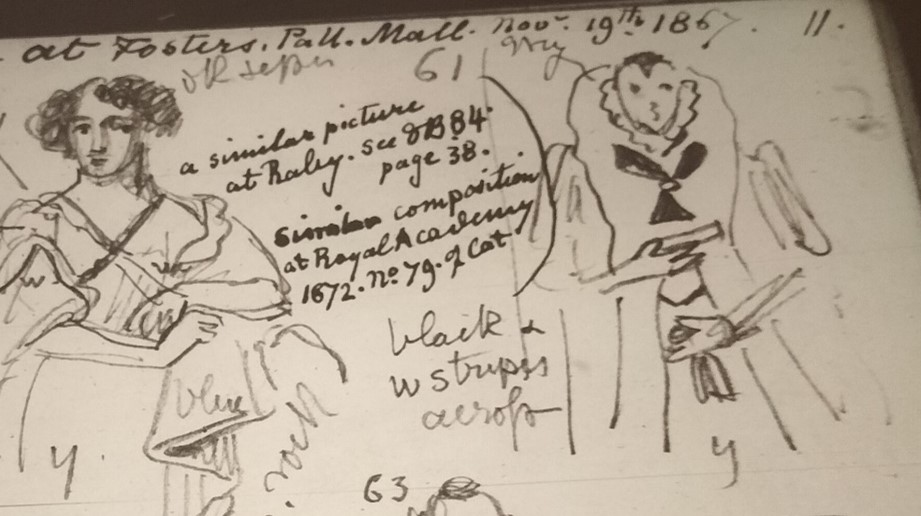
George Scharf Sketch
NPG100/1/1
© Heniz Archive, London

Edward Foster’s, or Foster and Son as it was better known was an auction house in London, which was established in 1833.  Unfortunately, to date, I have been unable to locate the auction catalogue for the sale mentioned by Scharf, however, this has been added to my list and attempts will be made to locate this on my next trip to London.

The portrait appears again when an image was published in The Illustrated London News in 1938.  The photograph seen, shows the painting prior to some of the restoration work removed by Philip Mould, and the article notes that the portrait was in the collection of Ewart Park in Northumberland.[5] The identification of the sitter, at that time, was incorrectly thought to be ‘Margaret Tudor, Queen of Scotland’ and the portrait was also incorrectly dated to the fifteenth century.  Size and materials used was also listed among the information provided.[6] 

The Butler Portrait 1937
© British Library Newspaper Archive

Built in the eighteenth century, and home to the St. Pauls and Butler family, the portrait and property was inherited by Horace Butler on the death of his father George Grey Butler in 1935.  George Grey Butler had begun selling some of the family’s possessions off in the 1920’s due to financial issues. [7] On his father’s death, Horace Butler was unable to maintain the cost of the upkeep for Ewart Park, it was briefly occupied by the military during World War II and was eventually sold by the family.  At present, no auction catalogue has been located for the contents of Ewart park, it may be possible that what little was left in the property, the family opted to take with them and was sold at a later date.

Sadly, for now, the provenance trail stops with Ewart Park, however, I do have one final interesting piece of information to share, connected to the Butler portrait.  Stored within the Icon Notes relating to Mary Tudor in the Heinz Archive London, is a rather interesting collection of letters and photographic images concerning a portrait of Queen Mary, and it could be argued that both portraits of the two sisters are related.[8]

Mary Tudor
Unknown Artist, previously attributed to Clouet.
© Heinz Archive, London

Dated to the early 1980’s, and from a private collector in France, the letters reports that she had inherited her portrait from her sister, who had purchased the painting in the in the 1950’s from Tours in France. She also notes that the portrait has a label on the back stating that it was transferred from panel to canvas, and the artist associated with its creation was French artist Francois Clouet.  

What can clearly be seen from the image above is that both portraits show the same characteristic approach when it comes to composition, style, and approach.  Unfortunately, the portrait of Queen Mary is currently missing, and it is hard to establish form the photograph if some later restoration work and overpaint has taken place.

As we have identified in many of the articles concerning the B Pattern of Anne Boleyn, the creation of portrait sets within the sixteenth century, stems a lot further back than initially thought.  Portrait sets were often unified using a curtain, pillow, or background colour.  As both portraits of Elizabeth and Mary include the unique pattern work seen on the gold demask fabric of the gowns, it may just be possible that both were part of an early set of portraits displaying the Tudor monarch.  Unfortunately, until the portrait of Queen Mary is located and tested to establish possible overpaint and date of creation, we may not know for sure.  The incorporation of the pattern in both portraits cannot be put down to coincidence and some further research will need to take place to identify any possible connection between both paintings.


[1] Tennants Auction Catalogue, Autum Sale, 18th November 2017, lot 66

[2] Moufarrige. Natasha, earliest full-length portrait of Queen Elizabeth I revealed – Showing her as studious and shy young woman, Daily Telegraph, June 17th 2018.

[3] National Portrait Gallery. The Notebooks of Sir George Scharf (1820-95), World Microfilm Publications, 1978, P.1 

[4] Heinz Archive. NPG100/1/1, Sketchbook of George Scharf (1886-1888), P. 11

[5] Clarification is currently needed to identify if the black ribbon and ring seen around the sitter’s neck and the object seen in the sitter’s right hand is original to the painting or later overpaint. Both items can clearly still be seen in the portrait today after restoration work had taken place, however, it may possibly have been deemed not to take the portrait back to its original state and the overpaint was simply left in place. interestingly, the same black ribbon and ring can be seen in the ‘La Royne D’Angleterre’ drawing of Elizabet discussed in my article on the Paine Miniature. See https://ladyjanegreyrevisited.com/2021/05/12/the-paine-miniature-is-it-elizabeth/ for more information

[6] Illustrated London news, Personalities of The Tudor and Stuart Period, 29th October 1938 p.30

[7] I have been able to locate eight Sotheby and Co auction catalogues from the years on 1928-29 that all include property from the estate of Mr George Grey Butler of Ewart Park, Northumberland

[8] Heinz Archive, London. NPG49/1/11, Notes on Sitters: Mary I, Queen of England. 1515-1558
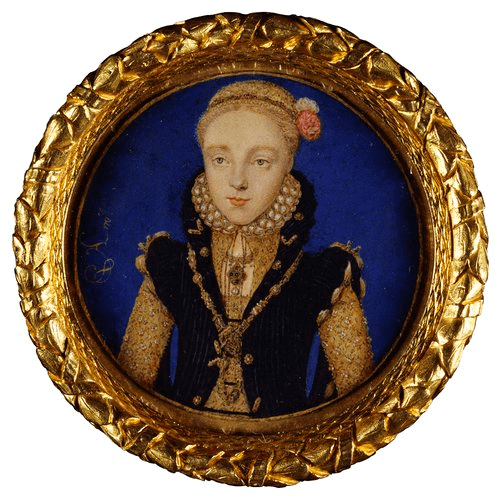
The Royal Collection Miniature Portrait

RCIN420944
Called Elizabeth I
Watercolour on Vellum Applied to Card
5.2 cm in diameter
©Royal Collection

Purchased as a portrait of Mary Tudor when Princess on behalf of Queen Victoria during the Christies sale on 24th May 1881, RCIN20944 has caused much debate among art historians over the years.  The sitter has been identified as at least three different members of the royal family from the Tudor period, and for around twenty-six years the sitter was thought to be Lady Jane Grey.  Two artists have been associated with its creation, though no proof has surfaced to establish a known creator.  Due the sitter once being identified as Lady Jane Grey, I have decided to discuss this painting on this website.     

RCIN420944 depicts a young lady facing full frontal, with grey eyes and light red hair.  She wears a bodice of gold damask fabric cut square at the neck and a partlet of contrasting fabric with small figure-of-eight ruff that surrounds her face.  A black loose gown with small puff sleeves and false hanging sleeves is also seen worn by the sitter and is fastened at the front with the use of gold aglets.  The sitter wears two chains around her neck of goldsmith work and pearls, and suspended from one is a large jewel containing five square cut diamonds and a large hanging pearl.  On her head she wears a hair net which again consists of goldsmith work, and a pink and white flower is also arranged within the sitter’s hair.  She is depicted on a blue background within a gold boarder. The beginning of an inscription stating “AÑO” is also seen on the left-hand side.    

Nothing is known regarding the early provenance for this painting or how the image became identified as a portrait of Mary Tudor when Princess.  The first documented record concerning the provenance of this portrait located to date is the sales catalogue for the collector and poet Samuel Rogers.  Following his death in 1855, his vast collection of art and antiques were sold as part of an eighteen-day sale commencing on 28th April 1856 at Messrs. Christie and Manson, St James Square.  RCIN420944 was sold on the eighth day of sale and is officially recorded in the catalogue as “lot 960. Princess Mary, daughter of Henry VIII, after Holbein.”[1] 

The portrait was purchased by collector Charles Sackville Bale, who appears not to have questioned the identity of the sitter or artist associated with it.  An early photographic image of the portrait appears in a book published in 1864 by Amelia B Edwards, and the portrait was also submitted to The Miniature Portrait Exhibition of 1865 at the South Kensington Museum.  Both the book and exhibition catalogue again refer to the portrait as “Queen Mary I of England, by Holbein,” with the exhibition catalogue also noting that the portrait was purchased from the collection of Samuel Rogers.

Upon the death of Charles Sackville Bale in 1880, the miniature sold from his collection and entered the Royal Collection.  The auction took place on 24th May 1881 and again the miniature was noted as “lot 1420 Mary Tudor, Queen of England, by H. Holbein”[2] within the catalogue for the sale.

Within years of entering the Royal collection, the sitter’s identity and the artist associated with its creation was challenged.   Lady Jane Grey was put forward as a possible candidate and the miniature would continue to be described as a portrait of Jane for the next two decades.

An article written by Richard Holmes, librarian to Queen Victoria, and published in 1884 in the English Illustrated Magazine does give us some clues as to the reason for the change of identification.  This article appears to be the first time the portrait was publicly published as an image of Lady Jane Grey, and the article also included an engraving of the painting noting Jane as the sitter in its title.  Holmes reports the reasons for the change in identity as follows

Engraving From English Illustrated Magazine 1884

“of the painters who must have worked in England between the time of Holbein and Hillard, a capital specimen has within the last few years been added to the number of royal portraits.  It is that of Lady Jane Grey, of which we give an engraving.  It had passed for many years as a portrait of princess, afterwards Queen Mary, but it is unlike her in every feature.  That it represents a Tudor Princess is undoubted, as in her hair are the red and white roses. It corresponds with all that is known of the characteristics of the unfortunate Lady Jane, and fills an important gap in the series of portraits of the Tudor Line”[3]

What is interesting about the above statement is that Holmes reports that the sitter depicted in the miniature was thought at that time to correspond with all that was known of the characteristics of Lady Jane Grey.  This then brings about the question as to what was actually known about Jane’s characteristics at that time. This article was written prior to the publication of Richard Davey’s biography on Jane in 1909, which contained the only detailed description of a small, freckled and red haired, Jane Grey entering the Tower of London as Queen on 10th July 1553, known to date.  Today, this description has been discovered to be a mere forgery.[4]  No other description documenting the details of Jane’s features has surfaced, which suggest that almost nothing was known regarding what Jane looked like, other than vague references referring to her as pretty which were made at a later date.

The miniature portrait was publicly exhibited in 1890 at the Royal House of Tudor Exhibition held at the New Gallery, London.  Within the exhibition catalogue, the portrait is recorded as coming from the collection of Her Majesty the Queen and referring to as “1068. Lady Jane Grey. By N. Hilliard, formerly in the collection of Charles Sackville Bale.”  It was probably around this point in time that a red leather label was attached to the back of the frame noting that the sitter depicted was “Lady Jane Grey/Born 1537-Died 1554/Hilliard”

The portrait continued to be displayed as an image of Lady Jane Grey and was Exhibited in the New Gallery exhibition of 1901 as a portrait of her.  In 1906, Richard Holmes again discussed the miniature in an article written for the Burlington Art Magazine on Nicholas Hillard.  

Lionel Cust, director of the National Portrait gallery, London, appears to be the first to question the identification of Lady Jane Grey as the sitter in RCIN420944.  In 1910, he produced a privately printed catalogue for the Royal Collection regarding the miniature portraits held within the Royal Palaces at that time.  In this, Cust dismisses the identification of Jane Grey and suggests Elizabeth I as an alternative sitter, noting that the miniature may have been produced by Levina Teerlinc and not Nicholas Hilliard.  Nothing is documented in the book to inform us as to why Cust came to this conclusion, though it would be tempting to speculate that he noted the costume worn by the sitter was a little too late in period to be an authentic portrait of Lady Jane Grey.

RCIN420987
Called Elizabeth I
Watercolour on Vellum
4.5 cm in diameter
©Royal Collection

The Identification of the sitter as Elizabeth was further strengthened in 1962 when the Royal Collection purchased another miniature portrait similar in composition and style to RCIN420944 at Christie’s auction.  This miniature is recorded in the catalogue for sale, taking place on April 10th at Christie’s auction house, London, as “A Lady, probably Princess Elizabeth, Later Queen Elizabeth I.” A description also noted that the miniature was painted on a playing card, and seen on the reverse of is blind stamp consisting of the letter C and a Crown. [5]   This was immediately associated with a description made in 1637 of a miniature portrait seen by Abraham Van der Doort, Surveyor of the Kings Pictures and described in an inventory made of the collection of King Charles I.

“Item don upon the right lighte in a white ivory box/ wthout a Christall a Certaine Ladies Picture in her haire/ in a gold bone lace little ruff, and black habbitt/ lined wth furr with goulden tissue sleeves/ with one hand over another supposed to have bin/ Queen Elizabeth before shee came to the Crowne. By an unknown hand”[6] 

Upon the purchase of the second miniature by the Royal Collection, both were thought to depict the same individual.  Due to the early Van der Doort description it was therefore thought that both miniatures represented the young Queen Elizabeth in the early years of her reign. Both images continue to be catalogued as Elizabeth I today.

Author Roy Strong was noted not to include either miniature in his 1963 book entitled Portrait of Queen Elizabeth.  He was observed to briefly discuss them in the 1987 revised version Gloriana The Portraits of Queen Elizabeth I.  When discussing both miniatures, he interestingly notes that “of the two miniatures, one is more certainly of her than the other.”[7]  It could be argued that both images depict separate individuals rather than a portrait of the same person.  There does appear to be significant differences in the composition and costume worn by both individuals to identify that one is not a direct copy of the other. 

Whoever RCIN420944 depicts will continue to be debated among art historians, but Lionel Cust was right back in 1910 to question the identity of the sitter being Lady Jane Grey. There appears to be nothing within the image to suggest that the portrait was painted of her, and no detailed description survives today that tells us anything about what she looked like.  This image can now be removed from any list of potential likenesses thought to depict her.


[1] Messrs. Christies and Manson, Sales Catalogue, April 28th, 1856, Page 90, lot 960

[2] Christie’s, Sales Catalogue, 24th May 1881, Page 109, lot 1420

[3] Holmes. Richard, The Royal Collection of Miniatures at Windsor Castle, English Illustrated Magazine, July 1184

[4] For more details on the new finding regarding Davey’s description of Jane see: Edwards John, Queen of a New Invention, Old John Publishing, 2015, page 177 and DeLisle. Leanda, Sisters Who Would Be Queen, Harper Press, 2008 

[5] Christie’s Sale Catalogue, 10th April 1962, Page 20

[6] O’Donoghue,F.M, A Descriptive and Classified Catalogue of Portraits of Queen Elizabeth , 1894, page 27, no 7

[7] Strong. Roy, Gloriana The Portraits of Queen Elizabeth I, 1987, Page 55