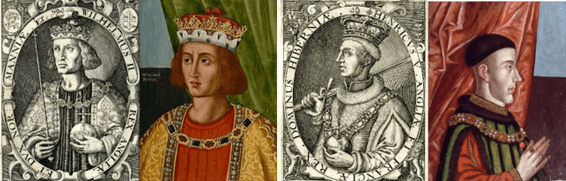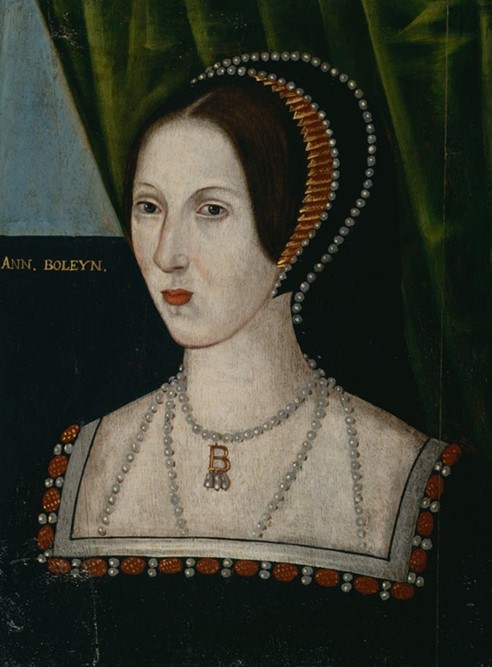
The Hornby Anne Boleyn

NPG 4980 (15)
Anne Boleyn
Oil on Panel
22 ¼ x 17 3/8 inches
© National Portrait Gallery, London

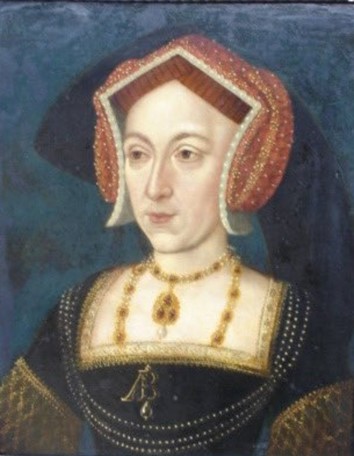
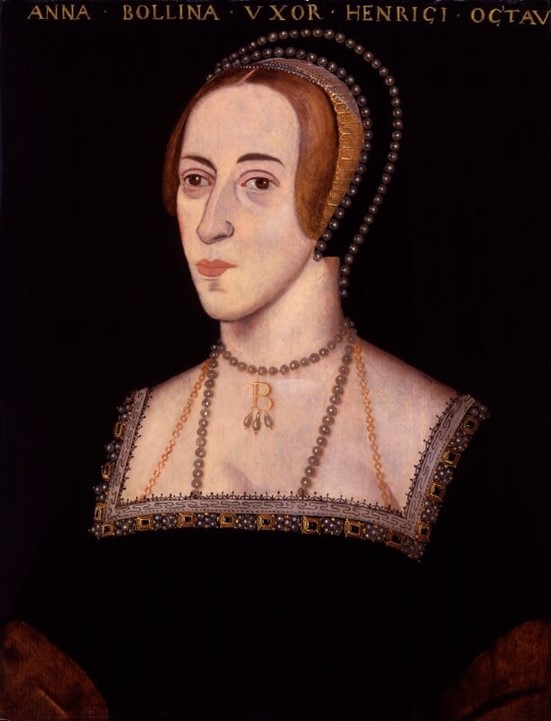
NPG 668 is not the only portrait of Anne Boleyn owned by The National Portrait Gallery, London.  In 1974, the gallery purchased a set of sixteen portrait’s depicting Kings and Queens of England which also included a portrait of Anne.  Though inferior in technique, and artistic quality to that of the now infamous NPG 668, the Hornby portrait or NPG 4980 (15) as it is better known was undoubtably created with the use of the B Pattern.  

Executed with the use of oil on panel.  The panel support is constructed with the use of two oak boards, seven millimetres thick, and aligned vertically to create one panel measuring 22 ¼ x 17 3/8 inches. The portrait depicts the head and upper torso of an adult female, placed before a plain background with her head turned slightly towards the viewers left. Her face is long, oval in shape, with a high forehead. Her hair is straight in texture, parted in the centre, and pulled back over her ears, and placed under her coif of gold fabric. Her eyes are brown, heavy lidded, and are crooked in appearance. She has full pink lips, an aquiline nose, and her eyebrows are pronounced with a strong shape.  Anne is seen wearing her trademark French Hood, constructed of black fabric, ending just below the jawline, and the black veil is visible hanging down at the back.  An upper billament of thirty-nine white pearls is visible on the back of the hood, and a lower billament of thirty-one pearls is seen at the front of the hood. At her neck she wears two strings of pearls with a large letter B pendant of goldsmith work with three hanging pearls suspended from the upper string.  A chain constructed of loops of square goldsmith work is also seen at the neckline.  Anne wears a French Gown constructed with the use of black fabric, cut square at the neck, and a white chemise, embroidered with blackwork.  Sixteen square cut ouches, each containing a diamond, are attached to the neckline of her kirtle. A further sixteen ouches, constructed of goldsmith work, and five pearls, are also seen in between these.  The turned back sleeves of the French Gown are constructed of a brown fabric, rather than the fur sleeves seen in other depictions.

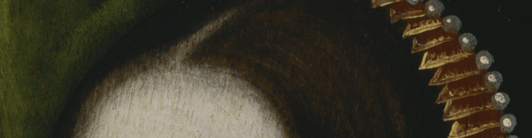
Detail showing inscription on panel surface.
© National Portrait Gallery, London

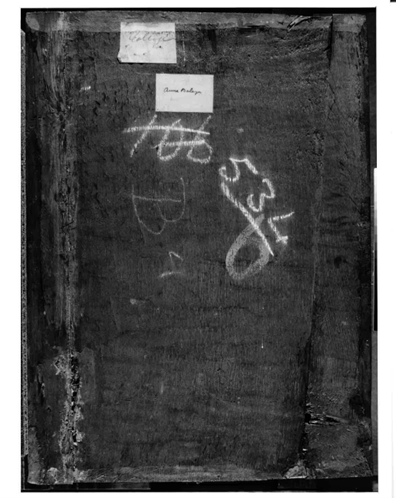
An inscription applied to the top of the panel in a yellow pigment identifies the sitter as ANNA. BOLLINA. VXOR. HENRICI. OCTAV or Anna Bollina wife of Henry Emperor. A handwritten label detailing The National Portrait Gallery registration number has also been applied to the back of the panel. No other inscriptions or labels are visible on the panel surface; however, it must be noted that the reverse of the panel was covered in a layer of balsa wood during early conservation treatment. I have been unable to obtain an image of the reverse of the panel prior to this treatment and I am unable to determine if any labels or further inscriptions lie below this.

Back of NPG 4980(15)
© National Portrait Gallery, London

When purchased by The National Portrait Gallery in 1974, the paintings had come from the collection of George Osborne, 10th Duke of Leeds.  It was recorded that the set had been on display at Hornby Castle, near Bedale. George Osborne died in 1927, and on his death his estate was broken up and eventually sold off.  The portrait set had initially been stored by the National Portrait Gallery in the 1930’s and was later offered for purchase by the 10th Duke of Leeds Trust.[1]

As with many of the portraits of Anne Boleyn seen in this study, documented information concerning them is scarce. In the case of the Hornby Portrait Set, we only start to see it appear in written documents towards the end of the nineteenth century. The first reference appears in 1868, when the collection of portraits was recorded as hanging in two rows in the Nursery Passage at Hornby Castle.[2]

Hornby Castle was originally built by the St. Quentin’s family in the fourteenth century and passed to the Conyers and Darcy families during the sixteenth century.  By 1778, the property then passed into the possession of Francis Osborne, 5th Duke of Leeds, through his marriage to Amelia Darcy.[3]

Due to lack of documentation, it is not exactly known if the set had originated in the Leeds collection and was transferred to Hornby castle from another property. Or, if it had originated with the sixteenth century owners of Hornby Castle and was commissioned for that specific residence.

When purchased by The National Portrait Gallery, a full condition report was undertaken on each of the sixteen portraits included in the Hornby Set. The condition reports held in the registered packet for the portrait of Anne Boleyn identifies that at the time of purchase the left-hand side panel of NPG 4980(15) was in a weak condition due to a splitting of the joint, flaking paint layers and paint loss was also noted to the sitter’s neck and chin, and extensive oil retouching was also observed throughout the portrait.  A thick layer of discoloured varnish was also viable on the panel surface.  

NPG 4980(15)
Before Conservation Work
© National Portrait Gallery, London

Conservation work was commenced immediately on the portrait, to stabilise the panel, secure the joint, and apply a thin layer of balsa wood to the reverse of the portrait. The flaking paint layers were secured with the use of wax resin, and adhesive, and the later overpaint and discoloured varnish was also removed from the panel surface. A gesso filling was applied to the large areas of paint loss, and retouching was completed. The portrait was then revarnished with a conservation varnish.[4]

Though not scientifically analysed until 2011, In 1975, Robin Gibson suggested that the Hornby set was created over a long period of time. He also suggested that the set was made up and purchased as two or three smaller portrait sets, much like that seen with the Dulwich Set.  Gibson separated the paintings into three distinctive groups in terms of date of creation, distinct differences in quality, and composition.

Group A: William I, Henry I, Stephan, Henry II, John, Edward II, was identified as being the later addition to the set, with Gibson estimating a date for creation as circa 1620-30.  

Group B: Edward III, Richard II, Henry IV, Edward IV, Edward V, Anne Boleyn. Gibson identified that Dr John Fletcher of Oxford University had completed Dendrochronology testing on the portrait of Anne Boleyn and Richard III, and a date of 1590-1605 was established as the most likely period in with both portraits were painted. 

Gibson identified Group B and Group C: Richard III, Henry VII, Henry VIII, Mary I, as a standard long gallery portrait set for this period. However, he also noted that Group C: contained a different characterisation in background and a higher quality craftmanship than that seen in the works of group B.  Robin suggested that although group B and C were created at the same time, group C was probably purchased from alternative workshops, and it was Gibson’s dates and theory that was applied by the National Portrait Gallery to the set.[5]

In 2011, the Hornby portrait set finally underwent significant testing as part of the Making Art in Tudor Britian project at the National Portrait Gallery.  During this, all portraits were dendrochronology tested, and it was identified that all panels were made from trees felled in the Eastern Baltic, between the 1580’s and early 1590’s.[6]  Test also carried out on the paintings identified that the portraits were produced by several artists, using different painting techniques, and working across multiple workshops. [7] This suggested that the set was either produced as a single commission, and not added to over the course of time as suggested by Gibson or was assembled at the same time using ready- made paintings from different sellers.

As seen in my article on the Dulwich Portrait set, printed material published at a similar time to the Hornby sets creation also appears to be the source material used by some of the artist when creating the portraits for the Hornby Set. The portraits of William I, Henry I, Stephan, John, and Henry III show visual similarities to the full sheet woodcuts produced by an unknown artist and published in a book entitled ‘A Booke, containing the true portraiture of the countenances and attires of the kings of England’.

First published in London in 1597, by John de Beauchesne, this book pre-dates ‘Bazliologia’, the book thought to have been the source for the Dulwich set, by twenty-one years. Its author, who was only named as ‘T.T.’ is now thought to be Thomas Talbot, who also produced what is now called the Talbot Rose containing similar images of the English monarchs some eighth years earlier in 1589.

Though the importance of accurate historical documentation was still in its infancy towards the end of the sixteenth century, some of the illustration produced for Talbot’s book can today be matched with contemporary source materials depicting the sitter illustrated, which does suggest that the artist who created the illustration at least attempted to reproduce what was thought to be an authentic likeness.

Left: NPG 4980 (2), King Henry I ©National Portrait Gallery, London Right: King Henry I Statue York Minster © Public Domain

When looking for a possible source for the portrait of Henry I, it could be argued that the image seen in the Hornby set shows a strong resemblance to the fifteenth century statue depicting the King at York Minster.  Both the statue and painted image show similarities in the hair, the treatment of the beard, moustache, and the collar of the gown.

Left: NPG 4980 (3) King Stephan ©National Portrait Gallery, London Right: Miniature From Matthew Paris’s Historia Anglorum ©Public Domain

The portrait King Stephan also shows similarities to several contemporary illustrations showing the king with a bobbed hairstyle and beardless.  Stephan is also seen beardless in his profile image on a silver penny from 1136 and is depicted in a full-frontal pose in the illustrated image for Matthew Paris’s ’Historia Anglarum’ produced between 1250 and 1259. Unfortunately, Talbot’s book does not include an image of Anne Boleyn, and it appears that artist who created the Hornby portrait looked elsewhere when depicting this legendary queen.

Sadley, NPG 4980(15) provides little information regarding the evolution of the B-pattern. The portrait is, however, it is one of a small number of paintings created with the use of this pattern that currently has a scientific date attached to it. What we can establish is that both NPG 4980(15) and NPG 668 were produced around the same time, and that both images were seen as, and identified as, an image of Anne by contemporary viewers towards the end of her daughter’s reign.  This image would continue to be seen as a depiction of Anne Boleyn some thirty years later when Edward Alleyn purchased his portrait of Anne for the Dulwich set and continues to be reproduced as an image of Anne Boleyn to this day.


[1] Heniz Archive, National Portrait Gallery, Registered Packet NPG 4980(15)

[2] Catalogue of the Paintings and Portraits at Hornby Castle the Seat of the Duke of Leeds, 1868.  The portrait set of Kings and Queens of England also appeared in subsequent catalogues detailing the collection at Hornby Castle, published in 1898 and 1902, and are again described as hanging in the ‘Nursery Passage’.

[3] Anon, Hornby Castle, Yorkshire, The Seat of the Duke of Leeds, Country Life Magazine, 1906, P 54-64

[4] Heniz Archive, National Portrait Gallery, Registered Packet NPG 4980(15), Technical Examination Report 1974

[5] Gibson Robin. The National Portrait Gallery’s set of Kings and Queens at Montacute House, National Trust Yearbook, 1975, P81-87

[6] Tyers. Ian, Tree-ring Analysis of Panel Paintings at the NPG, Group 4.5. March 2011, Registered Packet NPG 4980(15)

[7] Picturing History: A portrait set of early English kings and queens – National Portrait Gallery (npg.org.uk), accessed October 2023

The Butler Portrait

A Tale of Two Sisters

In 2018, London art dealer Philip Mould acquired a rather unusual portrait of Queen Elizabeth I.  Though naive in its composition, the painting was immediately compared to a series of early portraits showing an image of the young Queen Elizabeth, known as the ‘Clopton Type’

I have discussed the ‘Clopton Type’, and its possible evolution in a previous article on The Philip Portrait, so I will not go into detail regarding this in this article. The Butler portrait, as I will call it in this study, does appear to reinforce my opinion that the ‘Clopton Type’ was derived from an earlier portrait known as the Berry-Hill portrait.  During my research, I have also managed to locate a possible ‘sister portrait’ and some provenance information regarding the Butler portrait.  As this painting is an important artifact in terms of the iconography relating to Queen Elizabeth I, I will use this article to document the discoveries.

The Butler Portrait
Queen Elizabeth I
Oil on Panel
© Philip Mould Gallery, London

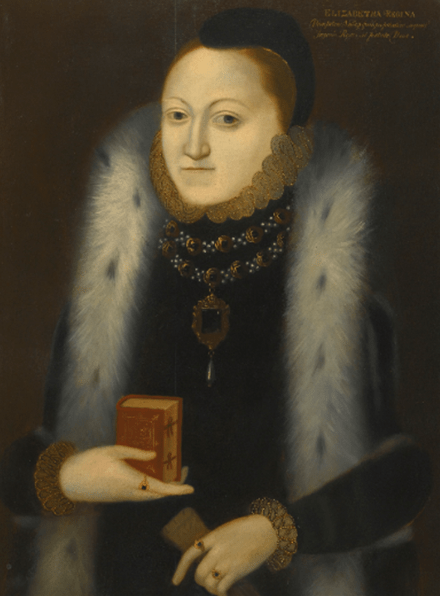
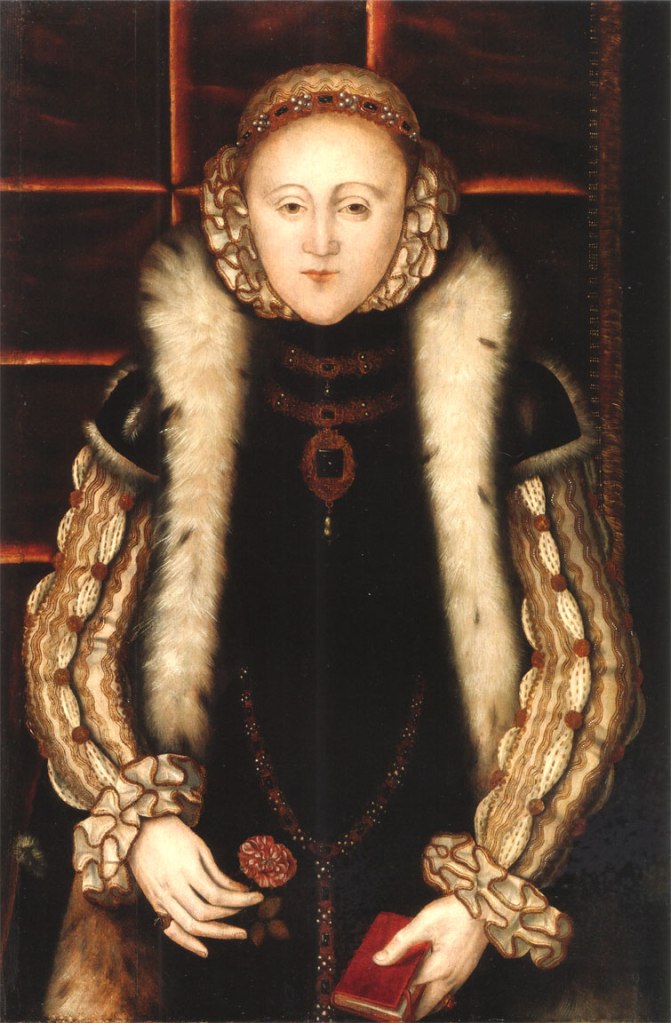
Constructed with the use of three vertical oak panels, measuring 95.5cm x 65cm in diameter. Elizabeth is seen standing three-quarter length, full frontal, with her head turned, slightly, towards the viewers left. The young Queen is missing her trademark wig of long red curls, her hair is simply parted in the middle, pulled back, and worn under a coif and black hood.  At her neck she wears a large ruff that surrounds her face, she also wears a lose gown of damask cloth of gold, and a black velvet surcoat, with a large fur collar and hanging sleeves. In her hand, she holds a book, and three rings are visible on her fingers. The portrait is entirely different to the images of power, wealth and majesty that has become illustrious with one of England’s most famous monarchs.

Mould purchased the portrait when it was sold by Tennants Auctioneers on 18th November 2017. Described in the catalogue for the sale as ‘English School, follower of Hans Eworth, portrait of a young lady, reputed to be Queen Elizabeth I’, the confirmed connection to Elizabeth had not been established at this point.  The auction house did note some similarities to the ‘Clopton Type’, however, also noted some ‘notable differences, including handling of brushwork, the portrait length, positioning of the hands, costume variances and the omission of the large jewel worn on a double chain known as the Mirror of France’.  Almost nothing was provided regarding the provenance of the painting, other than it had come from a private English collection and had been purchased by the then owner from Oakham Fine Art in 1996.[1]

Mould immediately sent the portrait to be cleaned, restored and dendrochronology tested, to establish a date of creation. The right-hand side panel had come adrift from the other two and this was once again secured. Discoloured varnish and overpaint was removed and a date of ’circa 1559’ was established for the portrait’s creation. Mould immediately noted that the Butler portrait was indeed related to the ‘Clopton Type’ and was, in fact, an earlier example. He concluded that the portrait was painted early in her reign, before Elizabeth, herself, truly understood the power of art, and noted that it was possibly one of the portraits Elizabeth attempted to eliminate with the draft proclamation of 1563.  Mould would later put the Butler portrait on public display in his gallery, identifying the huge significance of the portrait being one of the earliest representations of Elizabeth as Queen of England in related news stories.[2]

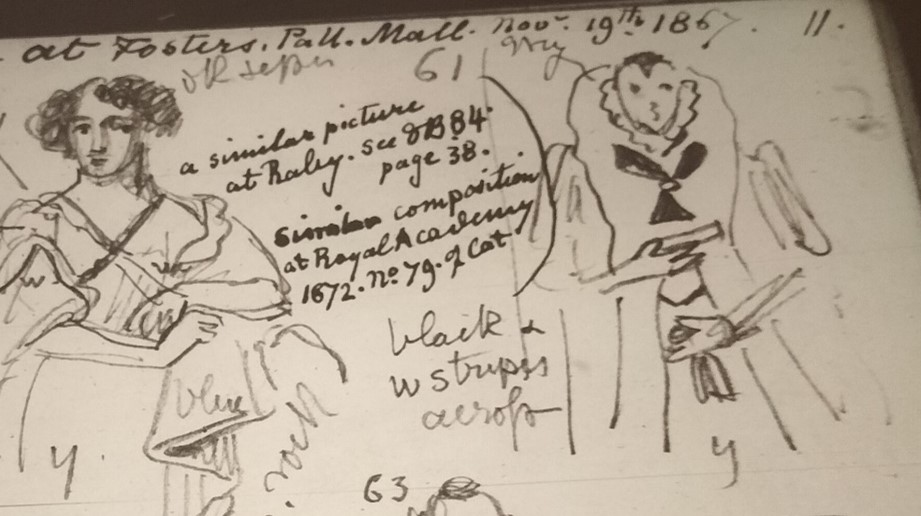
When looking for the possible provenance of this painting, I initially returned to the sketchbooks of Sir George Scharf in the Heinz archive, London. A valuable resource for anyone interested in art history, the gallery holds a total of two-hundred and twenty-three sketchbooks in its collection today.  These are separated into two categories, the first being the sketchbooks created in a personal capacity and second being Trustee sketchbooks, created to document possible acquisitions for the Galleries collection.  Due to their significance and fragility, the originals documents are closely guarded; however, in 1978, the archive opted to put the entire collection on microfilm, and it is this that the public view when requesting to see the sketchbooks.[3]

Unfortunately, the index system for the sketchbooks can be a little confusing, and in some cases, I have found it is best to just jump straight in and see what can be found. In the case of the Butler portrait this was successful, and it appears from one of the Trustee sketchbooks that Scharf, himself, viewed the portrait or a similar copy in 1867.  Scharf made a rough sketch of the painting, however, provided little information other than it was seen at ‘Foster’s, Pall Mall. 19th November 1867’. [4]

George Scharf Sketch
NPG100/1/1
© Heniz Archive, London

Edward Foster’s, or Foster and Son as it was better known was an auction house in London, which was established in 1833.  Unfortunately, to date, I have been unable to locate the auction catalogue for the sale mentioned by Scharf, however, this has been added to my list and attempts will be made to locate this on my next trip to London.

The portrait appears again when an image was published in The Illustrated London News in 1938.  The photograph seen, shows the painting prior to some of the restoration work removed by Philip Mould, and the article notes that the portrait was in the collection of Ewart Park in Northumberland.[5] The identification of the sitter, at that time, was incorrectly thought to be ‘Margaret Tudor, Queen of Scotland’ and the portrait was also incorrectly dated to the fifteenth century.  Size and materials used was also listed among the information provided.[6] 

The Butler Portrait 1937
© British Library Newspaper Archive

Built in the eighteenth century, and home to the St. Pauls and Butler family, the portrait and property was inherited by Horace Butler on the death of his father George Grey Butler in 1935.  George Grey Butler had begun selling some of the family’s possessions off in the 1920’s due to financial issues. [7] On his father’s death, Horace Butler was unable to maintain the cost of the upkeep for Ewart Park, it was briefly occupied by the military during World War II and was eventually sold by the family.  At present, no auction catalogue has been located for the contents of Ewart park, it may be possible that what little was left in the property, the family opted to take with them and was sold at a later date.

Sadly, for now, the provenance trail stops with Ewart Park, however, I do have one final interesting piece of information to share, connected to the Butler portrait.  Stored within the Icon Notes relating to Mary Tudor in the Heinz Archive London, is a rather interesting collection of letters and photographic images concerning a portrait of Queen Mary, and it could be argued that both portraits of the two sisters are related.[8]

Mary Tudor
Unknown Artist, previously attributed to Clouet.
© Heinz Archive, London

Dated to the early 1980’s, and from a private collector in France, the letters reports that she had inherited her portrait from her sister, who had purchased the painting in the in the 1950’s from Tours in France. She also notes that the portrait has a label on the back stating that it was transferred from panel to canvas, and the artist associated with its creation was French artist Francois Clouet.  

What can clearly be seen from the image above is that both portraits show the same characteristic approach when it comes to composition, style, and approach.  Unfortunately, the portrait of Queen Mary is currently missing, and it is hard to establish form the photograph if some later restoration work and overpaint has taken place.

As we have identified in many of the articles concerning the B Pattern of Anne Boleyn, the creation of portrait sets within the sixteenth century, stems a lot further back than initially thought.  Portrait sets were often unified using a curtain, pillow, or background colour.  As both portraits of Elizabeth and Mary include the unique pattern work seen on the gold demask fabric of the gowns, it may just be possible that both were part of an early set of portraits displaying the Tudor monarch.  Unfortunately, until the portrait of Queen Mary is located and tested to establish possible overpaint and date of creation, we may not know for sure.  The incorporation of the pattern in both portraits cannot be put down to coincidence and some further research will need to take place to identify any possible connection between both paintings.


[1] Tennants Auction Catalogue, Autum Sale, 18th November 2017, lot 66

[2] Moufarrige. Natasha, earliest full-length portrait of Queen Elizabeth I revealed – Showing her as studious and shy young woman, Daily Telegraph, June 17th 2018.

[3] National Portrait Gallery. The Notebooks of Sir George Scharf (1820-95), World Microfilm Publications, 1978, P.1 

[4] Heinz Archive. NPG100/1/1, Sketchbook of George Scharf (1886-1888), P. 11

[5] Clarification is currently needed to identify if the black ribbon and ring seen around the sitter’s neck and the object seen in the sitter’s right hand is original to the painting or later overpaint. Both items can clearly still be seen in the portrait today after restoration work had taken place, however, it may possibly have been deemed not to take the portrait back to its original state and the overpaint was simply left in place. interestingly, the same black ribbon and ring can be seen in the ‘La Royne D’Angleterre’ drawing of Elizabet discussed in my article on the Paine Miniature. See https://ladyjanegreyrevisited.com/2021/05/12/the-paine-miniature-is-it-elizabeth/ for more information

[6] Illustrated London news, Personalities of The Tudor and Stuart Period, 29th October 1938 p.30

[7] I have been able to locate eight Sotheby and Co auction catalogues from the years on 1928-29 that all include property from the estate of Mr George Grey Butler of Ewart Park, Northumberland

[8] Heinz Archive, London. NPG49/1/11, Notes on Sitters: Mary I, Queen of England. 1515-1558

The Dulwich Portrait of Anne Boleyn

Stored within the large collection of paintings at the Dulwich Picture Gallery, London, and currently on long-term loan to Strawberry Hill House, is a rather unique collection of portraits depicting seventeen Kings and Queens of England. Today, the Dulwich Portrait set is one of the largest sets of portraits, depicting English Monarchs to survive. However, it has received little attention when it comes to the literature concerning the production of portraits sets during the latter part of the sixteenth and early seventeenth century. In this article, we take a brief look at the history of the Dulwich set, examine its formation and possible sources. We will also take an in depth look at the portrait of Anne Boleyn and try to identify its role in relation to her iconography. 

The Dulwich Picture Set
© The Dulwich Picture Gallery

Though, not necessarily known for their artistic quality, the Dulwich Picture set brings with it the unique documentation that allows us to see how and when this collection of portraits was bought.  Originally purchased as a set of twenty-six portraits, all close in size, and, unified visually by the depiction of a blue skyline and a draped curtain in the background.  The collection was bequeathed in its entirety to the Dulwich College by its founder Edward Alleyn in 1626.[1]

Born on 1st September 1566, Edward Alleyn was an English Actor who achieved ‘celebrity status’ in Elizabethan England. In 1592, he married Joan Woodward, daughter of Philip Henslowe, Groom of the Chamber. Alleyn and Henslowe would eventually go into business together and Alleyn would eventually become sole proprietor of several playhouses, bear pits and other rental properties across London.  This made Alleyn a wealthy man, and on 25th October 1605, he purchased the manor of Dulwich, made up of 1500 acres of land and farms from Sir Francis Calton and began to build the College.  Completed on 1st September 1616, God’s Gift College, as it was originally named, was granted a Royal Patent from King James I and, today, is more famously known as the Dulwich College.[2]

Though no inventory survives detailing the collection of Edward Alleyn, the college does have his original diary/account book in its collection. This account book details his expenditure and daily activities between the years of 1617 to 1622, and it offers the unique insight into the purchase and trade of paintings in seventeenth century England.  It also shows us the exact sequence in which Alleyn purchased his portrait set of Kings and Queens of England and how much he paid for them.

In an entry written 29th September 1618, Alleyn records that he spent 200 pounds and bought the first set of paintings.  This entry notes that Alleyn started his set by purchasing the portraits of James I, Elizabeth I, Mary I, Edward VI, Henry VIII and Henry V.[3]  Just nine days later on 8th October, Alleyn returned to purchase another eight portraits of Edward III, Richard II, Henry IV, Edward IV, Edward V, Richard III and Henry VII, thus extending the sequence back to King Edward III.[4]  A gap of almost two years is noted within the account book before Alleyn returned to purchase more paintings. On 25th September 1620, Alleyn purchases the portraits of Edward II, Edward I, Henry III, Richard I and Henry II. [5]    He again returns one last time to complete his set on 30th September 1620, and purchases the portraits of Henry I, Stephan, William I, William II, the Black Prince, and Anne Boleyn. [6]

Alleyn’s handwritten account for the purchase of the portrait of Anne Boleyn
© Dulwich College, London

By the early seventeenth century, when Alleyn was purchasing his set of Kings and Queens, it had become relatively common for people of wealth to purchase paintings or engravings of political, religious, or influential figures.  Artists workshops of the period were producing portrait sets of various qualities, quickly, with much focus on the authentic image and detail.  These paintings were not only to decorate the home, but to also demonstrate loyalty to a specific cause. Today, only a small selection of portrait sets have survived, in some sort of entirety, however, many single paintings, which were once part of a set are now scattered among collections around the world. The publication of a variety of books containing written text and images of historical figures from many different sources began to be published in large quantities during the second half of the sixteenth century, and single-sheet engraved portraits were also becoming widely available for people of less income to collect and artists to copy.

Alleyn’s account book is unclear as to whether he purchased the set for his own home or to be displayed at the college, however, both places would have been a suitable dwelling for the set to achieve the impact it was designed for. It also needs to be remembered that around the time of purchasing the set, Alleyn was trying to obtain a Royal Patent for his college.

The surviving portraits of the Tudor Monarchs in the Dulwich set appear to be based on portraits completed by Holbein, Scrots and Antonis Mor, who as we know were all employed by the crown to produce an authentic likeness of the sitter. This demonstrates that the artist/artists who created the set were indeed looking and gaining access to authentic images of the more recent monarchs.

The surviving portraits of some of the earlier monarchs, from William the Conqueror up to Henry IV, show a close relationship in pose and detail to a set of engraved portraits by Renold Elstrack, published in Henry Holland’s ‘Baziliologia’ in 1618.   The portrait of Henry V, purchased by Alleyn during his first shopping spree in the September of 1618, also appears to be based on the image printed in ‘Baziliologia’, which suggest that the workshop had obtained a copy of this book, or at least a single sheet containing the image of Henry V early in its publication.

Far Left: Elstrack engraving of William II Left: Dulwich Copy Right: Elstrack engraving of Henry V Right: Dulwich Copy
© Public Domain

We do not know the specific reasons as to why Alleyn opted to wait two years to purchase further portraits of the earlier English Monarchs. It is highly unlikely that this was due to a lack of source material or that he had to wait for them to be painted.  At 6s 8d each, the paintings were not an expensive purchase for Alleyn, and money does not appear to be an issue as his account book demonstrates that he made larger purchases between buying the initial portraits of the more recent monarchs and completing the set in 1620. It may just be possible that he simply made the decision to extend the set further back and opted to revisit the seller years later to achieve this.

Alleyn died on 25th November 1626, without any children, and left ‘hangings and pictures’ to the college in his will. The college later received a further bequest of two hundred and thirty-nine pictures from the actor William Cartwright, and it was then decided to put the entire collection on public exhibition.  During the eighteenth century, the collection was displayed on the upper floor of the old college, however, by this point in time many of the portraits appear to have been in a state of disrepair.  Art Historian Horace Walpole noted that the collection contained ‘a hundred mouldy portraits among apostle’s sibyls and kings of England’.  The fact that the portraits received little attention in terms of conservation is possibly one of the reasons why the Dulwich portrait set is not complete today.[7]

Anne Boleyn
Oil on Panel
22 3/8 x 16 5/8 inches
© The Dulwich Picture Gallery

In terms of the portrait of Anne Boleyn, it is currently one of three portraits depicting Anne that has remained in the same collection for a long period of time and has not been separated from its original set.

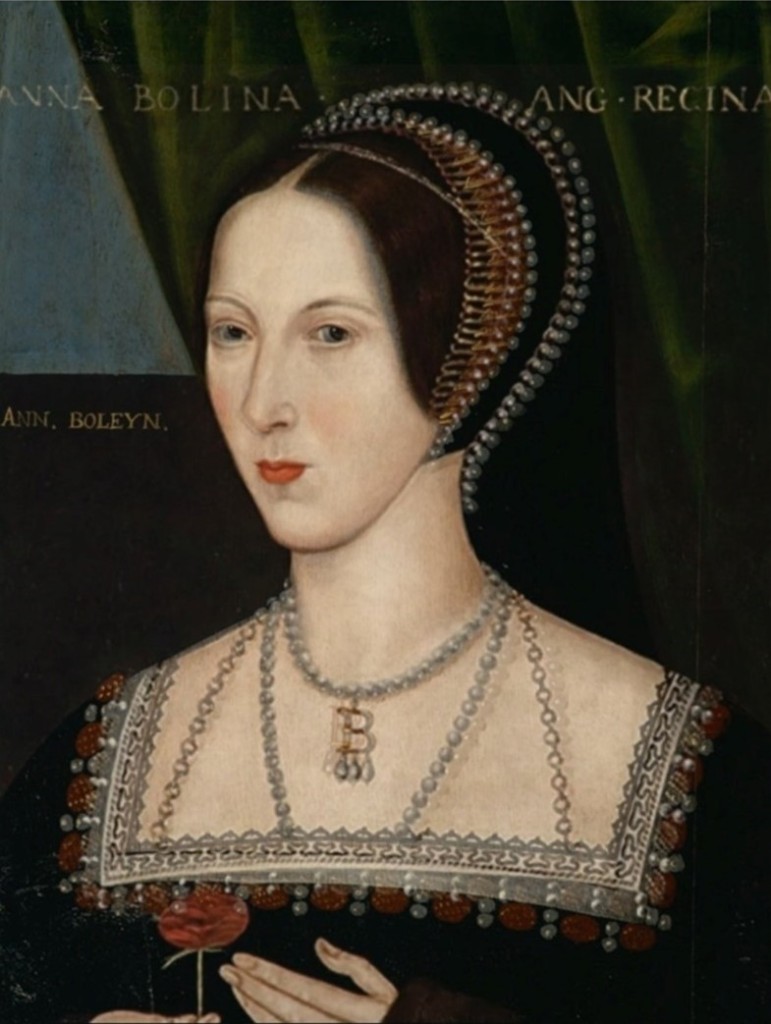
As we have seen with many other portraits in the study, the Queen is seen painted to just below the bust and is facing the viewers left. Anne is no longer placed in front of a plain background, and in accordance with the rest of the set, she is depicted in front of a curtain. Painted with the use of green pigment, the curtain is covering a window and seen under this is the inscription ‘ANN. BOLEYN.’  Anne wears her familiar French Hood on her head, constructed of black fabric with an upper billament showing thirty-nine pearls and a lower billament showing thirty-four pearls. Her gown is constructed with the same black fabric, cut square at the neck, and decorated with eighteen ouches and thirty-four pearls.  Under this, she wears a shift of white fabric, also cut square at the neckline, however the familiar blackwork embroidery around the edge of this is missing.  Around her neck, is a long strand of pearls with the now infamous ‘B’ Pendant hanging from them. Instead of the looped gold chain seen in the many other portraits of Anne, the artist has opted to depict another string of pearls.  The portrait does appear to have been painted quickly, lacking some of the finer details, form and shadows seen in other copies. 

Constructed with the use of three uneven vertical panels of oak, cut to create one rectangular panel measuring 22 3/8 inches by 16 5/8 inches. The panel reverse contains two early labels detailing the sitters name and a small number of old inventory numbers has also been chalked onto the back.[8]

Image showing the reverse of the portrait of Anne Boleyn
© The Dulwich Picture Gallery

The portrait has been painted with the use of oil paint; however, the painted surface is thin and much of the dark wood grain from the rough panel surface below is showing through and obstructing the original image. This can be seen on several portraits throughout the set, and would suggest that the images were painted quickly, with little time of effort put into preparing the panel surface for the paint application.   As discussed above, the use of a pattern was used to create the image of Anne, and evidence of under-drawing in the face, hair and jewels is observed through the painted surface.

Close up image of the hairline showing evidence of under drawing.
© Dulwich Picture Gallery

As we have seen from the entries written by Alleyn in his account book, the portrait of Anne Boleyn is the only image of a royal consort to be produced for the Dulwich set.  It could be possible that this was simply an overhang from the reign of her daughter, Elizabeth, however the fact that this was painted almost fifteen years after her death is a mystery, and we will never truly know the reasons why Alleyn opted to include her.  

Henry Holland did include an engraved image of Anne Boleyn in his 1618 book ‘Baziliologia’.  Anne is again noted to be the only consort to be depicted in the book, and this may possibly be one of the reasons why she is depicted in the set.  The Dulwich image is, interestingly, not based on Elstrack’s engraving of Anne, even though we know with some certainty that the artist/artists who created this image had used the Baziliologia engravings for other images produced in the set.  The exact reason why the artist opted to use the B Pattern image of Anne, over the Baziliologia image is unknown. It may just be possible that the B Pattern had already gained acceptance as an authentic image of the Queen by this point in time and the artist simply opted to use this over the other image produced in Baziliologia.

Baziliologia image of Anne Boleyn
Engraving
Renold Elstrack
© Public Domain

Unfortunately, the Baziliologia image of Anne created by Renold Elstrack has caused some debate over the course of time, as some art historians have argued that the engraving was possibly based on Holbein’s depiction of Queen Jane Seymour in the now lost Whitehall mural. The reason for this is that Anne is seen in the Elstrack engraving wearing similar jewellery and hood to that seen worn by Jane Seymour in the surviving copies of the Whitehall mural [9]

To me this theory has been accepted far too easily, and there are another two images of Anne Boleyn which in my opinion are closely related to the Elstrack engraving.  Both depict Anne wearing an English Gable Hood, and both are identifiable by the use of the monogram AR. The first of these is known today as ‘The Moost Happi’ medal which is stored in the collection of the British Museum, London.  Thought to have been struck during Anne’s lifetime for the expected birth of her second child in the autumn of 1534, it features an image of the Queen with her face seen in three- quarter view, like that seen in the Elstrack engraving. Unfortunately, the medal has sustained some damage to the nose at some point in its history, however, enough does remain untouched to establish some sort of face pattern.  The sitter depicted has a long-oval face, high cheek bones, a strong chin, and perhaps, a prominent nose. She also wears a large cross attached to her necklace, which again is noted in the Elstrack engraving.

The Moost Happi Medal
Anne Boleyn
1534
© British Museum, London

Unfortunately, little documentation has survived in terms of the household accounts of Anne Boleyn, and no complete Jewel inventory has, yet, surfaced to give us an in-depth view of the specific items held in her collection.  Dr Nicola Tallis has recently published a fantastic book in which she takes a fresh look at what is known today as the ‘Queen’s Jewels’.  In this, Tallis gives a unique insight into what is currently known about the personal jewellery belonging to Anne Boleyn and demonstrates how a collection of royal Jewels was passed down by Henry VIII to his wives. Tallis also notes that we do have at least three miniature portraits depicting Catherine of Aragon, Jane Seymour and Katheryn Parr wearing a similar cross to that seen in the Moost Happi medal and the Elstrack engraving, which does suggest that Anne Boleyn could have had access to one as part of the Queen’s Jewels.[10]

The second image is a panel portrait, formally in the collection of Nidd Hall, and now in a private collection. This image displays the Queen wearing and English Gable Hood, her face is three-quarter view, and once again she has that characteristic long-oval shaped face, high cheekbones, strong nose, and the firm chin as that seen in the Moost Happi medal and Elstrack’s engaging.  Unfortunately, to date the Nidd Hall portrait has not undergone any scientific investigation to establish if the engraving could be based on this pattern or vice versa. [11]

The Nidd Hall Portrait
Anne Boleyn
Sixteenth Century
Oil on Panel
© Private Collection

It could also be argued that the woman depicted in the Nidd Hall portrait has similar features to that seen in the B Pattern portrait, and this could be a more mature representation of the same individual.  As with the many portraits associated with Anne Boleyn, until a chronological date pattern is established, we will never know for certain, and cannot rule out the fact that one could be an authentic image.

Far Left: Hever Rose Portrait Left: Radclyffe Portrait Middle Rawlinson Portrait Right: Kentwell Portrait Far Right: Dulwich Portrait
© Public Domain
An overlay of the Dulwich and Hever Portrait

What is most intriguing about the Dulwich portrait of Anne Boleyn is that it appears to be the closest in comparison to the Rawlinson, Radclyffe, Kentwell, and Hever Rose Portrait. As discussed in my previous articles, two distinctive patterns appear to have been used when creating images of Anne Boleyn. It is highly likely that the pattern used to create these four portraits was also used to create the Dulwich copy, however the artist opted to leave the hands and rose out of this version.  The depiction of the Jewels and pearls are rendered with a much less refined technique than that seen in the Hever Rose, Radclyffe, and Rawlinson version, which suggests that these examples could possibly be earlier versions, however, this will not be known for sure until one of the copies has been dendrochronologically tested.  I have heard from a reliable source that the Hever Rose portrait is due to have this scientific procedure completed, so all the Anne Boleyn community are currently waiting in anticipation of these results.


[1] Though Alleyn purchased a portrait of James I to be included as part of this set, the portrait of James which is in the collection today appears to be of a finer quality than that seen in portraits of the earlier monarchs. Some further research is required to establish if this was indeed the original portrait purchased by Alleyn or a later copy that has been adapted in style to correspond with the rest of the paintings.

[2] G. F. Warner. The Manuscripts and Muniments of Alleyn’s College of God’s Gift at Dulwich, 1881, p. V-IIV

[3] Dulwich College, London. MSS 9,32r, Diary and Account Book of Edward Alleyn, September 29th, 1617, to October 1st, 1622.  29th September 1618 ‘bought 6 pictures of K J(ames): Q E(lizabeth): Q M(ary): K E(dward VI): K H(enry) ye 8th and K H(enry) ye 5th’

[4] As above, ‘8 pictures off E(dward) ye 3: R(ichard) ye 2: H(enry) ye 4: H(enry) ye 6: E(dward) ye 4: E(dward) ye 5: R(ichard) ye 3: H(enry) ye 7.’

[5] As Above: ’25 September 1620 Bought 6 heds of E(ward) ye 2/ E(dward) ye 1/ H(enry) ye 3/ Jo(hn)/ Ri(chard) ye 1/ H(enry) ye 2/ Paid 6s 8d a peec’ .

[6] As Above. 30th September 1620 ‘paid for six heds of H(enry) ye 1st: Steven: W(illiam): Rufus: W(Illiam) conquer: black prince: an of bullen’

[7] The Athenaeum Magazine, Volume 1630, January 22nd, 1859. P. 112

[8] My sincere thanks to the Dulwich Picture Gallery for providing me with an image of the back of the panel and  the condition report for the portrait of Anne Boleyn.

[9]Philip Mould Ltd, Lost Faces Identity and Discovery in Tudor Royal Portraiture, 6-18th March 2007, Page: 80

[10] Tallis, Nicola. All The Queen Jewels 14-45 – 1545 Power, majesty and Display, Routledge Taylor & Francis Group, 2023 p.136-138

[11] The Nidd Hall portrait has recently undergone some cleaning and restoration work, however, no dendrochronology testing has, as yet taken place.

The Philip Portrait – Does it Change Anything?

When it comes to the iconography of Queen Elizabeth, we have a plethora of surviving portraits from the sixteenth century. In today’s modern society, it must be hard to find an individual who is not familiar with the many images of the pale faced, Queen, decked out in her red wig and trademark pearls.

Many of these portraits are ingrained in the minds of many history lovers as the images of the confident virgin Queen, however these all relate to a period later in her reign when there was a huge demand for her likeness.  It is well documented that during the latter part of her reign Elizabeth herself, became more aware of the power connected to the use of her image.  The painting’s viewed today in galleries and stately homes across the globe are a symbol of royal authority, and in many cases were produced with the use of symbolism to demonstrate that, despite being a woman, Elizabeth was the natural and legitimate ruler of England. Rarely, do we get a glimpse of the human Elizabeth, stripped of all the makeup and regalia, who ascended to the throne in 1558 at the young age of just twenty-five years old. The iconography relating to the early part of her life and reign is a complex subject and portraits of the young Queen are scarce.  In terms of pictorial evidence there is very little available to inform us what the young Queen looked like.

The Philip Portrait was discovered in the late 1970’s, by London art dealer Richard Philip, little has been discussed or documented regarding the history of this painting and its significance as an early image of the young Queen Elizabeth.  In this painting, Elizabeth is depicted as the young fresh-faced monarch, who, by this period had not established the pomp and regalia associated with her later images but, was being represented by artists as the plainly dressed queen, devoted to the matter of religion.   Does this rarely seen portrait tell us anything about the young Elizabeth and does its possible connection to a small number of other paintings, in which the sitter has for many years been debated, tip the balance in favour of these also depicting the young Queen?

The Philip Portrait
Queen Elizabeth I
Oil on Panel
32 x 24 1/2 inches
©Private Collection

The Philip portrait was originally discovered leaning against the back wall in a picture shop in Cheltenham.  Due to significant overpainting the sitter in the portrait had lost its identity altogether and the painting was simply referred to as a portrait of a 1920’s flapper girl.  Art Dealer, Richard Philip recalls its discovery in a later article on the portrait.  He informs us that ‘upon examining the painting he noticed that a small section of the paint on the bottom left-hand side of the panel had begun to fall away. On closer examination he then noted that the exposed underpaint was harder and much older than the modern paint coving the rest of the panel’. Philip then opted to take a gamble and purchased the portrait immediately[1]

On returning to London, Philip sent the portrait to a picture restorer who immediately began cleaning tests. What was revealed beneath the modern paint layers both astonished Richard Philip and the restorer.  Once fully stripped of its modern overpaint the image of a sixteenth century lady, standing full frontal and seen three quarter length appeared.

The portrait was immediately thought, by Philip, to be a painting of the young Queen Elizabeth, however, as with all portrait research, evidence was required, and he began his research to attempt to prove his theory.  The portrait was first sent to Doctor John Fletcher, a pioneer in the use of dendrochronology, who attempted to establish a date of creation. Though, dendrochronology testing was in its infancy in the 1970’s, Doctor Fletcher was able to establish that the panel was constructed with the use of four boards: one board was of similar pattern to two of the three boards used in the portrait of Richard Wakeman by Hans Eworth which was inscribed with the date of 1566.  On further research Doctor Fletcher confirmed that the boards seen in both these paintings were ‘almost certainly’ from the same tree, and he dated the creation of the Philip portrait to the 1560’s. [2]

With an estimated date of creation Philip then approached Roy Strong, Director of the Victoria and Albert Museum.  Strong had published a book in 1963, entitled Portraits of Queen Elizabeth I, in which he documented a lifelong interest in the iconography relating to Elizabeth I. According to later reports by Philip, Roy Strong was ‘impressed and astonished’ by the discovery referring to it as ‘a major find in the art world’.[3]  Similarities were immediately recognised between the Philip Portrait and other iconography related to the early part of Queen Elizabeth’s reign and this apparent similarity has continued to be referred to during subsequent sales of the Portrait.[4]   

As for what specific iconography the Philip Portrait relates to is anyone’s guess. As discussed above, very little has survived in terms of portraiture of the young queen.  Unlike her predecessors, who had employed artists of immense talent such as Hans Holbein, William Scots and unofficially, Hans Eworth to produce portraits.  Elizabeth never officially employed a court painter during the first period of her reign, other than continuing the service of miniaturist and illustrator Levina Teerlinc.  The most famous painted image of the young Queen depicted full-frontal, similar to that seen in the Philip Portrait is known as the Coronation miniature.  In this, Elizabeth is depicted wearing her coronation robes and holding the royal regalia, however, recent research into this miniature and the subsequent larger copy, now in the collection of the National Portrait Gallery suggests that both were painted circa 1600, towards the end of Elizabeth’s life and possibly in celebration of her long reign. 

In 1978, the costume Historian, Janet Arnold suggested that both the coronation portraits were, in fact, based on a ‘now lost’ portrait depicting Elizabeth at the time of her coronation in 1559.  Arnold’s evidence for this theory was derived from the fact that the artists representation of the clothing worn by Elizabeth in both images matching contemporary documented evidence describing the items in Elizabeth’s wardrobe.  It was therefore suggested that either the portrait was related to an earlier portrait pattern or that the artist was given access to the clothing worn by Elizabeth on the day of her coronation.[5]

The fact that Elizabeth did not employ an official court painter does not necessarily mean that the demand for her portrait had declined.  Documentary evidence suggests that her image was in high demand from the period of her accession.  Elizabeth herself, appears to have been rather embarrassed about the production of her early images.  For this reason, her secretary, Sir William Cecil drafted a proclamation in 1563.  The draft proclamation announced that a portrait of the new Queen would be made by ‘some special cunning painter’ and that this image must be used when producing copies of the Queen’s likeness. Cecil also acknowledges that the Queen ‘hath bene allwise of her own right disposition very unwilling’ to sit for a portrait and asks that all ‘painters, printers, and engravers to cease production’ of her image until a portrait displaying ‘the natural representation of her Majesties person, favour or grace’ can be completed.[6]

Over the years it has been suggested that the 1563 proclamation refers to a particular portrait known as the ‘Clopton type’ however, it is possible that it could relate to an entirely different version of this portrait altogether. The proclamation suggests that due to a lack of access to the young Queen, artists, printers and engravers were creating images of Elizabeth to an unsatisfactory standard.
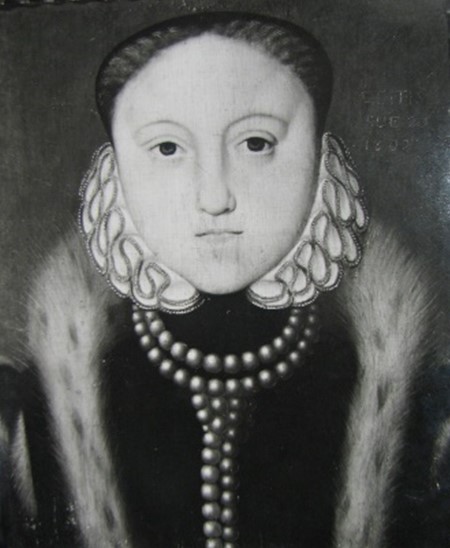
Named after Clopton Hall, the previous location of the largest version known to exist.  In this portrait, Elizabeth is depicted in a simple black gown with ermine trim and holds a pair of gloves in one hand and a prayer book in the other, a gold pendant containing a large cut gemstone is suspended from a chain of goldsmith work around her neck.  Several versions of this pattern exist, and those that have undergone scientific investigation have all are dated to the 1560’s.[7]  

The recent discovery and research into an early example of this pattern by London Art Dealer Philip Mould, brings about some very interesting questions.  Mould acquired a copy of this portrait in 2010, and, during scientific investigations on his copy he discovered that hidden under the painted surface was an entirely different image. An x-ray of the portrait was taken that revealed that the composition of this copy had been changed from full frontal, like the Philip portrait, to the image facing the viewers left.  Changes in the position of the sitter’s hands, ruff and sleeves where also noted.  Mould’s copy was also dendrochronological tested, and the most plausible date of creation was established as 1552, which does suggest that his copy was probably the first example of this pattern to be created.[8]

It is hard to ignore the similarities in the features depicted in the Philip portrait and the small number of other paintings associated with the young Elizabeth. The most prominent of these paintings are known as the Soule and Hever portraits and much debate regarding the identity of the sitter depicted in both these painting has been had over the course of time.[9]

Both the Soule and Hever portraits display striking similarities to the Philip Portrait, especially in terms of the face pattern used by the artist. Both paintings also display a similar costume as that depicted in both the Philip and Clopton portraits.  The sitter in the Hever Portrait is also shown holding what appears to be a pair of gloves which again is seen in the Clopton Pattern.  The hoods worn by the sitter do appear to be similar in style, however the hood worn in the Philip portrait is of a different colour and a billament of goldsmith work and pearls has been added.   

In preparation for the publication of his book A Queen of a New Invention Portraits of Lady Jane Grey/Dudley Historian, John Stephan Edwards complied intensive research into both the Soule and Hever Portrait’s.  As the Philip portrait had never actually been associated with Lady Jane Grey, Edwards was noted not to mention this copy in his book   During his research, both the Hever and Soule paintings underwent dendrochronology testing, and it was again established that both portraits dated to the late 1550’s. Edwards also suggests the theory that both the Hever and Soule portraits derive from an earlier, finer detailed painting known as Berry-Hill portrait and that all depict the same individual.  Unfortunately, the Berry-Hill portrait is currently listed as lost and was last seen in 1956, when it was purchased by the Berry-Hill Galleries, New York. Edwards rules out the identification of the sitter being that of Elizabeth in favour of Lady Catherine Grey. During his research he notes that no other potential sitter had been discussed and that the possibility of the portrait representing Elizabeth would have been of greater interest to potential buyers.[10]

The Berry-Hill Portrait
Unknown Lady
Oil on Panel
12 5/8 x 9 Inches
© Metropolitan Museum of Art

Roy strong was also noted to refer to the portraits as ‘Borderline cases’ in terms of fitting in with other iconography relating to the young Queen Elizabeth in his 1963 book, and it perhaps these painting in which Strong refers to on viewing the Philip portrait in the 1970’s . Many illuminated documents relating to the first period of her reign have also been discussed when suggesting Elizabeth as the possible sitter in the Berry-Hill, Soule and Hever Portrait’s. Though yes, some similarities can be seen in these manuscript illustrations It must be remembered that the figures of monarchs created on these documents were meant to be a representation and not a direct likeness. [11]

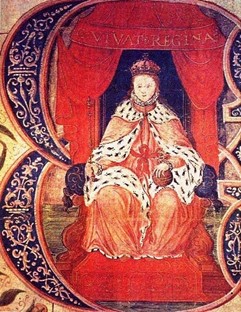
The first pictorial image we have available today, relating to the period when Elizabeth first ascended to the throne is an illustration produced on a document related to the Michaelmas Celebrations of 1558.  This illustration has been associated with artist Levina Teerlinc and in this, the figure of Elizabeth is inconsistent with the figure depicted in the Philip portrait.  The young Queen is not, yet, crowned and is depicted with the crown suspended above her head.  Her face is turned to the viewers left and, on her head, she wears a black French hood similar in style to that worn by her sister, during her reign.

Detail: 1558 Michaelmas Document
Queen Elizabeth I
© The National Archives, UK

A small number of other illuminated manuscripts produced after Elizabeth’s Coronation in 1559, are, again, all associated with Levina Teerlinc, show an image of the full-frontal young queen, with a small figure-of-eight ruff surrounding her face, very similar to that seen in the Philip, Berry Hill, Soule and Hever portraits.  This may suggest that there was some sort of full-frontal pattern produced of the young Queen which may have been the initial source for these representations during the early part of her reign.

It is my theory that the Clopton portrait type did, in fact, evolve from an earlier image depicting the young Princess Elizabeth, placed full-frontal like that seen in the Berry-Hill, Soule and Hever portrait’s.  The Philip portrait appears to sit directly in the middle of both the Berry-Hill and Clopton portraits, and it could be argued that Clopton portrait was an altered version of the Philip portrait.  The x-ray of Philip Mould’s copy, which shows a slightly altered full-frontal version beneath the painted surface only strengthens this claim.

It may also be possible that the Philip portrait was in turn a ‘pimped up’ version of the Berry-Hill portrait, created by an artist from an early portrait, possibly taken when Elizabeth was still Princess, to make Elizabeth look more regal due to a lack of access to the new Queen and a high demand for her image. If indeed all the sitters in the Berry-Hill, Soule and Hever portrait are the same individual then this would most defiantly tip the scales towards them all depicting Elizabeth.  It could also be argued that 1563 proclamation refers to the Philip and Berry-Hill type rather the Clopton pattern. If Stephan Edwards theory is correct, and the Berry-Hill portrait is the earliest example then there does appear to be a dramatic decline in artistic detail with the subsequent later copies. The 1563 proclamation may possibly be the reason why so fewer copies exist of the full-frontal pattern.  Further research and discussion is most definitely needed into this small group of portraits to identify once and for all if there is any possible connection to Queen Elizabeth and the true identity of the sitter in the Berry-Hill portrait.

UPDATE: 16th November 2021

After being missing for over a decade, the Berry-Hill portrait has finally resurfaced and is due to be sold by Butterscotch Auctioneers, Bedford Village, New York. The sale is to take place on Sunday 21st November at 10am. Item 209 is listed as a portrait of Mary Queen of Scots from a private collection in Scarsdale, New York.

The Berry Hill Portrait
Oil on Panel
12 1/2 x 9 inches

UPDATE: 22nd November 2021

Lot 209 sold for 120.000 dollar’s to an unknown buyer. The portrait was by far the most successful item in the auction and appeared to have sparked a lot of interest from potential buyers. Unfortunately, for now we will just have to wait and see if the new owner is willing to have the portrait scientifically tested to once and for all solve the riddle of the sitters identity.

Both myself and Stephan Edwards differ in opinion as to who the sitter is, however, this is not uncommon within the field of art history. Click the link below to view his most recent article on the Berry Hill portrait.

http://somegreymatter.com/berryhill.htm


[1] Philip. Richard, De-frocking a Flapper Girl, De-Frocking a Flapper Girl | Richard Philp, accesses June 2021

[2] Christie’s Auction Catalouge, Friday March 23rd 1979, lot 155, page 103

[3] Philip. Richard, De-frocking a Flapper Girl, De-Frocking a Flapper Girl | Richard Philp, accesses June 2021

[4] The Philip Portrait first appeared at Christie’s auction in March of 1979. It was subsequently sold again by Sotheby’s in December 2008.  Both catalogues for the sales list similarities between the Philip Portrait and other early iconography of Queen Elizabeth I.

[5]Arnold. Janet, The Coronation Portrait of Queen Elizabeth I, The Burlington Magazine, Vol.120, No. 908, Page 727. See also Golding. Elizabeth, Nicholas Hilliard Life of An Artist, Yale University Press, 2019, Page :244-247

[6] O’Donoghue. Freeman, A Descriptive and Classified Catalogue of Portraits of Queen Elizabeth, Dryden Press, 1894, Page ix-x

[7] NPG 4449; Queen Elizabeth I – conservation research – National Portrait Gallery, accessed July 2021

[8] Grosvenor. Bendor, Philip Mould Fine Paintings Catalogue, London 2010

[9] Edwards. John Stephan, A Queen of a New Invention The Portraits of Lady Jane Grey/Dudley, old John Publishing, Page: 157-167

[10] Edwards. John Stephan, A Queen of a New Invention The Portraits of Lady Jane Grey/Dudley, old John Publishing, Page: 157-167

[11] Strong. Roy, Portraits of Queen Elizabeth, Oxford Press, 1963, Page: 53-54

New Project Announcement!

Anne Boleyn: The B Pattern

Introduction:

Anne Boleyn was the second Queen of Henry VIII, she was executed in 1536, and she is arguably one of the more popular figures in Tudor history today.  Similar to Lady Jane Grey, many portraits have been associated with Anne’s name over the course of time.  None have produced the documentation to conclusively prove an identification and Anne continues to go without a portrait painted from life to this day.

One of the most famous depictions of Anne is what I refer to as the B pattern. This image has been extensively reproduced in history books when discussing Anne’s story.   The B pattern depicts a lady wearing a black French Hood and a pearl necklace with a gold letter ‘B’ hanging from it.  All surviving portraits were probably produced as part of portrait sets illustrating Kings and Queens of England, but what I find interesting about these portrait’s, is, we know so little about them.

During the latter half of the sixteenth century it had become popular for ‘portrait sets’ to be produced.  These sets were often displayed in public places, in galleries, in homes across Tudor England and in some of the royal palaces occupied by the Monarch.  Portrait sets were not only produced to document historic figures, but also demonstrated loyalty to a specific cause.  As the mother of the Reigning Monarch, Elizabeth I, Anne was often depicted within the sets as the wife of Henry VIII. 

Portrait sets were created in workshops and required a lesser skilled artist than the Great Masters who were probably commissioned to paint the original, thus making them cheaper and more accessible to the individual living in Tudor England.  An image was often derived from a standard pattern of an individual, based on an existing image, description, engraving or in some circumstances a tomb effigy.  These could be used by the workshops to quickly trace the desired image on to a wooden panel so that the portrait could be produced as quickly and effectively as possible.[1]

A small number of portraits based on the B pattern and dated to the end of sixteenth century still exist today.  Some are in public galleries whilst others remain in private collections across the world.  Most of the individual portraits depicting Anne, first appear in documentation during the turn of the twentieth century, with little known regarding there provenance prior to this.   

The B pattern was most certainly accepted as an image of Anne Boleyn during the latter half of the sixteenth century.  As for what source it was based on, in truth, we do not really know today. The purpose of this study is to look at the surviving collection of portraits depicting Anne that derive from the B pattern.  In compiling this study, I hope to establish a better understanding about the production of ‘portrait sets’, and the use of Anne’s image. I hope to Look at each portrait as an individual, in the hope of establishing some sort of database of information concerning each portrait.  Where possible I will attempt to document information relating specifically to the date and provenance of each image in the hope of ascertaining more information and identifying a possible sequence in which the portraits were painted.      


[1] For more information on the production and use of portrait sets see: Daunt. Catherine, Portraits Sets in Tudor and Jacobean England, May 2015

The Skeffington Portrait

Research into sixteenth century portraiture is a complex but fascinating subject. In many cases, the search starts with the surviving painting itself and then continues with the search for any written documentation concerning its provenance and any clues to the possible identification of the sitter.

When discussing portraits that have a history of approximately four hundred and fifty years behind them, it must be remembered that it is hard today to discover a portrait that has not been altered in some shape or form.  Over the years the original painted surface of a portrait may have been repainted due to bad restoration or over cleaning.  Inscriptions and coats of arms may also have been added at a later period in time, and in some cases the composition, original inscriptions and signatures may have been cut down to enable the portrait to fit in a new frame.

In the case of the Skeffington portrait, much of the above has happened.  This portrait has also been identified as at least four separate individuals during its modern recorded history.  Three out of the four sitters suggested have all faced execution, and today the portrait is now identified as an unknown lady.  

Our first documented record regarding this portrait’s survival is a book in the collection of the Society of Antiquaries, London.  This book contains copies of minutes of meetings held by the society during the nineteenth century and records that a portrait thought to depict Lady Jane Grey was presented to the Society by Sir William Skeffington on 6th February 1806.[1]

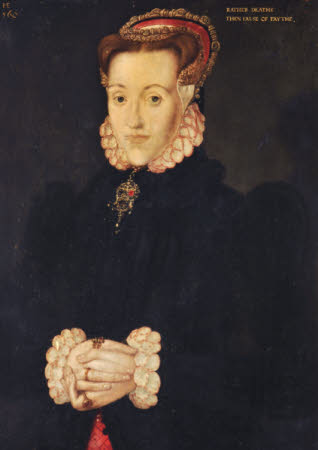
The portrait presented depicts a lady, seen to just below the waist and facing the viewer’s left.  Both hands are clasped in front of the sitter, and four gold rings can be seen on her fingers.   The sitter has grey eyes and auburn hair that is parted in the middle.  On her head, she wears a French hood constructed of crimson and white fabric with both upper and lower billaments of goldsmith work.  A black veil is also seen hanging down from the back of the hood, and under this she wears a gold coif.  A black loose gown with a fur collar and mutton leg sleeves is worn by the sitter and is fastened to the waist.  Under this the hint of a crimson kirtle is seen, and at her neck and wrists the sitter wears a figure-of-eight ruff which is embroidered with red thread.  The lady also wears a pendant of goldsmith work containing three square cut gemstones and three pearls suspended at her neck.  She is depicted in front of a plain background, and the image is painted on wooden panel.

Unknown Lady Called Anne Askew
Oil on Panel
27 x 21 inches
Associated with Hans Eworth
©The National Trust

Sir William Farrell-Skeffington adopted the Skeffington name in 1786 and inherited the fifteenth century manor house Skeffington Hall in East Leicester.  Prior to his death he began to sell objects off from the estate and eventually sold the house, land and contents in July 1814.[2]

Skeffington presented the painting for sale to the Reverend John Brand, Secretary of the society of Antiquaries. He informed the Society that the portrait represented Lady Jane Grey and was painted by Lucas de Heere.  No information is provided in the minutes of this meeting to inform us why Skeffington thought the portrait was a depiction of Lady Jane, and no information concerning the paintings provenance was recorded.  It appears that Mr Brand immediately challenged Skeffington’s identification as a painting of Jane Grey, noting that a fragment of an inscription can be seen on the top left-hand side of the panel surface which identified the date that the portrait was painted as 1560.  Brand rightfully recalled that the date painted on the surface did not coincide with the death of Lady Jane Grey and suggested that the portrait must in fact represent Jane’s mother Lady Frances Brandon, with Brand noting that she died in 1563.[3]   

One possible reason for the misidentification as a portrait of Lady Jane Grey is the inscription seen on the right-hand side of the panel surface.  This inscription reads ‘Rather deathe / than false of Faythe,’ which suggest that the sitter depicted would rather die or may possibly have died as a result of religious conflict.  The inscription itself appears to have been painted in a slightly different shade of yellow than the other one detailing the year and artists initials on the left side.  This suggests that one of the inscriptions was possibly added at a later date, though scientific testing would be required to establish if this theory is correct.

There is a popular tradition that Queen Mary offered Jane a pardon if she was willing to convert to Roman Catholicism. The tradition appears to have emerged shortly after Jane’s death as a way for Protestants to promote Jane’s dedication to the Protestant cause even when faced with death.  There is no surviving evidence to document that Jane was ever offered an actual pardon if she would convert, but there was indeed an effort made to get her to convert

Jane was visited by John Feckenham, Queen Mary’s personal chaplain, on 8th Feburary 1554.  By this point in her story, Jane had faced trial and had been convicted and sentenced to death as a traitor for accepting the crown and signing herself as queen. Mary was prevented from issuing a pardon because the Spanish demanded that Jane die as a condition of the marriage between Mary and Philip of Spain. Her execution had originally been set for the following day.  Mary was able to try to save Jane’s immortal soul, however, and she sent Feckenham to see Jane with that specific task, to try and convert Jane to Catholicism prior to her death.

Jane’s execution was postponed for three days, and a debate was had between Feckenham and Jane which resulted in Jane staying strong to the Protestant faith rather than relinquishing it.  This debate was recorded and apparently signed in Jane’s own hand. Within months of her death it appeared in printed format, along with a letter written by Jane to her former tutor Thomas Harding in which she condemned him for his change to Catholicism, thus promoting Jane’s strong belief in the Protestant faith.  In 1615, a pamphlet entitled ‘The Life, Death and Actions of The Most Chaste, Learned and Religious Lady, The Lady Jane Grey’ was published in London. This pamphlet contained a copy of the earlier printed debate and it was noted in the introduction that:

Even those which were of the best fame and reputation, were sent unto her to dissuade her from that true profession of the gospel, which from her cradle she had held. Each striving by art, by flattery, by threatening’s, by the promise of life, or what else might move most in the bosom of a weak woman.[4] 

It is quite possible that the inscription seen on the right-hand side of the portrait and the myth that Jane had been offered the promise of a pardon if she was willing to change her faith led Skeffington or a previous owner to believe that the painting must in fact depict Jane Grey. 

The Skeffington portrait was purchased by the Society of Antiquaries and remained in their collection where it was last recorded in 1847.[5]   How the portrait left the Society remains a bit of a mystery, but it was officially recorded as a ‘missing painting’ in one of the more recent publications on its collection.[6]

As discussed above, the portrait disappeared sometime after 1847, but it reappeared again in 1866 when it was exhibited as a painting of Anne Askew in the National Portraits Exhibition from the collection of a Reginald Cholmondeley.[7]  Reginald Cholmondeley’s principal estate was the sixteenth century Condover Hall in Shrewsbury.   On his death the contents of the Hall were sold at auction on March 6th 1897.  The identification of the sitter appears to have changed once again, and by 1897 the portrait was then referred to as:

Item 43. Lucas de Heere, Queen Mary (of Scots), in black with pink-edged ruff and cuffs, cap with gold chain and jewelled badge. Inscribed “Rather Deathe than false of Faythe,” dated 1560.

The portrait was purchased at this auction on behalf of Wilbraham Egerton, Earl Egerton, brother-in law of Reginald Cholmondeley, and was then displayed at Tatton Park.  In 1958 Tatton Park and its contents were bequeathed to The National Trust by Maurice Egerton, 4th Baron Egerton of Tatton, and the portrait remains on exhibition there today. 

It is my opinion that until scientific investigation has taken place on this portrait to establish if the inscriptions are original or added later then the true identity of its sitter may continue to be unknown.   The portrait is currently listed today on The National Trust collections website as an Unknown Lady, called Anne Askew.  As discussed in detail in other articles on this website, the size of the ruff worn by the sitter and the date inscribed on the left- hand side are both inconsistent with the date of both the deaths of Jane Grey and Anne Askew.  The Skeffington portrait can now be removed from the list of any potential likenesses thought to depict Lady Jane Grey


[1] Proceedings of the society of antiquaries of London, volume 1, page 47

[2] A large fifteen-day sale of the contents of Skeffington Hall commenced on 11th July 1814.  William Ferrell-Skeffington moved to London that same year however died less than a year later on 26th January 1815

[3] Proceedings of The Society of Antiquaries of London, vol 1, page 47. John Band appears to have inaccurately listed the date of Frances Grey’s death.  Frances died on 20th November 1559 and not 1563 as listed in these minutes. One interesting point is that John Brand also owned a portrait thought to depict Lady Jane Grey.  The portrait sold on his death at Stewards Auctions, Piccadilly on June 23rd 1807.  It was purchased by the book collector Richard Heber Esq for the sum of eight pounds.  No portrait described as Lady Jane Grey appears in the sales catalogues of Heber’s collection.

[4] The Life, Death and Actions of The Most Chaste, Learned and Religious Lady, The Lady Jane Grey, Printed by G. Eld for John Wright, 1615, page 22

[5] Electronic communication, Lucy Ellis, Museums Collections Manager, Society of Antiquaries, September 2018

[6] Franklin. J. A, Catalouge of Paintings in the Collection of The Society of Antiquaries of London, 2015, page 411-412

[7] Catalogue for the 1866 National Portrait Exhibition page 21.  Anne Askew was burnt as the stake as a heretic in 1546 for refusing to acknowledge that the sacrament was the ‘flesh, blood and bone of Christ’.