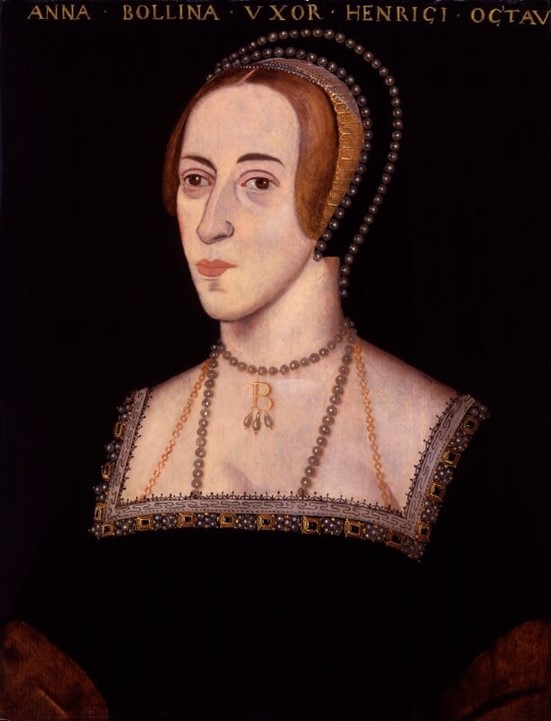
The Hornby Anne Boleyn

NPG 4980 (15)
Anne Boleyn
Oil on Panel
22 ¼ x 17 3/8 inches
© National Portrait Gallery, London

NPG 668 is not the only portrait of Anne Boleyn owned by The National Portrait Gallery, London.  In 1974, the gallery purchased a set of sixteen portrait’s depicting Kings and Queens of England which also included a portrait of Anne.  Though inferior in technique, and artistic quality to that of the now infamous NPG 668, the Hornby portrait or NPG 4980 (15) as it is better known was undoubtably created with the use of the B Pattern.  

Executed with the use of oil on panel.  The panel support is constructed with the use of two oak boards, seven millimetres thick, and aligned vertically to create one panel measuring 22 ¼ x 17 3/8 inches. The portrait depicts the head and upper torso of an adult female, placed before a plain background with her head turned slightly towards the viewers left. Her face is long, oval in shape, with a high forehead. Her hair is straight in texture, parted in the centre, and pulled back over her ears, and placed under her coif of gold fabric. Her eyes are brown, heavy lidded, and are crooked in appearance. She has full pink lips, an aquiline nose, and her eyebrows are pronounced with a strong shape.  Anne is seen wearing her trademark French Hood, constructed of black fabric, ending just below the jawline, and the black veil is visible hanging down at the back.  An upper billament of thirty-nine white pearls is visible on the back of the hood, and a lower billament of thirty-one pearls is seen at the front of the hood. At her neck she wears two strings of pearls with a large letter B pendant of goldsmith work with three hanging pearls suspended from the upper string.  A chain constructed of loops of square goldsmith work is also seen at the neckline.  Anne wears a French Gown constructed with the use of black fabric, cut square at the neck, and a white chemise, embroidered with blackwork.  Sixteen square cut ouches, each containing a diamond, are attached to the neckline of her kirtle. A further sixteen ouches, constructed of goldsmith work, and five pearls, are also seen in between these.  The turned back sleeves of the French Gown are constructed of a brown fabric, rather than the fur sleeves seen in other depictions.

Detail showing inscription on panel surface.
© National Portrait Gallery, London

An inscription applied to the top of the panel in a yellow pigment identifies the sitter as ANNA. BOLLINA. VXOR. HENRICI. OCTAV or Anna Bollina wife of Henry Emperor. A handwritten label detailing The National Portrait Gallery registration number has also been applied to the back of the panel. No other inscriptions or labels are visible on the panel surface; however, it must be noted that the reverse of the panel was covered in a layer of balsa wood during early conservation treatment. I have been unable to obtain an image of the reverse of the panel prior to this treatment and I am unable to determine if any labels or further inscriptions lie below this.

Back of NPG 4980(15)
© National Portrait Gallery, London

When purchased by The National Portrait Gallery in 1974, the paintings had come from the collection of George Osborne, 10th Duke of Leeds.  It was recorded that the set had been on display at Hornby Castle, near Bedale. George Osborne died in 1927, and on his death his estate was broken up and eventually sold off.  The portrait set had initially been stored by the National Portrait Gallery in the 1930’s and was later offered for purchase by the 10th Duke of Leeds Trust.[1]

As with many of the portraits of Anne Boleyn seen in this study, documented information concerning them is scarce. In the case of the Hornby Portrait Set, we only start to see it appear in written documents towards the end of the nineteenth century. The first reference appears in 1868, when the collection of portraits was recorded as hanging in two rows in the Nursery Passage at Hornby Castle.[2]

Hornby Castle was originally built by the St. Quentin’s family in the fourteenth century and passed to the Conyers and Darcy families during the sixteenth century.  By 1778, the property then passed into the possession of Francis Osborne, 5th Duke of Leeds, through his marriage to Amelia Darcy.[3]

Due to lack of documentation, it is not exactly known if the set had originated in the Leeds collection and was transferred to Hornby castle from another property. Or, if it had originated with the sixteenth century owners of Hornby Castle and was commissioned for that specific residence.

When purchased by The National Portrait Gallery, a full condition report was undertaken on each of the sixteen portraits included in the Hornby Set. The condition reports held in the registered packet for the portrait of Anne Boleyn identifies that at the time of purchase the left-hand side panel of NPG 4980(15) was in a weak condition due to a splitting of the joint, flaking paint layers and paint loss was also noted to the sitter’s neck and chin, and extensive oil retouching was also observed throughout the portrait.  A thick layer of discoloured varnish was also viable on the panel surface.  

NPG 4980(15)
Before Conservation Work
© National Portrait Gallery, London

Conservation work was commenced immediately on the portrait, to stabilise the panel, secure the joint, and apply a thin layer of balsa wood to the reverse of the portrait. The flaking paint layers were secured with the use of wax resin, and adhesive, and the later overpaint and discoloured varnish was also removed from the panel surface. A gesso filling was applied to the large areas of paint loss, and retouching was completed. The portrait was then revarnished with a conservation varnish.[4]

Though not scientifically analysed until 2011, In 1975, Robin Gibson suggested that the Hornby set was created over a long period of time. He also suggested that the set was made up and purchased as two or three smaller portrait sets, much like that seen with the Dulwich Set.  Gibson separated the paintings into three distinctive groups in terms of date of creation, distinct differences in quality, and composition.

Group A: William I, Henry I, Stephan, Henry II, John, Edward II, was identified as being the later addition to the set, with Gibson estimating a date for creation as circa 1620-30.  

Group B: Edward III, Richard II, Henry IV, Edward IV, Edward V, Anne Boleyn. Gibson identified that Dr John Fletcher of Oxford University had completed Dendrochronology testing on the portrait of Anne Boleyn and Richard III, and a date of 1590-1605 was established as the most likely period in with both portraits were painted. 

Gibson identified Group B and Group C: Richard III, Henry VII, Henry VIII, Mary I, as a standard long gallery portrait set for this period. However, he also noted that Group C: contained a different characterisation in background and a higher quality craftmanship than that seen in the works of group B.  Robin suggested that although group B and C were created at the same time, group C was probably purchased from alternative workshops, and it was Gibson’s dates and theory that was applied by the National Portrait Gallery to the set.[5]

In 2011, the Hornby portrait set finally underwent significant testing as part of the Making Art in Tudor Britian project at the National Portrait Gallery.  During this, all portraits were dendrochronology tested, and it was identified that all panels were made from trees felled in the Eastern Baltic, between the 1580’s and early 1590’s.[6]  Test also carried out on the paintings identified that the portraits were produced by several artists, using different painting techniques, and working across multiple workshops. [7] This suggested that the set was either produced as a single commission, and not added to over the course of time as suggested by Gibson or was assembled at the same time using ready- made paintings from different sellers.

As seen in my article on the Dulwich Portrait set, printed material published at a similar time to the Hornby sets creation also appears to be the source material used by some of the artist when creating the portraits for the Hornby Set. The portraits of William I, Henry I, Stephan, John, and Henry III show visual similarities to the full sheet woodcuts produced by an unknown artist and published in a book entitled ‘A Booke, containing the true portraiture of the countenances and attires of the kings of England’.

First published in London in 1597, by John de Beauchesne, this book pre-dates ‘Bazliologia’, the book thought to have been the source for the Dulwich set, by twenty-one years. Its author, who was only named as ‘T.T.’ is now thought to be Thomas Talbot, who also produced what is now called the Talbot Rose containing similar images of the English monarchs some eighth years earlier in 1589.

Though the importance of accurate historical documentation was still in its infancy towards the end of the sixteenth century, some of the illustration produced for Talbot’s book can today be matched with contemporary source materials depicting the sitter illustrated, which does suggest that the artist who created the illustration at least attempted to reproduce what was thought to be an authentic likeness.

Left: NPG 4980 (2), King Henry I ©National Portrait Gallery, London Right: King Henry I Statue York Minster © Public Domain

When looking for a possible source for the portrait of Henry I, it could be argued that the image seen in the Hornby set shows a strong resemblance to the fifteenth century statue depicting the King at York Minster.  Both the statue and painted image show similarities in the hair, the treatment of the beard, moustache, and the collar of the gown.

Left: NPG 4980 (3) King Stephan ©National Portrait Gallery, London Right: Miniature From Matthew Paris’s Historia Anglorum ©Public Domain

The portrait King Stephan also shows similarities to several contemporary illustrations showing the king with a bobbed hairstyle and beardless.  Stephan is also seen beardless in his profile image on a silver penny from 1136 and is depicted in a full-frontal pose in the illustrated image for Matthew Paris’s ’Historia Anglarum’ produced between 1250 and 1259. Unfortunately, Talbot’s book does not include an image of Anne Boleyn, and it appears that artist who created the Hornby portrait looked elsewhere when depicting this legendary queen.

Sadley, NPG 4980(15) provides little information regarding the evolution of the B-pattern. The portrait is, however, it is one of a small number of paintings created with the use of this pattern that currently has a scientific date attached to it. What we can establish is that both NPG 4980(15) and NPG 668 were produced around the same time, and that both images were seen as, and identified as, an image of Anne by contemporary viewers towards the end of her daughter’s reign.  This image would continue to be seen as a depiction of Anne Boleyn some thirty years later when Edward Alleyn purchased his portrait of Anne for the Dulwich set and continues to be reproduced as an image of Anne Boleyn to this day.


[1] Heniz Archive, National Portrait Gallery, Registered Packet NPG 4980(15)

[2] Catalogue of the Paintings and Portraits at Hornby Castle the Seat of the Duke of Leeds, 1868.  The portrait set of Kings and Queens of England also appeared in subsequent catalogues detailing the collection at Hornby Castle, published in 1898 and 1902, and are again described as hanging in the ‘Nursery Passage’.

[3] Anon, Hornby Castle, Yorkshire, The Seat of the Duke of Leeds, Country Life Magazine, 1906, P 54-64

[4] Heniz Archive, National Portrait Gallery, Registered Packet NPG 4980(15), Technical Examination Report 1974

[5] Gibson Robin. The National Portrait Gallery’s set of Kings and Queens at Montacute House, National Trust Yearbook, 1975, P81-87

[6] Tyers. Ian, Tree-ring Analysis of Panel Paintings at the NPG, Group 4.5. March 2011, Registered Packet NPG 4980(15)

[7] Picturing History: A portrait set of early English kings and queens – National Portrait Gallery (npg.org.uk), accessed October 2023

The Butler Portrait

A Tale of Two Sisters

In 2018, London art dealer Philip Mould acquired a rather unusual portrait of Queen Elizabeth I.  Though naive in its composition, the painting was immediately compared to a series of early portraits showing an image of the young Queen Elizabeth, known as the ‘Clopton Type’

I have discussed the ‘Clopton Type’, and its possible evolution in a previous article on The Philip Portrait, so I will not go into detail regarding this in this article. The Butler portrait, as I will call it in this study, does appear to reinforce my opinion that the ‘Clopton Type’ was derived from an earlier portrait known as the Berry-Hill portrait.  During my research, I have also managed to locate a possible ‘sister portrait’ and some provenance information regarding the Butler portrait.  As this painting is an important artifact in terms of the iconography relating to Queen Elizabeth I, I will use this article to document the discoveries.

The Butler Portrait
Queen Elizabeth I
Oil on Panel
© Philip Mould Gallery, London

Constructed with the use of three vertical oak panels, measuring 95.5cm x 65cm in diameter. Elizabeth is seen standing three-quarter length, full frontal, with her head turned, slightly, towards the viewers left. The young Queen is missing her trademark wig of long red curls, her hair is simply parted in the middle, pulled back, and worn under a coif and black hood.  At her neck she wears a large ruff that surrounds her face, she also wears a lose gown of damask cloth of gold, and a black velvet surcoat, with a large fur collar and hanging sleeves. In her hand, she holds a book, and three rings are visible on her fingers. The portrait is entirely different to the images of power, wealth and majesty that has become illustrious with one of England’s most famous monarchs.

Mould purchased the portrait when it was sold by Tennants Auctioneers on 18th November 2017. Described in the catalogue for the sale as ‘English School, follower of Hans Eworth, portrait of a young lady, reputed to be Queen Elizabeth I’, the confirmed connection to Elizabeth had not been established at this point.  The auction house did note some similarities to the ‘Clopton Type’, however, also noted some ‘notable differences, including handling of brushwork, the portrait length, positioning of the hands, costume variances and the omission of the large jewel worn on a double chain known as the Mirror of France’.  Almost nothing was provided regarding the provenance of the painting, other than it had come from a private English collection and had been purchased by the then owner from Oakham Fine Art in 1996.[1]

Mould immediately sent the portrait to be cleaned, restored and dendrochronology tested, to establish a date of creation. The right-hand side panel had come adrift from the other two and this was once again secured. Discoloured varnish and overpaint was removed and a date of ’circa 1559’ was established for the portrait’s creation. Mould immediately noted that the Butler portrait was indeed related to the ‘Clopton Type’ and was, in fact, an earlier example. He concluded that the portrait was painted early in her reign, before Elizabeth, herself, truly understood the power of art, and noted that it was possibly one of the portraits Elizabeth attempted to eliminate with the draft proclamation of 1563.  Mould would later put the Butler portrait on public display in his gallery, identifying the huge significance of the portrait being one of the earliest representations of Elizabeth as Queen of England in related news stories.[2]

When looking for the possible provenance of this painting, I initially returned to the sketchbooks of Sir George Scharf in the Heinz archive, London. A valuable resource for anyone interested in art history, the gallery holds a total of two-hundred and twenty-three sketchbooks in its collection today.  These are separated into two categories, the first being the sketchbooks created in a personal capacity and second being Trustee sketchbooks, created to document possible acquisitions for the Galleries collection.  Due to their significance and fragility, the originals documents are closely guarded; however, in 1978, the archive opted to put the entire collection on microfilm, and it is this that the public view when requesting to see the sketchbooks.[3]

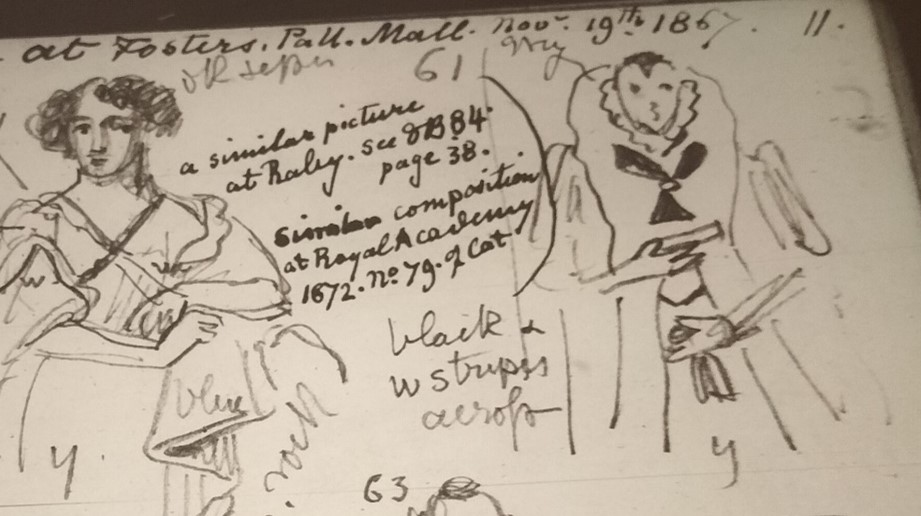
Unfortunately, the index system for the sketchbooks can be a little confusing, and in some cases, I have found it is best to just jump straight in and see what can be found. In the case of the Butler portrait this was successful, and it appears from one of the Trustee sketchbooks that Scharf, himself, viewed the portrait or a similar copy in 1867.  Scharf made a rough sketch of the painting, however, provided little information other than it was seen at ‘Foster’s, Pall Mall. 19th November 1867’. [4]

George Scharf Sketch
NPG100/1/1
© Heniz Archive, London

Edward Foster’s, or Foster and Son as it was better known was an auction house in London, which was established in 1833.  Unfortunately, to date, I have been unable to locate the auction catalogue for the sale mentioned by Scharf, however, this has been added to my list and attempts will be made to locate this on my next trip to London.

The portrait appears again when an image was published in The Illustrated London News in 1938.  The photograph seen, shows the painting prior to some of the restoration work removed by Philip Mould, and the article notes that the portrait was in the collection of Ewart Park in Northumberland.[5] The identification of the sitter, at that time, was incorrectly thought to be ‘Margaret Tudor, Queen of Scotland’ and the portrait was also incorrectly dated to the fifteenth century.  Size and materials used was also listed among the information provided.[6] 

The Butler Portrait 1937
© British Library Newspaper Archive

Built in the eighteenth century, and home to the St. Pauls and Butler family, the portrait and property was inherited by Horace Butler on the death of his father George Grey Butler in 1935.  George Grey Butler had begun selling some of the family’s possessions off in the 1920’s due to financial issues. [7] On his father’s death, Horace Butler was unable to maintain the cost of the upkeep for Ewart Park, it was briefly occupied by the military during World War II and was eventually sold by the family.  At present, no auction catalogue has been located for the contents of Ewart park, it may be possible that what little was left in the property, the family opted to take with them and was sold at a later date.

Sadly, for now, the provenance trail stops with Ewart Park, however, I do have one final interesting piece of information to share, connected to the Butler portrait.  Stored within the Icon Notes relating to Mary Tudor in the Heinz Archive London, is a rather interesting collection of letters and photographic images concerning a portrait of Queen Mary, and it could be argued that both portraits of the two sisters are related.[8]

Mary Tudor
Unknown Artist, previously attributed to Clouet.
© Heinz Archive, London

Dated to the early 1980’s, and from a private collector in France, the letters reports that she had inherited her portrait from her sister, who had purchased the painting in the in the 1950’s from Tours in France. She also notes that the portrait has a label on the back stating that it was transferred from panel to canvas, and the artist associated with its creation was French artist Francois Clouet.  

What can clearly be seen from the image above is that both portraits show the same characteristic approach when it comes to composition, style, and approach.  Unfortunately, the portrait of Queen Mary is currently missing, and it is hard to establish form the photograph if some later restoration work and overpaint has taken place.

As we have identified in many of the articles concerning the B Pattern of Anne Boleyn, the creation of portrait sets within the sixteenth century, stems a lot further back than initially thought.  Portrait sets were often unified using a curtain, pillow, or background colour.  As both portraits of Elizabeth and Mary include the unique pattern work seen on the gold demask fabric of the gowns, it may just be possible that both were part of an early set of portraits displaying the Tudor monarch.  Unfortunately, until the portrait of Queen Mary is located and tested to establish possible overpaint and date of creation, we may not know for sure.  The incorporation of the pattern in both portraits cannot be put down to coincidence and some further research will need to take place to identify any possible connection between both paintings.


[1] Tennants Auction Catalogue, Autum Sale, 18th November 2017, lot 66

[2] Moufarrige. Natasha, earliest full-length portrait of Queen Elizabeth I revealed – Showing her as studious and shy young woman, Daily Telegraph, June 17th 2018.

[3] National Portrait Gallery. The Notebooks of Sir George Scharf (1820-95), World Microfilm Publications, 1978, P.1 

[4] Heinz Archive. NPG100/1/1, Sketchbook of George Scharf (1886-1888), P. 11

[5] Clarification is currently needed to identify if the black ribbon and ring seen around the sitter’s neck and the object seen in the sitter’s right hand is original to the painting or later overpaint. Both items can clearly still be seen in the portrait today after restoration work had taken place, however, it may possibly have been deemed not to take the portrait back to its original state and the overpaint was simply left in place. interestingly, the same black ribbon and ring can be seen in the ‘La Royne D’Angleterre’ drawing of Elizabet discussed in my article on the Paine Miniature. See https://ladyjanegreyrevisited.com/2021/05/12/the-paine-miniature-is-it-elizabeth/ for more information

[6] Illustrated London news, Personalities of The Tudor and Stuart Period, 29th October 1938 p.30

[7] I have been able to locate eight Sotheby and Co auction catalogues from the years on 1928-29 that all include property from the estate of Mr George Grey Butler of Ewart Park, Northumberland

[8] Heinz Archive, London. NPG49/1/11, Notes on Sitters: Mary I, Queen of England. 1515-1558

Anne Boleyn & The Romney Portrait

 A Tale of Too Many Thomas’s

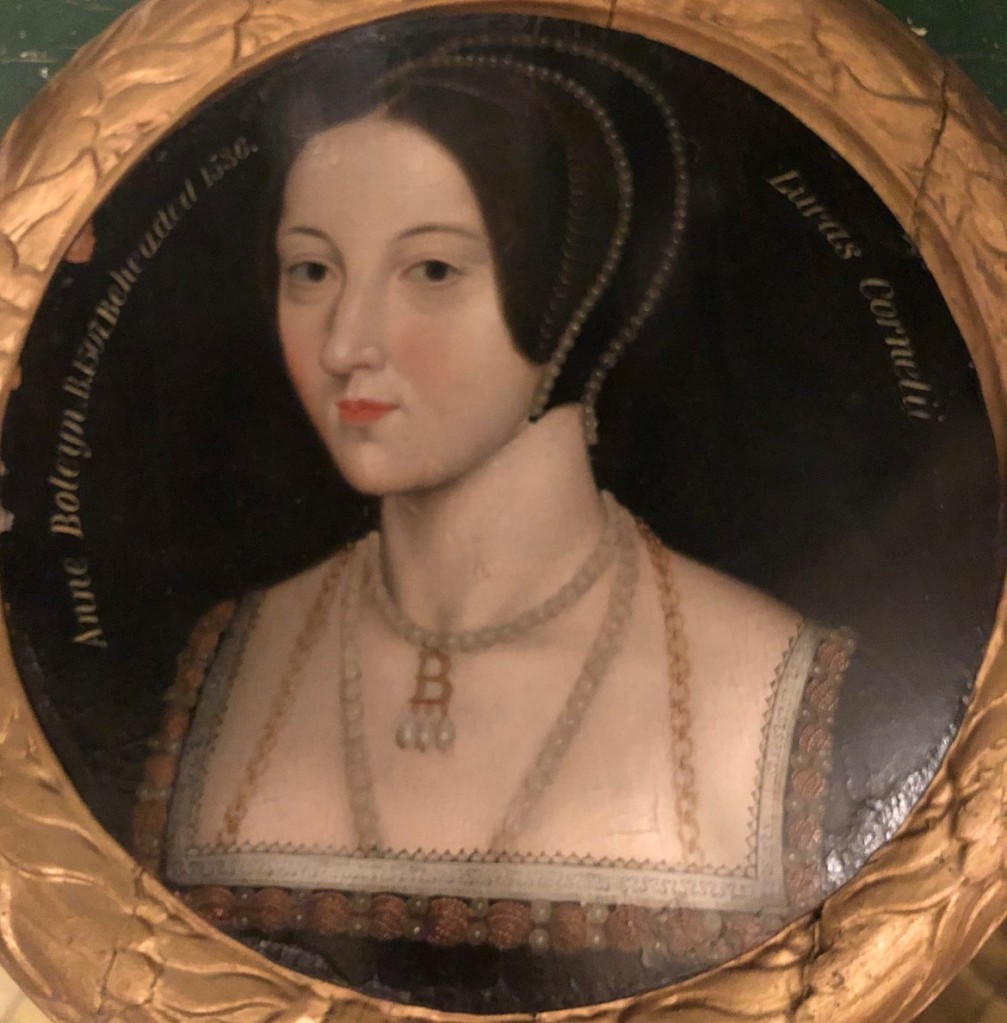
The Romney Portrait
Anne Boleyn
Oil on Panel
10 inches in diameter
© Earl of Romney

The Romney Portrait is among a small group of paintings associated with the Iconography of Anne Boleyn which has rarely been seen or studied by any academic.  Much has been written about NPG 668 and the Hever Rose Portrait, and in terms of a published image these two portraits tend to be the most popular when an illustration of Anne Boleyn is provided.

The Romney portrait has made a few public appearances. It was first exhibited in 1890, when it was featured among eight other portraits supposedly depicting Anne Boleyn in the New Gallery, ‘Royal House of Tudor Exhibition.’[1]  The portrait appeared again in 1902, when it was displayed among portraits of other British Kings and Queens in the ‘Monarchs of Great Britain’ exhibition.[2]

According to tradition, the portrait has been in the collection of the descendants of the Wyatt family for over four hundred years and was claimed by members of the family to be an authentic likeness of the doomed queen. At first glance, everything appears to add up, and for the first time in this research we have a portrait with a long family tradition, inscription, and artists name, however, are things too good to be true?

Painted with the use of oil on a singular wooden panel, the portrait depicts the image of Anne Boleyn, which over the course of time has become ingrained in the mind of any viewer familiar to her story.  The Queen is seen painted to just below the bust, facing the viewers left, and is placed in front of a plain dark background. On her head, she wears the French Hood constructed of black fabric with eighty-eight pearls visible. Her gown is constructed with the same black fabric, cut square at the neck, and decorated with twenty-four ouches and forty-three pearls set in gold.  Under this, she wears a shift of white fabric, also cut square, with blackwork embroidery around the edge.  Around her neck is a gold chain and a long strand of pearls with the now infamous ‘B’ Pendant hanging from them. 

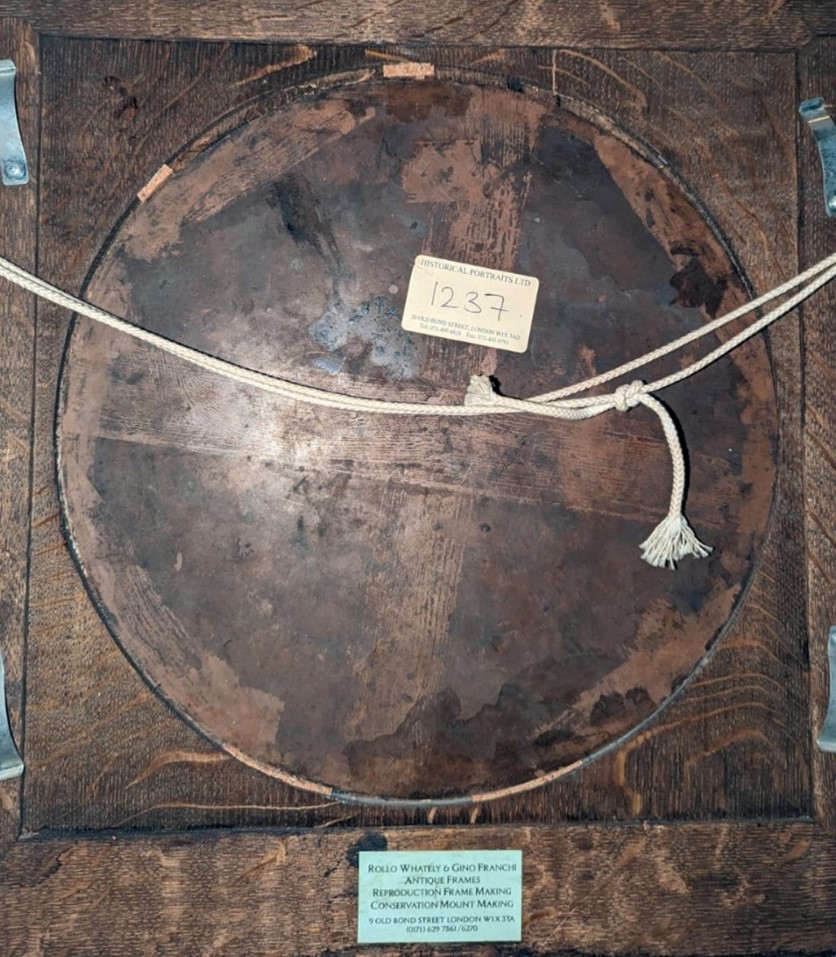
The Romney Portrait Reverse The Romney Portrait
© Earl of Romney

Generally, the portrait is in relatively good condition, however, surface dirt and discoloured varnish has obstructed the image slightly, and the portrait would most definitely benefit from having some restoration work completed. Some large areas of paint loss around the edge of the panel are also noted which may possibly suggest that the painting has been cut down at some point in time. A small area of lifting/flaking paint can also be seen above the sitters left breast.

As seen in the image above, the portrait contains an inscription completed in a yellow pigment. This informs the viewer that the sitter is ‘ANNE BOLEYN. B. 1507. BEHEADED 1536’ and that the artist is ‘LURAS CORNELLI.

The association with Lucas Cornelli or Cornelisz de Kock, as he is better known, is a tricky one.  Cornelisz was a Dutch painter born in Leyden in 1493, he is today one of the more obscure artists from the Tudor Court.  According to the seventeenth century biographer, Karel Van Mander, Cornelisz moved to England with his wife and seven or eight children and was eventually employed by King Henry VIII as the Kings Painter.[3]  Unfortunately, no work that can be reliably identified as being by his hand, has yet, surfaced and the exact date in which he arrived in England is unknown. A set of nineteen portraits depicting the office of constable of Queenborough Castle in Kent, was once associated with him during the eighteenth century. Today, this set is now known to date to the1590’s, and the association with Cornelisz was made due to the wrong interpretation of the monogram ‘LCP’ on one of the portraits.[4] 

Having undertaken a large amount of research into the iconography of Lady Jane Grey, I am personally very sceptical when it comes to portrait inscriptions.  I am only one hundred percent convinced when the inscription has undergone rigorous investigation to identify if the inscription is authentic to the artists hand or not.

Left: Thomas Wyatt the Elder Right: Thomas Wyatt the Younger
Oil on Panel
© Earl of Romney

Two further portrait’s depicting Thomas Wyatt the elder and his son Thomas Wyatt the younger, are also in the collection of the Earl of Romney.  Both are of similar size and constructed with the use of a circular oak panel.  Both also contain a similar inscription completed in yellow pigment as that seen in the Boleyn Portrait, and the portrait of Thomas Wyatt the elder is also associated with the artist Lucas Cornelli.  Both these paintings contain an earlier inscription which indicates that all three portraits had inscriptions added to the outer area at a later period, rather than by the artist who created them.

Before we look at the provenance and documentation relating to the Romney portrait, we first need to take a brief look at the history of the Wyatt family and the properties associated with them.  Allington Castle in Kent was the seat of the Wyatt family during the first half of the sixteenth century. It was purchased Sir Henry Wyatt as his principal residence in 1493, and the castle is less than twenty miles away from Anne Boleyn’s childhood home of Hever Castle.  Much debate, myth and exaggeration has been had over the centuries as to the exact relationship between Thomas Wyatt the elder, son of Sir Henry Wyatt and Anne Boleyn.  We do know for certain that both families knew of each other and most definitely mixed in the same circles. No record of a portrait of Anne Boleyn within the Wyatt family’s collection has yet surfaced, and no inventories listing the possessions at Allington Castle has survived. The castle remained within the Wyatt family until 1554, when it was confiscated by the Crown due to Thomas Wyatt the youngers involvement in the plot against Queen Mary I. His wife, Jane Hawte was left destitute after the execution of her husband, however, some of the Wyatt lands, not including Allington, were restored to her in 1555. In 1568, Allington Castle was granted by Queen Elizabeth I to John Astley, and it eventually passed through marriage into the hands of the Earls of Romney.  

In 1570, Queen Elizabeth I restored further Wyatt lands, including Boxley Abbey and Wavering to Sir George Wyatt, son of Thomas and Jane Hawte. George became heir to all the Wyatt estates in that same year and he became fixated on the history associated with his family. He began a conscious effort to rehabilitate his family name and fortune by collecting family stories, papers, writing pamphlets, and he even wrote what would be the first biography on Anne Boleyn.[5] 

On George Wyatt’s death in 1623, his collection of family memorabilia and the remaining Wyatt lands passed to his son Sir Francis Wyatt, then onto his son Edwin Wyatt in 1644.[6]

By 1725, we have our first piece of documented evidence concerning the Romney Portrait.  This comes to us when the portrait was viewed and documented in the notebook of the eighteenth-century engraver and antiquary George Vertue.  Vertue viewed the portrait on at least two separate occasions, and when seeing it he simply wrote a few lines noting that the portrait was:

‘In poss. Mr…. Wyatt in Charter House Yard. Picture of Q. Anne a Bolene. In a round (Frame) painted on Board.’

George Vertue’s Notebook detailing the viewing of the Romney Portrait of Anne Boleyn
© Public Domain

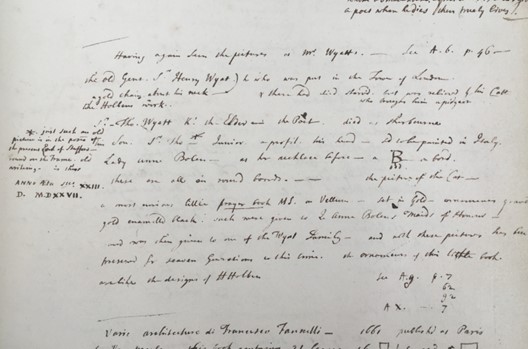
Thomas Wyatt, son of Edwin Wyatt, also presented the portrait, along with a small prayer book to the society of Antiquaries in 1725.  This viewing is again documented, and notes taken at the time indicates that Thomas Wyatt believed the portrait to be ‘original’. Also documented is the tradition that Anne gave the prayer book on the day of her execution to a member of the Wyatt family.

There does appear to be a tradition that Margaret Wyatt, sister of Thomas Wyatt the elder, attended Anne Boleyn on that fateful day in 1536.  This appears to stem from an early manuscript regarding the life of Thomas Wyatt the elder, copied and published in the eighteenth century by Thomas Gray.  Sadly, we know very little about the ladies who served Anne in her final hours.  Contemporary descriptions of this event do not provide the detail of their names, and if discussed at all then they are simply referred as ‘her ladies’, ‘her women’, or ‘four young ladies’. No description of Anne giving out gifts when on the scaffold is also known to exist and Sir George Wyatt makes no mention of the prayer book or Margaret Wyatt supporting Anne on the scaffold in his biography on Anne Boleyn.

Society of Antiquaries Notes on viewing the Romney Portrait and Wyatt Prayer Book © Public Domain

The direct Wyatt line died out in 1746, with the death of Thomas Wyatt, and it appears the small collection of family portraits and papers then passed to his aunt, Margareta, who was grandmother to the 1st Earl of Romney. The painting continued to be passed down the Romney family line and today, the portrait hangs on the walls at Gayton Hall, seat of the Earl of Romney.[7] 

As this article demonstrates, the tradition associated with the Romney portrait of Anne Boleyn appears to be a rather complex one, and although once claimed to be an authentic likeness, this is not exactly known for sure.  None of the Romney portraits have undergone any scientific investigation or dendrochronology testing to establish a date of creation, and the portrait of Anne Boleyn has not been seen in public for over one hundred and twenty years.  The portrait itself probably dates to the end of the sixteenth century when descendants of the earlier notorious Wyatt’s were attempting to restore the family fortunes and lift the association of treason which had been applied to family name.

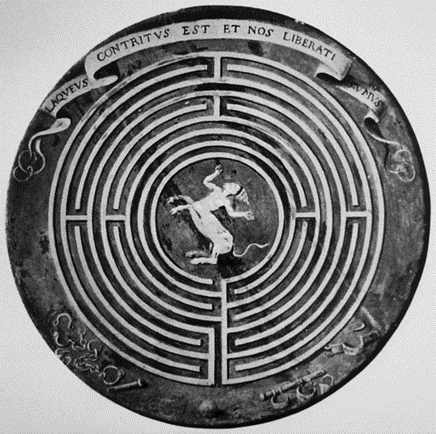
One clue does support this theory, stored in the Wyatt papers is a rather curious tale concerning Thomas Wyatt the elder, documented toward the end of the sixteenth century by his grandson Sir George Wyatt. According to Sir George, he was informed of the story from two sources: ‘One a gentleman, a follower of Sir Thomas and another a Kinsman of his name.’ Sir George then goes on to document the tale noting that when in Rome, Thomas ‘Wyatt stopped at an inn to change horses. On the wall of his chamber Thomas drew a ’Maze and in it a Minotaur with a triple crown on his head, both as it were falling’ and above this he placed the inscription ‘Laqueus contritus est et nos liberate sumus’’[8] 

The Wyatt Maze
Oil on Panel
© Earl of Romney

Once attached to the back of the Romney portrait of Thomas Wyatt the elder, was a separate panel painting depicting the image supposedly drew by Thomas on the wall of the inn. As George documents this story at a later period and notes that he was informed of this by two other individuals, it is highly likely that George Wyatt had this painting created himself.  This would also suggest the possibility that George had some of the Family portraits, as well as the portrait of Anne Boleyn, copied from available images as a way of promoting his family history.[9]

If indeed all three portraits date towards the end of the sixteenth century it would be tempting to suggest that since a portrait of all three sitters was recorded in the collection of John, 1st Baron Lumley in 1590, then it may just be possible that these portraits were used as the reference images for the Romney portraits.  Unfortunately, until further examination is completed on the paintings, we will not know for certain the year in which all were create. However, since Sir George Wyatt went to much effort to rehabilitate the family name, it is highly likely that they all date to his lifetime.   


[1] Exhibition of the royal house of Tudor : New Gallery (London, England) : Free Download, Borrow, and Streaming : Internet Archive accessed 28/05/2023

[2] The monarchs of Great Britain and Ireland : Winter Exhibition, the New Gallery, 1901-2 : New Gallery (London, England) : Free Download, Borrow, and Streaming : Internet Archive accessed  28.05.2023

[3] Het leven van Lucas Cornelisz. de Kock, Schilder van Leyden., Het schilder-boeck, Karel van Mander – dbnl, accessed January 2023

[4] Daunt Catherine, Portrait set in Tudor and Jacobean England, University of Sussex, 2015, Vol I, Page: 80 – 87

[5] Goeorge Wyatt’s book entitled ‘The Extracts from the Life of the Virtuous, Christian and Renowned Queen Anne Boleigne.’ Was published towards the end of the sixteenth century. 27 copies of the book were privately printed, and six copies are held in the British Library today.

[6] Edwin left his estate to his eldest son Francis, who died without children, leaving the estate to his brother, Richard, who also died without issue and was the last in this line of the Wyatt family. Richard left the land to a relative, Robert Marsham, Lord Romney (son of [Margaret] (Bosvile) Marsham.

[7] I am extremely grateful to the current Earl of Romney for providing me with the colour photographic images of this painting.

[8] Loades. David. The Papers of George Wyatt Esquire of Kent Son and Heir of Sir Thomas Wyatt the Younger, 1968, Royal Historical Society, PP:  28 – 29

[9] The Wyatt Maze is no longer attached to the back of the Thomas Wyatt portrait as it was removed at an earlier period and now hangs directly next to the portrait of Thomas Wyatt the elder.

Hever Castle: The Mould and Zouche Portraits

The Hever Rose Portrait is not the only painting of Anne Boleyn, based on the B Pattern, in the collection of her childhood home at Hever Castle.  Though undoubtedly, the Hever Rose Portrait is one of the castles prize possessions, a further two later copies are stored in the castles collection and both portrait’s feature strongly in the 2023 exhibition ‘Catherine and Anne, Queens, Rivals & Mothers.’ Organised by castle curator’s Alison Palmer, Owen Emmerson, and Kate McCaffrey.  This beautifully produced exhibition explores the complex connections between Catherine and Anne. It brings together for the first time in five hundred years two Books of Hours belonging to both these remarkable Queens of England and includes some never-before-seen portraits from private collections of Catherine of Aragon.  

When it comes to contemporary descriptions of Anne Boleyn, recorded during her lifetime or in the few months after her death, we have very little. What we do have provides a mixture of opinions, and some do appear to be embellished with a personal hatred towards Anne, due to the controversy that surrounded her relationship with the king.  One thing is for sure, Anne stood out among the people who were able to witness what she looked like for themselves. Her general persona appears to have caused debate even when she was alive, and this debate would continue for centuries after her death. The French scholar and poet Lancelot de Carles described her as

‘Beautiful with and elegant figure…. She became so graceful that you would never have taken her for an Englishwoman, but for a Frenchwoman born’. [1]

Carles would go on to note that Anne’s most attractive feature was:

‘her eyes, which she well knew how to use. In truth such was their power that many a man paid his allegiance’.[2]

In 1528, she was also described as ‘very beautiful’ by a Venetian diplomat, however, when described in 1532, by Francesco Sanuto, he appears less certain about Anne’s beauty. Sanuto was again observed to be captivated by Anne’s eyes.

‘Madam Anne is not one of the handsomest women in the world; she is of middling stature, swarthy complexion, long neck, wide mouth, bosom not much raised, and in fact has nothing but the English King’s great appetite, and her eyes, which are black and beautiful, and take great effect on those who served the Queen when she was on the throne.[3]

What is interesting, about some of the above features detailed by her contemporaries, is that some of these features are seen within the B Pattern of Anne Boleyn. When comparing both the contemporary descriptions and some of the earlier portraits based on the B Pattern to the Mould and Zouche portraits. Both paintings demonstrate how the sands of time have manipulated the everchanging image of Anne, and how her features would be slightly altered or airbrushed to suit the perception of beauty during the period in which the later copies were created.

Both the Mould and Zouche paintings are, in fact, relatively modern acquisitions within the castles collection and little information concerning their provenance are currently stored in the archive at Hever Castle today.  As both portraits are held within a significant collection relating to Anne Boleyn, then what little is currently known about the history of these two paintings deserves to be documented.

The Mould Copy
Anne Boleyn
Oil on Copper
10 ½ inches in diameter
Unknown Artist
© Hever Castle, Kent

The first, and certainly the earliest portrait is what I refer to as the Mould Copy. This painting was acquired by the castle from the London Art Specialist, Philip Mould, prior to 2012, and it has continually been on exhibition since its purchase.  The Mould copy is most certainly derived from one of the earlier paintings based on the B Pattern. As the slight curvature is seen at the neckline of the bodice, and the lips and nose have been altered slightly to that seen in NPG668.  It would be tempting to say that the Mould Copy was based on a painting similar to the portrait of Anne Boleyn seen in the Royal Collection. Anne has been slightly cropped in the Mould version the painting stops just below the neckline of her sumptuous gown. Her trademark pearls and B pendant can clearly be seen around her neck. Anne’s features have been somewhat enhanced to achieve the raven-coloured hair and large dark expressive eyes she would undoubtedly become famous for.

RCIN 404742
Anne Boleyn
Unknown Artist
Oil on Panel
© The Royal Collection

The portrait is in excellent condition for its age, some slight craquelure to the paint surface is seen on close inspection, however, there does appear to be no evidence of paint loss.  At first glance, Anne appears to be missing the black veil attached to the back of the French Hood. On viewing the portrait in person, it does appear to have been part of the original composition.  However, the veil appears to have been painted out at a later period and some evidence of a slight touch up to the bottom and outer portion of the pearl billiment is also visible. No artist inscription or name was located on the painted surface.

Detail of The Mould Copy
© Hever Castle, Kent

Executed with the use of oil paint on a sheet of circular copper, the portrait has a name plate applied to the frame with an estimated date for its creation of ‘circa sixteenth century’. The use of copper as a surface to paint on, appears to have originated in Florence towards the end of the sixteenth century, however, surviving examples from this period are rare. This method of painting eventually spread to Rome, Antwerp, and other countries during the seventeenth century and was often used by artists for small paintings, as the smooth surface would provide an ideal support to create detailed images.  

Stylistically, the use of the blue pigment seen in the Mould Copy to achieve that porcelain skin affect when modelling the flesh, the handling of the eyes, nose and mouth are more consistent with the hand of a seventeenth century artist, when the use of copper as a support for portraiture was at its height. Copper began to wean off during the second half of the seventeenth century and by the beginning of the eighteenth century it would become almost obsolete when the use of canvas would again become the most popular support for a painting surface.[4]    

Reverse of The Mould Copy
©Hever Castle, Kent

When it comes to the documented provenance of the Mould portrait, we unfortunately have very little in terms of information prior to its modern purchase. The painting doesn’t appear to have been included in any of the major nineteenth century exhibitions relating to Tudor portraiture. We do have many auction records concerning portraits of Anne Boleyn sold over the course of four centuries, however, no direct record for this particular portrait has yet, been located.  Unfortunaly the back of the copper plate also provides no other details, other than the modern Philip Mould inventory sticker.

A search of the Getty Provenance Database has identified two tantalizing auction entries from the early nineteenth century that could possibly identify two of the previous owners of this painting. The first reference is a portrait described as being that of ‘Anne Boleyn on Copper’ which sold from the collection of a John Dent by Christie’s, London on 6th February 1802. The second, is another portrait described again as representing ‘Anne Bullen on Copper’ which sold some fourteen years later from the collection of a Reverend James Cradocke. Due to the poor content of these early auction entries and the constant demand for Anne’s likeness, no direct match has been made to truly confirm that either one of the references is, in fact, related to the Mould Copy or the B pattern. Until further information is obtained, then we cannot truly list either names as previous owners.[5]

During a recent trip to London, I was able to locate one positive reference about the Mould Portrait made towards the end of the nineteenth century.  George Scharf, then Director of the National Portrait Gallery London, viewed many significant Tudor related portraits during his career.  Scharf was noted to have an active interest in sixteenth century portraiture and would often seek out paintings to feed his own interests in the subject or as a possible purchase for the galleries collection. Unfortunately, Anne Boleyn does not appear to be at the top of his list when attempting to locate images, however, he does illustrate a small number of portraits that caught his eye in his many sketchbooks.

Drawing of Mould Portrait
George Scharf
©National Portrait Gallery, London

The Mould Copy portrait was viewed by George Scharf on 19th July 1872. During this viewing he took notes regarding his observations and made a drawing of the portrait in one of the sketchbooks stored in the galleries archive today.  Unfortunately, the notes given provide us with little information other than the size of the painting, materials used, and the fact that Scharf had a poor opinion of the portrait noting it to be a ‘a very poor fabrication ignorantly done from the Windsor Picture.’ Scharf does make one rather puzzling note along the far left-hand side of his drawing and lists the rather curious name ‘J.K Sepia Boleyn’. This could possibly be the owner of the portrait in 1872, however, for the moment I have unfortunately been unable to locate and information regarding a J.K Sepia Boleyn or a J.K Sepia [6]

The Zouche Copy
Anne Boleyn
Unknown Artist
15 ½ x 12 ¼ inches
Oil on Canvas
© Hever Castle, Kent

Unlike the Mould copy, the Zouche Portrait appears to have a rich history in terms of provenance and documentation. In this version, Anne is depicted to just above the waist, her famous dark hair has been lightened to an almost auburn colour, and her eyes have been enlarged. Anne’s features have been softened and appear younger in years to that seen in the earlier patterns, and the hint of rosy pink cheeks and red lips are also observed.  

The French inscription applied to the top of the panel gives us a clue as to the origin of the painting and it’s first acknowledgement to its past is seen on a label attached to the back of the stretcher. Written in French the label informs its viewer that the portrait is a depiction of:

Portrait de Anne de Boulon, femme de Henry VIII roy(al) de l’angleterre……Da Chateau de Thorigny’[7].

Located in Yonne, France, the Chateau de Thorigny was built for Alexandre Jean Baptiste Lambert on the same land as an earlier family property between the years of 1719 and 1726. On his death in 1726, the chateau entered a spiral of sales were its valuable collection of books, furniture and architectural features were unfortunately sold off. A shell of a castle was finally acquired by a wealthy Italian family; however, it was eventually demolished in 1806.[8]  

Detail showing the label fixed to the reverse of the Zouche Copy
© Hever Castle, Kent

By 1897, the portrait was in England in the collection of Robert Nathaniel Cecil George Curzon, 15th Baron Zouche of Perham Park. Curzon’s was an avid collector, traveller and writer who is known to have acquired a large collection of Biblical Manuscripts during his lifetime. Today, a large amount of his collection is stored in the British Library London. It may just be possible that Robert Curzon purchased the Zouche copy himself from one of the many sales taking place at the Chateau de Thorigny during one of his many excursions abroad.[9]

The Zouche Copy first appeared, publicly, when it was exhibited in the 1897 ‘Royal House of Tudor Exhibition’.  Situated in Manchester’s Art Gallery, the exhibition consisted of eight rooms containing thousands of Tudor related artifacts sourced from public and private collections across the country.  Seen in room two was item 32 in the exhibition catalouge:

Queen Anne Boleyn (1507-1536) Small half-length, to the left: square cut, low dark dress; black hood, edged with pearls; pearl necklace with a letter B. Canvas 15 x 12 inches. Attributed to Janet.[10]

The association with the sixteenth century artist Janet or Jean Clouet is an intriguing one. During the latter half of the nineteenth and early twentieth century many portraits were associated with the French artists Jean and Francois Clouet due to a significant amount of research being produced about both artists.  However, access to information, archival material, and any scientific investigation in terms of dating, paint analysis or infrared reflectography was non-existent.  Portraits were simply grouped together by style and associated with names of some of the more famous artists to work within the period the portrait was at that time thought to date to. It is safe to say that the Zouche Portraits has nothing in terms of the stylistic qualities seen in some of Clouet’s known works. The fact that the portrait is on canvas also indicates that it most certainly dates to a period after the sixteenth century and the attribution to ‘Janet’ in the exhibition catalouge was a simple mistake.  Today, the portrait is thought to date to the eighteenth century and may just have been commissioned by Alexandre Lambert to hang in the newly built Chateau de Thorigny.

The Zouche Copy was passed by descent to other members of the Curzon’s family. It appeared in a further two public exhibitions in 1902 and 1909 and remained in the family’s collection when Parham House and the estate was sold off in 1922. The portrait eventually appeared up for auction on 29th October 1986, when it was incorrectly described as being ‘English School’.  On completion of this sale the portrait then entered the collection at Hever Castle and remains part of the collection to this day.   


[1] Weir, Alison. The Six Wives of Henry VIII, 2007, pp 151

[2]Ibid  

[3]Calendar of state papers,  Venice: October 1532 | British History Online (british-history.ac.uk), accessed 12.02.23

[4] For more information on the history of the use of copper see: Komanecky. Michael K. Copper as Canvas: Two Centuries of Masterpiece Painting on Copper, 1575 – 1775, Oxford University Press, 1998.

[5] Getty Provenance Index & Getty Provenance Index accessed 10.02.2023

[6] The Heinz Archives, London. Trustees’ Sketchbook 18, 1871-1872, NPG7/1/3/1/2/18, pp.38 

[7] I am extremely grateful to Owen Emmerson, Kate McCaffrey and Alison Palmer for allowing me to see photographic images of the reverse of both portraits.

[8] Miller. Etienne, The Lambert de Thorigny Family, Bulletin of the Archaeological Society of Sens, Volume: VI, (2008), pp. 102-185

[9] Sidney lee. Dictionary of National Biography, Smith, Elder & Co, London, (1900) Vol 63

[10] Royal House of Tudor Exhibition Catalouge, 1897, P.12, item:32

Lady Jane Grey and The Longleat Portrait

Lost, Found and a Case of Misidentification

In 2015, John Stephan Edwards included the Longleat portrait among a small number of ‘lost’ portraits in his in-depth analysis on the iconography of Lady Jane Grey.  Edwards briefly stated that a portrait of Lady Jane Grey was ‘recorded at Longleat in the 1860s, seat of the Marquis of Bath.’  When attempting to locate the missing portrait for himself, Edwards noted that, unfortunately, the painting thought to be Jane was not uncovered at Longleat during the Courtauld Photographic survey, and that no portrait thought to depict Jane Grey was also included in a book detailing the artwork at Longleat published in the 1880’s.  As any reader of this website may appreciate, Edwards ‘lost list’ fascinated me from the moment I read it, and it was this list that started my very own little adventure into the iconography associated with Lady Jane Grey.

When undergoing my own research into this painting, I decided to start at the very beginning. I contacted the Curator at Longleat, in the hope that some new evidence or research had come to light since the publication of Edwards book.  Unfortunately, the response I received provided little information other than no portrait thought to depict Lady Jane Grey was currently in the collection of the Marques of Bath today. No reference was also located in any book concerning the collection of paintings at Longleat and a search of the nineteenth century visitor’s manuals that included detailed descriptions of Longleat’s collection was, unfortunately, unsuccessful in terms of any reference to a portrait of Jane Grey.  

NPG Index Card

© Heinz Archive, London

During a visit to the Heinz Archives in London, I was able to locate the original source material that informs us of the Longleat portrait’s existence.  Stored within the archive are thousands of index cards containing details of images, listed under various sitters that have been reported to the National Portrait Gallery over the course of one hundred and fifty years.  Some of these cards list existing portraits, whilst others list illustrations, exhibition entries, auction sales, and archive material stored within the Galleries collection.  A small number of these cards are filed under the sitter’s name of Lady Jane Grey, and It is among these that we get our first mention of a portrait depicting her at Longleat.  The card directs its viewer to a sketchbook in the archives collection produced by George Scharf, director of the National Portrait Gallery, however, the question mark seen next to Jane Grey’s name indicates that the portrait may possibly depict her, and some uncertainty was express at the time of writing. 

Thankfully, I was able to successfully locate the sketchbook indicated on the index card. In this, George Scharf records that he visited Longleat House in December of 1862, to sketch the collection of paintings then held in the collection of Thomas Thynne, 5th Marquess of Bath.  Among the many rough sketches seen within the small sketchbook is a drawing of a portrait that Scharf recorded to be hung in the Saloon at the time of viewing.  Scharf also notes that the sitter depicted has yellow hair and white sleeves. Under his drawing, he writes the words ‘query Lady Jane Grey’, suggesting that he thought the portrait to be a possible depiction of her.[1]

George Scharf

Drawing of the Longleat Portrait

©The National Portrait Gallery, London

In May 2021 and early December 2022, two interesting portraits came up for sale on two separate online auction sites. Both portraits, appear to match the drawing made by George Scharf in 1862 when viewing the Longleat portrait.  The first painting was described as a portrait of ‘Elizabeth I as a young woman’ and the second was referred to as a ‘Large English Old Master portrait of Mary Tudor, Queen Mary I of England’.  Both paintings were described as ‘circa 17th Century’ in date, and no information concerning either of the portrait’s provenance was provided on the lot listings for each of the paintings, other than both would be shipped from ‘London, England’[2] .

Called Elizabeth I as a young woman

Oil on Canvas

30 x 24 inches

© Public Domain

Called Queen Mary I

Oil on Canvas

37 inches x 32 inches

©NY Elizabeth Galleries

Though most definitely seventeenth century in date, both portraits are inconsistent with any of the surviving images of Queen Mary I and Queen Elizabeth I.  It is therefore highly unlikely that the images were based on any contemporary portrait of these formidable Queen’s, and their names may possibly have been simply attached to the paintings by a previous owner, due to the fame associated.  Longleat did confirm that they indeed still have a portrait matching both the paintings sold and the drawing produced by George Scharf in the collection today.  However, there version is known as Jane Shore, mistress of Edward VI and not Lady Jane Grey.  According to the information provided, the Longleat portrait was purchased in ‘Feburary 1685’ and has traditionally been identified as a portrait of Shore for a long period of time.[3] 

I am by no means doubting that the artist who created these portraits did in fact intend them to be a representation of Jane Shore, who as Thomas More once described was famed for her ‘yellow hair.’[4]  The seventeenth century date also appears to be consistent, as interest in the story of Jane Shore became hugely popular towards the end of the seventeenth century.  This was once again promoted even further when the popular play ‘The Tragedy of Jane Shore,’ written by Nicholas Rowe premiered at the Theatre Royal, London, on 2nd February 1714.

It is my opinion that when producing his drawing of the Longleat portrait, George Scharf was right to query the identity of the sitter.  From the images seen above, the artist who created the original version of this portrait appears to have used two separate earlier paintings as a source of inspiration, due to the lack of an authentic likeness of Jane Shore.  This explains the fact that a young Jane Shore is depicted wearing clothing that was fashionable decades after her actual death in 1527.

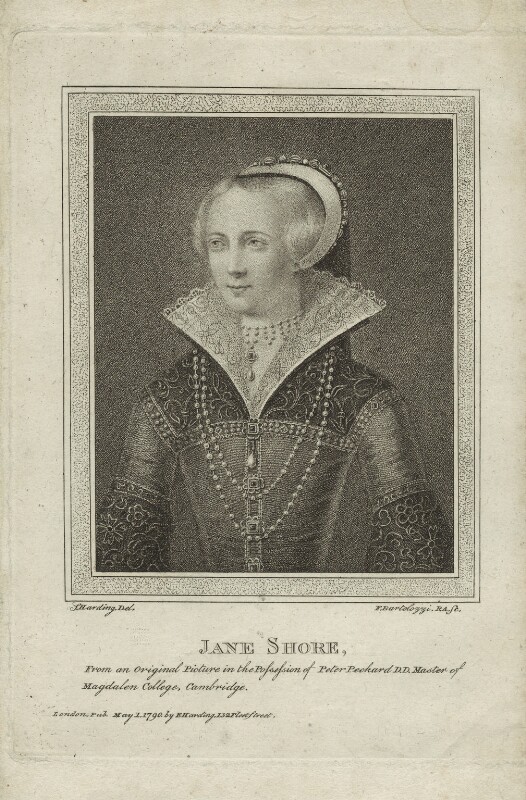
The first image used, appears to be a portrait which was thought to depict Jane Shore when engraved in 1790.  At the time the engraving was created the portrait was recorded as being in the collection of Dr Peter Peckard of the Magdalene College.  The costume, pose and jewellery seen is clearly very similar to a portrait once exhibited as a painting of Anne Boleyn in 1866, from the collection of the Earl of Denbigh.[5]  Though it cannot be known for certain if it was indeed these portraits used, the similarities between the images are striking.

Jane Shore From the Collection of Dr Peter Peckard

1790

Francesco Bartolozzi

© Public Domain

Unknown Lady

Previously identified as Anne Boleyn

© Earl of Denbigh. 

Unfortunately, the original Magdalene portrait, supposedly depicting Jane Shore has long since vanished. It was last recorded in the last will and testament of Dr Peter Peckard. Peckard bequeathed the portrait, along with his collection of paintings at the college to his wife Martha Peckard in 1798.[6] 

One final clue does give us a little more understanding as to why George Scharf may have questioned the identity of the sitter in the Longleat portrait. This come to us in the shape of an early photographic image of a portrait listed as being in the collection of Agecroft Hall held in the Heinz Archive, London. [7]   

The Agecroft Hall Portrait

Oil on Panel

Size Unknown

Unknown whereabouts

© Heinz Archive, London

Detail of Agecroft Portrait

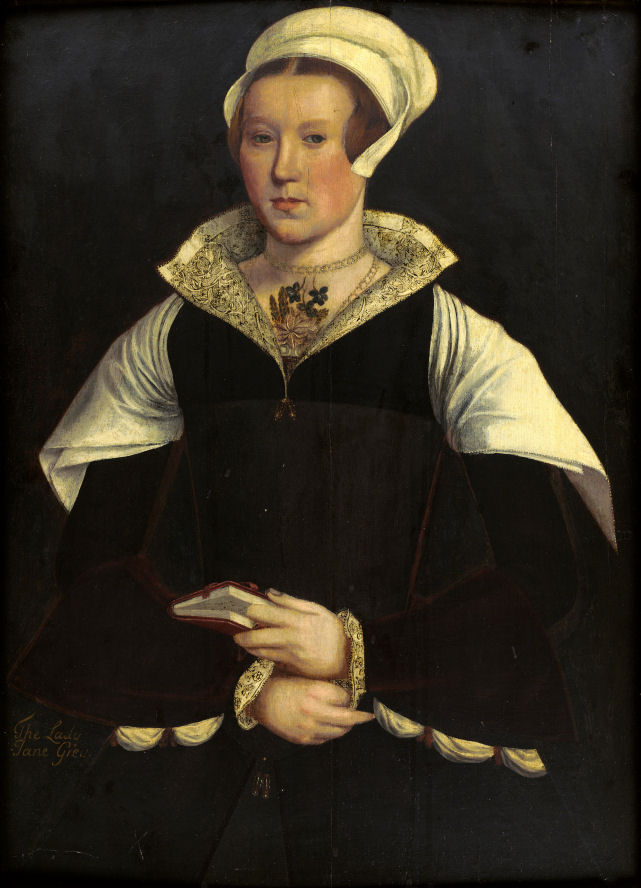
This photograph appears to be a perfect match to the Francesco Bartolozzi engraving of the Magdalene Portrait and it also shows similarities in the facial features and hood, particularly, in the treatment and arrangement of the jewelled billaments to that seen in the recent sold copies and Longleat portrait of Jane Shore. The Agecroft Hall portrait is, in turn, very similar to the Norris, Houghton and Streatham portrait thought to be a representation of Lady Jane Grey.

Left: The Norris Portrait, Lady Jane Grey, Oil on Panel, Unknown Size, © Heinz Archive, London.  Middle: The Houghton Portrait, Lady Jane Grey, Oil on Panel, 30 x 24 inches, © Private Collection. Right: The Streatham Portrait, Lady Jane Grey, Oil on Panel, 33 ¾ x 23 ¾ inches, ©NPG, London
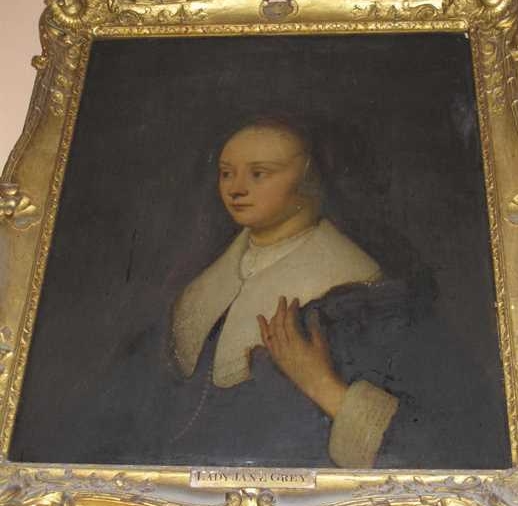
As discussed above the Longleat portrait was almost certainly created by the artist to be a representation of Jane Shore, however, the production of this particular image appears to be a little more complex.  What can be established is that the missing Longleat portrait of Lady Jane Grey can be removed from the list of lost portraits associated with her, however, the debate continues as to whether an image of Lady Jane Grey, rather than Jane Shore was used to create the Longleat portrait continues.


[1] Heinz Archive, London. NPG7/3/4/2/76, Page: 63, accessed Feburary 2022

[2] PORTRAIT OF QUEEN MARY I (1516-1558) OF ENGLAND OIL PAINTING – Dec 04, 2022 | NY Elizabeth in CA (liveauctioneers.com), accessed December 2022. Unfortunately, the eBay link for the portrait of Princess Elizabeth has expired, however, if anyone is interested in locating more information on this painting I do have paper copies of the description in my collection.

[3] Email communication between the author and Kate Harris, Curator, Longleat Historic Collections, November 2019.  Several of the nineteenth century tourist guides do mention a portrait of Jane Shore including a reference from 1798 in which William Fordyce Mavor discussed the painting in his British Tourist or Travellers Pocket Companion

[4] Thornton. Tim, Thomas More, The History of King Richard III, and Elizabeth Shore, Moreana, Volume 59, issue 1, Edinburgh University Press, Page 113-140

[5] Royal House of Tudor Exhibition Catalogue, 1866, item 140, Page. 48

[6] National Archives, London, Last Will and Testament of Dr peter Peckard, PROB 11/1302/249

[7] Agecroft Hall was sold by the Dauntsey family in 1926 and was dismantled and shipped to Richmond, Virginia. Email communication has confirmed that this portrait is no longer at the property today.

William Frederick Yeames Lost Masterpiece ‘Lady Jane Grey in The Tower ‘

Introduction

Between 1794 and 1877, a total of twenty-six paintings depicting scenes from the life of Lady Jane Grey were exhibited at the Royal Academy of Arts, London.  When looking at the various titles of each painting exhibited, there appears to be a pattern of four significant events in Jane’s life which were prominent themes chosen by artists who opted to promote her story.  Some of these events are, in fact, based on contemporary descriptions from her time, whilst others are steeped in the air of myth which began to surround Jane from the moment of her death. 

The first common scene often depicted is a promotion of Jane’s virtues as an exemplary pupil and her passion for learning. Many of the artists of the paintings based on this scene used the account published by Roger Ascham in 1570 as a source of inspiration.  In this account, Ascham recalls the day on which he encountered Jane alone at Bradgate Park, engrossed in Plato whilst the rest of her family were out hunting. The Victorian myth that both Jane and King Edward VI were educated together and were in fact childhood sweethearts is also depicted within this group of paintings. 

The second common theme is Jane’s initial refusal of the crown. Again, this is based on true events that took place at Syon House and were described by Jane herself in a letter to Queen Mary written during her imprisonment, after she lost her crown in 1553.  The final two common events are a promotion of Jane’s role as a martyr and innocent victim, either when imprisoned in the Tower of London or her final moments on the scaffold.

Of the twenty- six paintings exhibited, a total of nine depicted scenes were from Lady Jane Grey’s imprisonment in The Tower of London between 19th July 1553 and 12th February 1554.
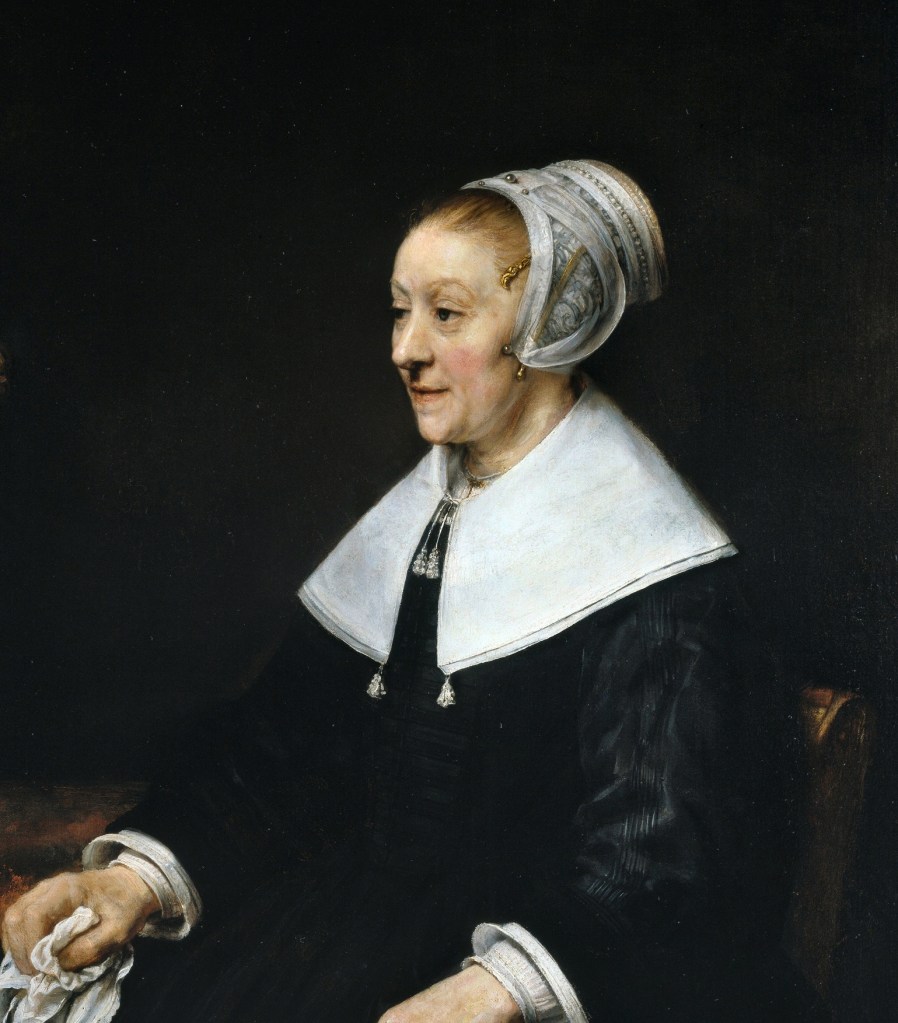
In this article I intend to look at one of the more famous of these paintings, exhibited at the Royal Academy by William Frederick Yeames in 1868.  Until recently, the original painting was thought to have been lost to the sands of time, however as discussed later in this article, an interesting email from a viewer of this website brought some fascinating news to my attention.

When first exhibited, the painting entitled ‘Lady Jane Grey in the Tower’ received excellent reviews from observer’s who had visited the exhibition, with some reporting that

‘Mr. Yeames “Lady Jane Grey in the Tower,” is perhaps the best picture this young and hard-working artist has yet elaborated.’[1]

‘In 1868 was exhibited the picture which I should rank as the painter’s masterpiece thus far, ‘Lady Jane Grey in the Tower,’ wearily but gently listening to the exhortations of Feckenham, Abbot of Westminster. Of all the Lady Jane English painting’s, I know of none at once so touching and so true to historical character at this of Mr Yeames.’[2]

‘The little Jane is thoroughly well conceived and better executed by Mr Yeames than by Queen Mary’s executioner’[3]

William Frederick Yeames circa 1884
Joseph Parkin Mayall
© Public Domain

William Frederick Yeames was born in Russia on 18th December 1835, fourth son of William Yeames, a British consul in Taganrog and his wife Eliza Mary Henley.  On his father’s death in 1842, he attended a school in Dresden, and he began to study painting. By 1848, Yeames had moved to England where he studied anatomy and composition under George Scharf. He also visited Florence and Rome to continue his development in life studies, landscapes, and the old masters, eventually returning to England in 1858 and setting up his studio in Park Place, London.   In 1859, Yeames exhibited his first painting into the annual exhibition at the Royal Academy of Arts and he was eventually made an associate of the Royal Academy in 1866.  Yeames continued to exhibit paintings within the annual exhibition and themed most of his subjects around historical events from British history. He along with other artists formed an artistic circle known today as the ‘St John’s Wood Clique.’ All enjoyed visiting historic houses, including Hever Castle in Kent and would often spend time sketching and painting interiors which would eventually appear as backdrops for their historically themed paintings.  Yeames died on 3rd May 1918, leaving behind a large portfolio of work inspired by some of the most prominent characters in English History. [4]

Setting The scene

The original painting displayed in the 1868 exhibition has not been seen or studied by any art or history academic.  Today, it is only known through the original exhibition catalogue entry and the small preparatory painting produced by Yeames which is now in the collection of Weston Park Museum, Sheffield.  Images of his preparatory painting have appeared in numerous publications over the years and this smaller version was initially in the collection of businessman and collector John Newton Mappin (1800-1883).  On his death, Mappin bequeathed a total of one hundred and fifty-four paintings representing many of the leading artists of the day to the Weston Park Museum. He also left the huge sum of fifteen thousand pounds for a Gallery to be built so that his collection of paintings could be viewed by the public. The Mappin Gallery eventually opened to the public on 27th July 1887 and Yeames preparatory painting for ‘Lady Jane Grey in the Tower’ as well as the rest of his collection could be viewed and admired for generations. [5]

Lady Jane Grey in The Tower Preparatory Painting
William Frederick Yeames
1867
Oil on Canvas
11×17 inches
© Sheffield Museums

The preparatory painting (above) produced by Yeames does provide some clues as to the exact scene depicted in the completed painting exhibited in 1868.  This version is signed and dated by the artist to 1867 and shows Yeames workings of the composition.  The exact event which he opted to depict is when Lady Jane Grey was visited by John Feckenham, Queen Mary’s personal chaplain, on 8th February 1554.  By this point in her story, Jane had faced trial and had been convicted and sentenced to death as a traitor for accepting the crown and signing herself as queen. Mary was prevented from issuing Jane with a pardon because the Spanish demanded that Jane die as a condition of the marriage between Mary and Philip of Spain. 

Mary was unable to save Jane’s life, however she did attempt to save her immortal soul, and she sent Feckenham to see Jane with that specific task, to try and convert her to Catholicism prior to her death. Jane’s execution was postponed for three days, and a debate was held between Feckenham and Jane which resulted in Jane staying strong to the Protestant faith rather than relinquishing it.  This famous debate was apparently recorded and signed by Jane’s own hand, however unfortunately the original document no-longer survives today.  The original documentation does appear to have been smuggled out of the Tower of London as within months of Jane’s death, it began to appear in printed format and was used to promote Jane’s strong belief in the Protestant faith.

The popular tradition of Queen Mary offering Jane a pardon if she was willing to convert to Roman Catholicism began to emerge shortly after Jane’s death.  In 1615, a pamphlet entitled ‘The Life, Death and Actions of The Most Chaste, Learned and Religious Lady, The Lady Jane Grey’ was published in London. This pamphlet again contained a copy of the earlier printed debate, and it was noted in the introduction that:

Even those which were of the best fame and reputation, were sent unto her to dissuade her from that true profession of the gospel, which from her cradle she had held. Each striving by art, by flattery, by threatening’s, by the promise of life, or what else might move most in the bosom of a weak woman.

There is no surviving contemporary evidence to prove that Jane was ever offered an actual pardon if she would convert, but as discussed above there was indeed an effort made to encourage her to convert to what Mary thought was the true religion and save her soul.

The preparatory painting also informs us that Yeames appears to have made every effort to try and keep his composition as accurate as possible.  In this version of the painting, his image of Jane is heavily based on the Wrest Park portrait which was once thought to be a contemporary portrait and was widely reproduced to illustrate Jane during the nineteenth century. Yeames does appear to have altered the facial composition slightly from the original portrait in an attempt to make the sitter in his version look closer to Jane’s actual age at the time of her death. 

The Wrest Park Portrait
Previously Identified as Lady Jane Grey
© Private Collection

The preparatory painting depicts Jane placed within a furnished room with a fire along with her books and writing paper which were objects often associated with her iconography. The myth that Jane was imprisoned in an empty prison cell was often portrayed by other artists of the nineteenth century. Although we have very little in terms of historical documentation to inform us what Jane’s life was like during her imprisonment.  The author of the sixteenth century manuscript ‘Chronicles of Queen Jane’ does provide us some signs as to her circumstances when in the Tower of London.  The writer informs us that Jane was imprisoned on the top floor of the house of Nathaniel Partridge, she was allowed at least three of her gentlewomen and a man servant. As a cousin of the Queen and a prisoner of high status, Jane would certainly have had some level of comfort during her imprisonment and Yeames has certainly captured this well in his image.

Yeames does appear to have followed the myth that Feckenham was an aged man at the time he met Jane.  John Howman or John Feckenham as he is better known was born in Feckenham, Worcestershire.  Though his exact date of birth is unrecorded it is traditionally thought to have been around 1515.  Initially educated by the parish priests he eventually received an education as a Benediction student at Gloucester Hall, Oxford.  Feckenham spent a lifetime in and out of imprisonment for his religious beliefs, however, he was described by a peer of the day as a ‘gentle person’. He was eventually freed from the Tower of London by Queen Mary in 1553, and he became personal chaplain and confessor to the Queen, and eventually Abbot of Westminster.  Feckenham died, once again in captivity in 1584.[6] 

If Feckenham had been born around 1515 as traditionally thought, then he would have been in his early forties at the time of meeting Jane rather than the man of a mature age who is portrayed in the preparatory painting and is so often depicted by other artists in visual depictions of Jane’s story.

Conclusion

In early 2020, I began to publish images alongside basic information on this website concerning the many paintings exhibited at the Royal Academy inspired by the life of Lady Jane Grey. One of the main reasons for doing this was firstly, to have a platform to record all the information currently known regarding each painting.  And to secondly, create awareness of these paintings, in the hope of some of the lost paintings finally resurfacing so they can be studied and seen.  

In 2021, I received an email from a follower of this site, asking several questions regarding the preparatory painting produced by Yeames and the dimensions of the painting listed under his name on my website.  I immediately responded, informing them that, unfortunately, the dimensions listed are for the preparatory painting as Yeames completed work had not been seen since the 1868 exhibition. The response I received greatly interested me and on opening the attachment I was surprised to see the long-lost completed painting of ‘Lady Jane Grey in The Tower’ by William Frederick Yeames staring right back at me. During several further emails, the current owner reported that he was unfortunately unable to give much information regarding the provenance of the painting, however, he did report that he had inherited the painting from his parents, who had purchased it from a gallery in Blakedown, Worcestershire in the 1970’s.  He also recalled a story in which his parents took the painting along to the BBC Antiques Roadshow in the 1980’s, however, the subject of the painting was deemed too depressing to be seen on television.[7]

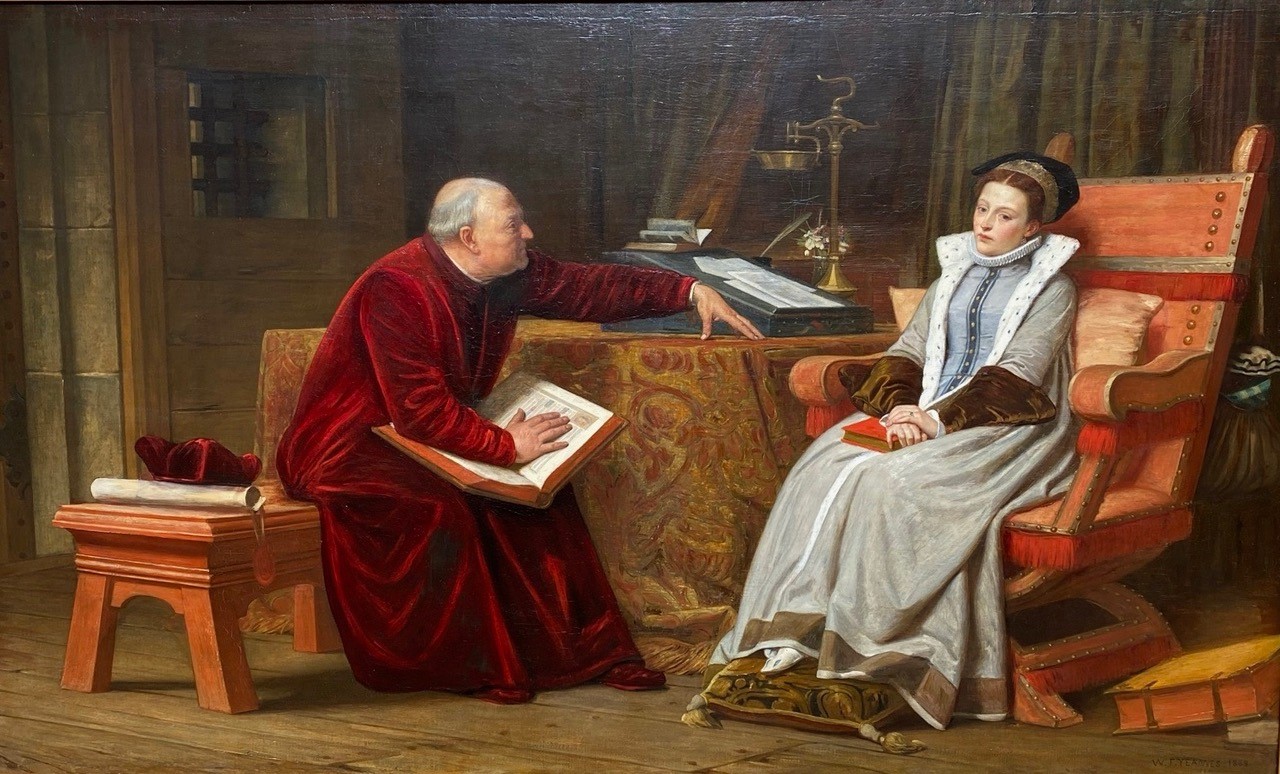
Lady Jane Grey in The Tower
1868
William Frederick Yeames
Oil on Canvas
35×61 inches
© Private Collection

Unfortunately, for the moment we do appear to be missing that smoking gun to be able to determine if indeed the above painting was the final painting exhibited by Yeames in 1868 or another preparatory work.  No dimensions of the final version were listed in the exhibition catalogue, and unfortunately the only reference to its actual size is a comment from 1903, noting that the completed image was ‘bigger than the preparatory painting’[8].  The artists signature and date of 1868 can clearly be seen in the bottom right-hand corner of the above image provided and this second version is considerably larger than the preparatory painting, which certainly suggests that this was indeed the final version exhibited at the Royal Academy. 

Detail Image showing Yeames signature and date

There does appear to be some major adjustments made to the background and figure of Jane, when compared to the preparatory painting. However, Yeames certainly spent a lot of time and effort in working out the composition of his final image and this is to be expected when comparing preliminary drawings to final compositions.

During a search of the auction records, I was able to track one previous owner of either this version or the preparatory painting. On 9th July 1875, an auction took place at Christie, Manson and Woods, London.  The sale lasted two days and consisted of 280 lots belonging to the recently deceased W.E.J Roffey, Esq of Bloomsbury Square, London. Roffey was an avid picture collector, acquiring a large collection of paintings produced by modern artists of the day, particularly those who had exhibited within the Royal Academy exhibition. Listed among the 280 lots are four works by William Frederick Yeames, including

‘Item 237 W. F. Yeames, ARA, 1867 – Lady Jane Grey in the Tower – Exhibited at the Royal Academy, 1868’[9]

Item 237, sold for twenty-seven pounds, however, once again the important factor of measurements is missing from the catalogue.  The catalogue does state that this was the version exhibited in the 1868 exhibition, however the date of 1867 printed next to the artists name does raise the question as to whether this could possibly be the preparatory painting which we do know was indeed dated to 1867. 

Further research does need to take place to locate more information regarding the provenance of this newly surfaced version of Lady Jane Grey in The Tower.  And, to try and establish if indeed the painting sold in 1875 was the final version or the preparatory painting, possibly purchased by John Newton Mappin for his collection.  I would like to convey my thanks to the current owner of this painting for giving me the opportunity to see his version and publish it in this article on the missing Yeames painting so it can be seen by others with an interest in Jane.  This second version is truly beautiful, and I for one, can now see why Yeames received so much praise for this work when it was exhibited.  

I do hope to be able to fill some of these missing gaps and unanswered questions during future trips to the archives so please keep an eye out for further updates on this work.  


[1] Burk. Emily, The Annual Register: A Review of Public Events at Home & Abroad for The Year 1868, page 317

[2] Hamerton. Philip, The Portfolio an Artistic Periodical, 1871, page 83

[3] Thomas. Alfred & Lewis. Leopold, The Mask, Volume I, 1868, page 133

[4] Meynell. Wilfred, The Modern School of Art, W.R Howell & Company, 1886, vol I, page 206- 215

[5]City of Sheffield, Mappin Art Gallery Catalogue of the Permanent Collection and Other Works of Art, 1903, Page vi-viii

[6] Fuller. Thomas, The History of the Worthies of England, 1840, vol 3, page 375-376

[7] Email communication between author and owner, 2021-2022

[8] City of Sheffield, Mappin Art Gallery Catalogue of the Permanent Collection and Other Works of Art, 1903, Page 15

[9]Christie, Manson & Woods, Modern Pictures, 9th July 1875, page 24

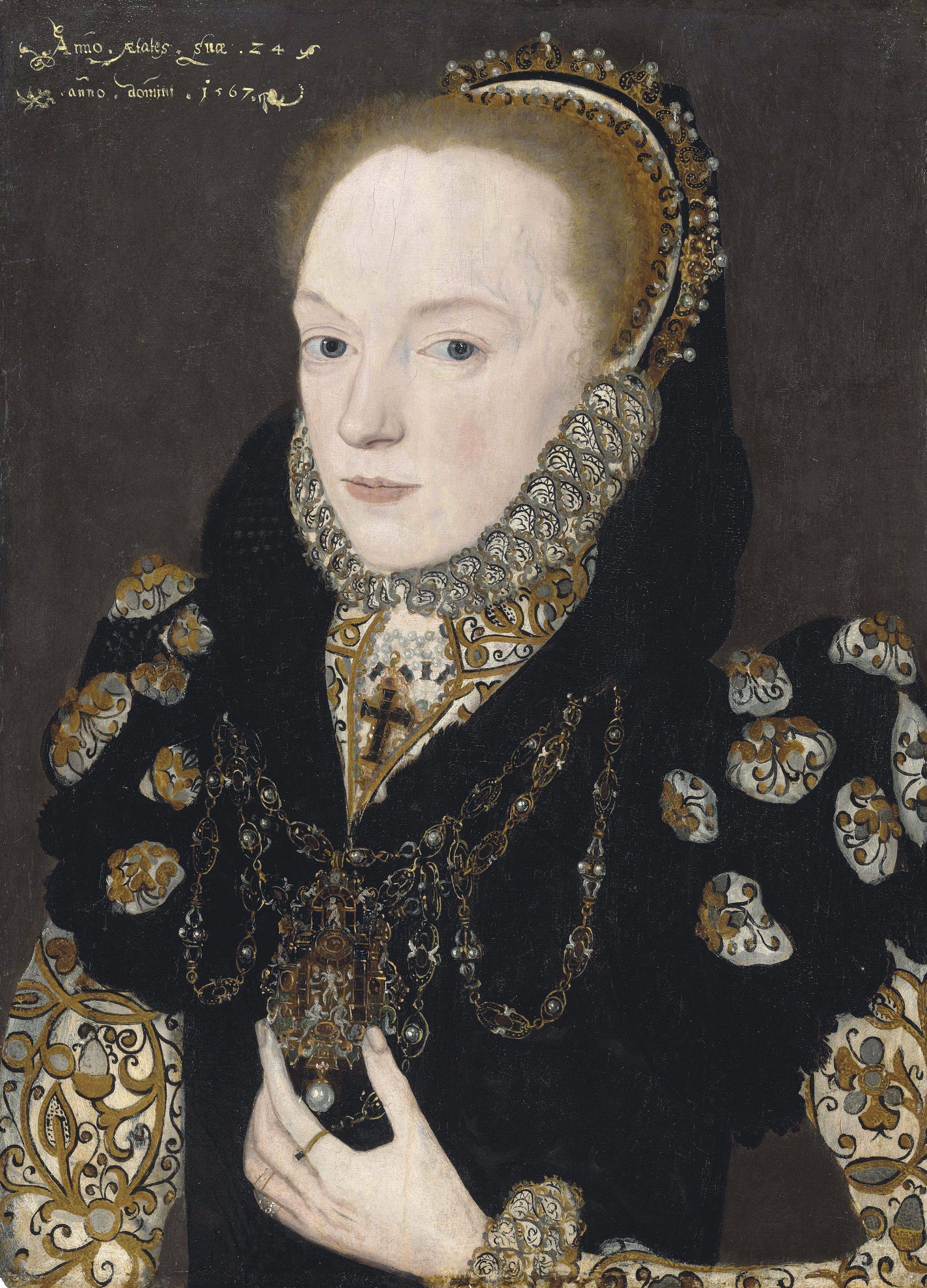
The Arkwright Portrait

Katherine De Vere
Oil on panel
18 1/2 X 13 3/4 inches
(c) Private Collection

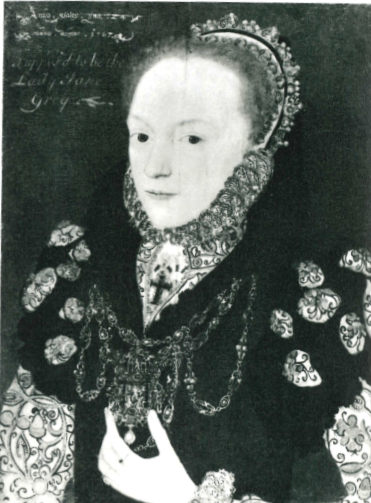
Sold at Christie’s auction, London, on 9th December 2016, lot 151 was rightfully described as a portrait of Katherine de Vere, Lady Windsor (1540-1600) and associated to the artist known today as Master of The Countess of Warwick.   What is not commonly known about this painting is that prior to the 1960’s, it was thought to depict Lady Jane Grey. Due to this painting once being associated with Jane Grey, I have decided to discuss it on this website.  This portrait is a good example of how Jane Grey’s name was applied to a sixteenth century portrait, depicting a female sitter, even if the inscription detailing facts about the sitter did not match with what was known about Jane.   

The Arkwright portrait shows a lady, painted to just above the waist and facing the viewer’s left. She has auburn hair that is pulled away from the face, and her eyes are blue.  The sitter wears a black loose gown/night gown, with large puffed short sleeves and a high collar.  This style of gown was popular in England from the 1530’s onwards. It was worn as an alternative to the tight-fitted French Gowns with the low square necklines and large sleeves.  Generally worn over a kirtle by both the middle and upper class lady, this gown was easier to put on independently due to its front fastening and was a comfortable gown to wear during the day or when in the bedchamber as informal wear. During the 1560’s the loose gown became tighter and more fitted around the bodice, much like that seen in the Arkwright portrait.  An embroidered chemise is also seen worn under the gown. This is embroidered using black and gold thread and incorporates the use of an acorn within the design.  A small figure-of-eight ruff is worn surrounding the face.  This is also embroidered with black work and gold thread.  On her head, she wears a French hood with an upper and lower billament of goldsmith work containing gemstones and pearls. The traditional black veil is also visible falling from the back of the hood.  A small cross suspended from a pearl necklace is seen at the neck, and she holds with her left hand a large pendant suspended from a larger necklace of goldwork.  The sitter is depicted in front of a brown background, and a contemporary inscription in the top left-hand corner has been added identifying the sitter’s age as twenty-four and the year as 1567.

The artist associated with the Arkwright portrait is an anonymous painter who is known to have produced several portraits of female sitters during the second half of the sixteenth century.  We do know that he worked in England between the years of 1567-1569 and that he also painted a portrait of Anne Russell, Countess of Warwick, now at Woburn Abbey.  As a result, other works thought to have been produced by this artist are simply grouped under the attribution of “Master of The Countess of Warwick.”

Early photographic image showing Lady Jane Grey inscription.
(c) Heinz Archive

The only evidence I have been able to locate to date which shows us that this painting was indeed thought in the past to depict Jane Grey is an early photographic image stored in the Heinz Archives, London.[1] This photograph shows the Arkwright painting prior to modern cleaning and restoration.  What is seen from the above image is that an inscription was added to the panel surface on the left-hand side at some point to inform the viewer that this portrait was supposed to be of Lady Jane Grey.  This inscription no longer survives on the panel surface today.  This suggests that during the recent cleaning process it was identified to be a much later addition, and it was removed from the surface.   

As with many of the other portraits thought to represent Jane Grey, no information has been located about the Arkwright portrait to inform us, the modern-day viewer, when and why this painting was thought to depict her.  It is possible that her name was simply attached to the Arkwright portrait in the nineteenth or early twentieth century due to a high demand and need for a physical image of Jane Grey. During the nineteenth and twentieth centuries, Jane’s popularity was at its height. Many published biographies, plays, and paintings depicting various scenes from her life were created during this period.  This in turn made Jane’s story more accessible to the viewing public and in some cases captured people’s interest in her as a historical figure. Her popularity then created a demand for her image and allowed owners of various portraits that fitted with what was being recorded at that time to attach her name to their painting with no evidence to support this.  Today, some of these portraits are now being re-evaluated due to easier access to documentation, a better understanding of the progression of fashion during the sixteenth century, and new scientific techniques which were not available during the earlier periods.

What is clear from the early photograph of the Arkwright portrait is that the identification as an image of Jane Grey was made with very little thought.  The inscription clearly indicates the sitter’s age as twenty-four and the year as 1567.  Both the age and the date are inconsistent with Jane Grey. It may have been possible that the owner who had the Jane Grey inscription applied to the panel surface may have thought the earlier inscription to be false and a later addition.  This cannot be known for certain due to missing documentation.  Jane Grey’s birth has over the centuries been debated by various writers due to lack of documentation, and no exact date is known. It was commonly known and recorded, however, that she died in 1554 and was sixteen/seventeen years old at the time of her death.  This does bring about the question as to why her name was attached to a portrait with incorrect information.     

In a book published by Roy Strong in 1969 entitled The English Icon the provenance for the Arkwright portrait was briefly discussed[2].  Strong records that the portrait was once in the collection at Hampton Court, Herefordshire and that by 1969 the portrait was in the collection of David Arkwright Esq, who was noted to live at Kinsham Court.   

Hampton Court Castle, as it is known today, dates to the fifteenth century and was home to the Coningsby family from 1510 until 1810. The castle and estate were then purchased by John Arkwright (1785-1858), the great grandson of the cotton-spinning industrialist Sir Richard Arkwright.  The estate remained in the family until it was sold by Sir John Stanhope Arkwright (1872-1954) in 1910.  John Stanhope Arkwright then purchased Kinsham Court, Herefordshire, and it appears he had taken the portrait with him. David Lyndon Arkwright (1911-1983) inherited Kinsham Court from his father in 1954. He died without ever marrying or producing issue in 1983, leaving Kinsham Court and its contents to his mother’s great niece Mrs. Susan Wood.

Two years after Susan Wood inherited Kinsham Court, the portrait appears for the first time at auction on 19th July 1985, when it was sold by Christie’s Auction House, London as a portrait of Katherine de Vere. By 2016, the portrait was once again up for public auction, and it was again described as a portrait of Katherine de Vere, Lady Windsor[3]

Edward Lord Windsor and Family
(c) Marquess of Bute

It appears that prior to 1969 the Arkwright portrait was compared to an almost identical image thought to be by the same artist and now in the collection of the Marquess of Bute. That painting uses the identical individual portrait image seen in the Arkwright portrait, though the sitter is painted three quarter length and is incorporated into a family group.  The Bute Family Portrait includes a contemporary inscription made by the artist identifying the year in which the portrait was painted and the sitter’s ages.  A later inscription has also been added to the panel surface that identifies the sitter’s as Edward Lord Windsor, and his lady, daughter to the Earl of Oxford. Their children, Lord Frederick Windsor, Lord Thomas Windsor, and two younger brothers.  Though this inscription is a later addition, it does appear to be an early one.  In some cases, inscriptions that included the names of the sitters where applied to a portrait at some later period in time by other family members in hopes of fixing the identities of the sitters depicted before they passed from living memory.  This is very similar to what we do today with photographs of loved ones.  Though Edward Windsor’s lady is not named within this description, he did marry Katherine de Vere in 1555.  Katherine de Vere was the daughter of John de Vere, 16th Earl of Oxford, who is also noted in the inscription, it was then decided that the Arkwright portrait was mostly likely to depict Katherine de Vere and not Lady Jane Grey.


[1] NPG018643, Artist Box, Master of The Countess of Warwick

[2] Strong, Roy, The English Icon, Elizabethan and Jacobean Portraiture, 1969, page 108

[3] https://www.mutualart.com/Artwork/Portrait-of-Katherine-de-Vere–Lady-Wind/D25D6374F8362979 accessed, 10th April 2019

The Stowe House Portraits

During the early nineteenth century, a small number of portraits at Stowe House in Buckinghamshire were described as representing Lady Jane Grey.

Today, Stowe House is a Grade I listed building that is open to the public for tours and that also incorporates a private school.   It was the former home of the Temple-Grenville family and George Nugent Temple-Grenville, who was created the 1st Marquis of Buckingham in December of 1784.  The house passed through descent down the family line.  Various auctions of some of its contents took place due to financial issues, and the family eventually sold the property in 1921.

The Manuscript Room Miniature Portrait

Early in the nineteenth century houses across the country began to open their doors to visitors who were able to take a tour of the buildings for a small fee. A descriptive catalogue of Stowe House and Gardens was printed in 1817 and sold for the use of tourists.

Described in this catalogue and referred to as being displayed over the chimney in the Manuscript Room is a miniature portrait thought at that time to be a representation of Lady Jane Grey.  The Catalogue reports that the miniature, along with several other miniature portraits, including one thought to depict Jane Seymour and another of Thomas Seymour,

Came into the possession of Mrs. Grenville from the collection of her grandfather Charles, Duke of Somerset.[1]

The Mrs Grenville mentioned is Elizabeth Grenville (1717-1769), daughter of Sir William Wyndham and his first wife Lady Catherine Seymour.  Elizabeth married George Grenville (1712-1770) in 1749 and was mother to George Nugent-Temple Grenville 1st Marques of Buckingham. She had inherited a small amount of money from her grandfather Charles Seymour, 6th Duke of Somerset, and it is possible that she had also inherited the miniature portraits as well.

Called Lady Jane Grey by Robert Cooper
Taken From The Manuscript Room Miniature
(c)Heinz Archive London

No description of the miniature thought to depict Lady Jane Grey is given in the 1817 catalogue, but it was engraved by Robert Cooper (died 1828) in the early nineteenth century, along with the other two portraits thought to depict Jane and Thomas Seymour.  These engravings survive today, and inscribed on each engraving beneath the image is a statement that the originals are in the possession of the Marquis of Buckingham at Stowe.

What is clearly seen from this engraving is that the miniature portrait thought in 1817 to depict Jane Grey is based on the pattern used to create NPG4451, the Hastings portrait and the Jersey Portrait. The distinctive crown headed brooch is seen in the engraving of the Manuscript Room Miniature worn pinned to the front of the sitter’s bodice, and this brooch also appears in NPG4451, the Hastings portrait, the Jersey portrait and the Van de Passe Engraving.  The brooch was used in 1997 as the focus for the reidentification of NPG4451 as a portrait of Katherine Parr.  Today, all portraits relating to this pattern are now thought to be a depiction of Katherine Parr rather than Jane Grey, and therefore this rules out Jane Grey as the possible sitter in the Stowe House miniature portrait.    

It does appear that this miniature was sold on March 15th, 1849 as part of the large thirty-seven day auction of the contents of Stowe House facilitated by Messrs. Christies and Manson.  It appears in the original catalogue for this sale, under the miniatures section referring to Royal Personages.

Item 3. The Lady Jane Grey, in a crimson dress.[2]

An annotated copy of this catalogue in the collection of the Heinz Archive, London, records the buyer of the miniature as “Lagrange or La Grange.”[3]  I have been unable to locate any other information regarding the current whereabouts of this image.

The West Stairs Portrait

The second portrait to be discussed appears in the 1849 sales catalogue for the contents of Stowe House and is described as:

Item 372. A portrait called Lady Jane Grey[4]

This portrait was displayed on the west staircase and was documented in the sales catalogue as being purchased by a R. Berkeley, Esq, who also purchased several other paintings at this sale. As the portrait is documented as “called” Lady Jane Grey in the catalogue description, this suggests that some doubt was expressed in 1848 about the identity of the sitter.

Called Lady Jane Grey (c) British Museum

Robert Berkeley Esq (1794-1874) of Spetchley Park, near Worcester, was a descendant of an aristocratic family dating back to the Norman conquest of England in 1066. The Berkeley family owned a large amount of land including Berkeley Castle in Gloucestershire, which still belongs to living descendants today.

An engraving dating to the nineteenth century that is now in the collection of the British Museum depicts a portrait of a lady wearing clothing that dates to a period much later than that of Jane Grey’s lifetime.  This engraving is inscribed at the bottom in pencil. The inscription identifies the sitter as “Lady Jane Grey/ The Marquis of Buckingham/ Private plate”.  The Engraving was bequeathed to the British Museum in 1868 from the collection of a Felix Slade (1788-1868), who is known to have been a keen collector, acquiring a large collection of books and prints during his lifetime.

Called Lady Jane Grey (c) Private Collection

Email communication with the Berkeley estate has confirmed that a portrait matching this engraving and thought to represent Lady Jane Grey is still in their collection today and appears for the first time in an inventory taken in 1893. 

What can be seen from the photographic image of this painting is that the lady depicted most definitely dates to a later period than that of Lady Jane Grey’s lifetime.  The costume the sitter is wearing is not consistent with the style worn in England during the period in which Jane Grey was alive.  The portrait dates to the 1650’s when the large ruffs worn across Europe during the earlier periods were being replaced with the plainer broad lace or linen collar. The elaborate French fashions worn previously during the reigns of James I and Charles I were by this later period becoming more sombre in style and colour.

This portrait also appears continental in style and is probably Dutch in origin. The west stair portrait is close in comparison to a number of portraits by Netherlandish artists such as Rembrandt van Rijh (1606-1669) depicting female sitters in the same manner and a similar style of costume. Though difficult to see in the photographic image, the hood worn by the sitter is similar in style to that seen in several portraits of Dutch origin dating to the middle of the seventeenth century.  Catrina Hooghsaet wears a similar hood without the attached vail in her portrait by Rembrandt van Rijn in 1657. During the 1660’s, in England, Ladies began to embrace the fashion of wearing their hair curled and pinned up with the use of jewels as embellishment rather than wearing a hood that had been popular in the past.

How the West Stairs portrait became known as a portrait of Lady Jane Grey is unknown, and it is highly unlikely that this portrait was painted to represent Jane Grey in the first place. It is possible that her name was simply attached to the portrait due to the plainness of dress depicted or that the frame used for this portrait, which also includes the inscription identifying the sitter as Jane Grey, was simply reused from another portrait thought to represent her. It can now be removed from the list of potential likenesses as it dates to a period of some ninety years after her death and therefore cannot be an authentic likeness.

The East Hall Portrait

The third and final portrait to be discussed appears in the 1817 descriptive catalogue from Stowe House. This book records another portrait thought to be Jane Grey in the “passage of the east hall” at Stowe.  The portrait is simply referred to as:

Lady Jane Grey (original).[5]

No further description is given of the painting. Since some of the other portraits are explicitly described in the catalogue as “full length,” and this one is not, it does suggest the possibility that this painting was less than full length, perhaps three quarter, half, or bust length. The use of the term “original” also indicates that in 1817 this portrait was deemed to be old.

As yet, I have been unable to track the current whereabouts of this portrait.  I have been able to locate a further two references to a portrait of Lady Jane Grey in the collection of The Marquis of Buckingham that could possibly be this particular painting, however.  These do give us more details as to what the portrait actually looked like, and when investigated further, these also give us some indication as to whether or not this portrait was a painting of Lady Jane Grey.

The first reference appears in the appendix of Richard Davey’s 1909 biography on Jane Grey.  Davey describes an engraving of the portrait as:

Lady Jane Grey. From a portrait in the possession of the Marquis of Buckingham. She wears a velvet gown open at the throat to display a double chain with a pendant cross. On table, large gold chalice.[6]

Since this description is inconsistent with the West Stair portrait and Manuscript Room Miniature, also thought to be Jane Grey, it is possible that the source used by the unidentified engraver was the “original portrait in the passage of the east hall.”  The description given by Davey of the East Hall Portrait is of interest as he does give us a little more information as to what this image looked like.

Another clue appears in 1917, in a magazine article published in the Musical Courier, which discusses the discovery of the then lost Pryor’s Bank portrait thought to represent Lady Jane Grey.  The article reports:

A portrait somewhat similar, in which this same chalice figures, is in the collection of the Marques of Buckingham.[7]

From the above descriptions, we see that the East Hall Portrait was probably similar in look to the Pryor’s Bank portrait.  Since no image has as yet been located, I am unable to discuss the similarities in-depth.  However, what is seen from the descriptions is that both the Pryor’s Bank Portrait and the East Hall portrait included a depiction of a chalice within the composition.

It is possible that an authentic portrait of Jane Grey could have been painted that included the use of a chalice within the composition.  This does not, however, fit with the general style of other portraits produced of female figures painted during her lifetime.  A number of portraits from this period show that females where generally depicted by artists in front of a plain background or cloth.  This was done to enable the depiction of the sitter to be the most prominent part of the painting.  Latin inscriptions that identified the sitter age and date in which the portrait was painted were generally added by the artist, and in some cases a motto or coat of arms as well.  Some paintings do survive which also demonstrate that female sitters were also depicted within a domestic surrounding that included objects within the composition. These paintings including one of Princess Elizabeth, now in the Royal Collection, and another of Lady Mary Dacre.  They are rare and are not as common as those depicting a sitter in front of a plain background.

Since the description of the East Hall portrait mentions the use of the chalice, I personally err on the side of caution when looking at this information.  As discussed in previous articles, the iconography of Jane Grey is a difficult and complex subject due to the large number of portraits and the little information surviving about them.

It does appear that over the years several paintings once identified as being of Jane Grey have turned out to be representations of Mary Magdalene when studied further.  As discussed in my article on the Pryor’s Bank portrait, the use of the golden chalice in the iconography of Mary Magdalene was popular and was used along with other artefacts depicted in the paintings as a form of symbolism.  Mary Magdalene was commonly portrayed alone, in isolation reading, writing or playing the lute.  The chalice was commonly used to symbolise the jar of oil used to wash the feet of Jesus. The Symbolism used within depictions of the Magdalene is similar to the description given by Roger Ascham in his book The Schoolmaster of Jane sat alone at Bradgate reading Plato.  This description was commonly used during the nineteenth and twentieth century by authors and artists when discussing and depicting Jane to demonstrate that her love of learning had isolated her from her family, who Ascham notes were out hunting at the time of his visit.

Althorp Portrait Called Lady Jane Grey in 1817 Engraving appeared in Bibliographical Decameron by Thomas Frognall Dibdin

One possible reason for the number of portraits depicting the Magdalene being confused for that of Jane Grey is the publication in 1817 of the engraved image of a painting that is known today as the Althorp Portrait. That image appeared in a book entitled Bibliographical Decameron by Thomas Frognall Dibdin (1776-1847). That engraving was based on a portrait in the collection of Spencer family at Althorp house which at that time was thought to be of Lady Jane Grey. That portrait also incorporated the use of a golden chalice within the composition. Today, it is now thought that this painting is a depiction of Mary Magdalene. In 1817, Dibdin stated in the footnote of his book that,

This is the only legitimate portrait of Lady Jane Grey that has yet been made public[8]

This then allowed others who may have owned a similar portrait depicting a sixteenth century lady close to Jane’s age, reading and with a chalice, to then attach her name to their painting.    

Until the East Hall portrait is located, it cannot be known for certain whether It is a possible image of Lady Jane Grey or another portrait of Mary Magdalene that Jane’s name had been associated with.  

The Jersey Portrait

Stowe house had a fourth portrait in its collection that in time was to become associated with Lady Jane Grey. It is known today as the Jersey portrait.

The Jersey Portrait
Katherine Parr
(c) The Earldom of Jersey Trust

This portrait was purchased from the Pryor’s Bank sale on May 3rd 1841, where it was described in the catalogue as:

Item 509. A panel painting, Queen Mary I., in carved guilt frame[9]

The painting remained in the Stowe collection, where it was hung in the Private Dining Room. It is described in the Stowe auction catalogue as:

290 Queen Mary, in a black dress, with richly ornamented sleeves-(Holbein)[10]

The annotated catalogue records the buyer of this portrait as a Mr J. Oxford Ryman, and within the same year of the sale this painting ended up in the collection of the Countess of Jersey.  Initially it was thought to have been destroyed by fire in 1949, but recent research completed by John Stephan Edwards has confirmed that this portrait did indeed survive the fire. 

The Jersey Portraits identity as an image of Lady Jane Grey originates with the purchase of NPG4451 by the National Portrait Gallery, London, in 1965.  Newspaper clippings from the late 1960’s show that almost immediately Roy Strong, Director of the National Portrait Gallery, compared NPG4451 to the Van de Passe engraving, thought at that time to be the only authentic image of Jane Grey, and a portrait in the collection of Lord Hastings, which had been associated with Jane’s name for many years.  By 1969, Roy Strong published his book Tudor and Jacobean Portraits, in which he also discussed the Jersey portrait under the heading Authentic and Possibly Authentic Portraits. Strong noted similarities between the Jersey portrait and the other images connected to NPG4451 and tentatively suggested that the Jersey portrait was also related to this set and must therefore also be another image of Jane Grey.  At that time, Strong also reported that the “face is that of a much older woman.”[11]  He dismissed the identity of it being a portrait of Queen Mary I, however, and tentatively put this down to bad restoration.  He also noted that the Jersey portrait had been destroyed by fire and that further research was unable to take place.     

Research produced and published by Susan James in January 1996[12] has now established that some of the jewels worn by the sitter in NPG4451 appear in inventories made of Katherine Parr’s jewels in 1550.  By June of 1996, the National Portrait Gallery then opted to reidentify NPG4451 as a portrait of Katherine Parr and not Lady Jane Grey, as all evidence indicated that the sitter depicted was most likely to be Katherine Parr. This in turn allowed the other portraits connected with this pattern to also be reidentified as Katherine Parr.

UPDATE: 20th November 2019

The West Stair Portrait is to be sold from the Berkeley collection on 11th December 2019 by Sotheby’s Auction House. The portrait is referred to as ‘A Portrait of A Lady, Manner of Rembrandt’. Materials are listed as oil on panel and measurements are given as 28 1/4 x 22 inches.

Digital Resource:

https://www.sothebys.com/en/buy/auction/2019/spetchley-property-from-the-berkeley-collection/manner-of-rembrandt-portrait-of-a-lady-half-length


[1] Stowe A Description of The House and Gardens, 1817, page 52

[2] Catalogue of The Contents of Stowe House, Messrs. Christie and Manson, 1848, page130

[3] Heinz Archive: NPG125400

[4] Foster, Henry, The Stowe Catalogue Priced and Annotated, 1848, page178

[5] Stowe A Description of The House and Gardens, 1817, page 36

[6] Davey, Richard, Nine Days Queen, Lady Jane Grey and Her Times, 1909, page 362

[7] Musical Courier, Namara Discovers Valuable Portrait, 8th November 1917, page 43

[8] Dubdin, Thomas, The Bibliographical Decameron, 1817, page 250

[9] Mr Deacon, Pryor’s Bank Sales Catalouge, 3rd May 1841, page33

[10] Foster, Henry, The Stowe Catalogue Priced and Annotated, 1848, Page176

[11] Strong, Roy, Tudor and Jacobean Portraits, 1969, volume I, page 78-79

[12] James, Susan, Lady Jane Grey of Queen Katheryn Parr, Burlington Magazine, vol. 138, January 1996, Page 20-24

The Duff House Portrait

Among the index cards referring to portraits of Lady jane Grey in the Heinz Archive, London, is a card recording a portrait of her once in the collection of the Earl of Fife.  Until recently this portrait was thought to have been lost, and to my knowledge it has not been studied by historians or exhibited in any public exhibition as a representation of her.

The first record regarding this image located today was published in a privately printed book from 1798.  The book details the large collection of paintings and portraits belonging to James Duff, 4th Earl of Fife (1776-1854) across his various properties.  Recorded as being displayed in the large drawing room at Duff House, an eighteenth-century estate house designed for the family by William, Adam is a portrait of Lady Jane Grey.   The entry reads    

item 18. Lady Jane Grey – half length. This unfortunate lady was forced to accept the crown, 5th July 1553, and was beheaded 12th February, 1554. She was daughter to Henry Grey, Duke of Dorset, by Lady Frances Brandon, by Mary queen of France.  She was remarkable for her learning and virtue.  Her husband, Lord Guildford Dudley, was beheaded on the same day.  Zucchero.[1]

This description is vague and gives us very little detail about the actual painting itself. The description does give us our first clue that this painting was not a portrait of Lady Jane Grey, however.  The artist recorded as creating the painting is a “Zucchero,” which suggests the portrait was later in period than that of Jane Grey’s lifetime.

Federigo Zuccaro (c.1540 – 1609), as he is better known, was an Italian artist who first visited England in 1574.  During that visit he was commissioned by Robert Dudley (Jane’s brother in law) to paint an image of himself and Queen Elizabeth.  Compositional drawings for both portraits survive today in the collection of the British Museum.   If the Duff House portrait was painted by this artist, then it could not have been an authentic image of Jane Grey since she had died some twenty years earlier.

Duff House remained in the possession of the Earls of Fife until 1906.  The property was then gifted to the village of Banff Burgh in which the house was built by the then Duke of Fife, Alexander William George Duff (1849-1912).  Alexander Duff had inherited the property and its contents by descent, and when marrying Princess Louise in 1889, he no longer required the property as a principal residence.  Though he did donate the building for the use of the people of Banff, its contents were sold off through auction.  The auction was facilitated by Messrs. Christies, Mason and Woods and took place on 7th June 1907.  The auction catalogue for this sale records that all “pictures are part of a very large collection which was made by James, Earl of Fife towards the end of the eighteenth century and all were displayed at Duff House.”[2]  A portrait thought by the family to depict Lady Jane Grey in 1907 was also included in this auction, and the catalogue does give us our first detailed description.

item 43 Lucas De Heere, portrait of Lady Jane Grey, in rich flowered bodice with lace cuffs and collar, green skirt and crimson robe, lace headdress with red bows.  Holding a kerchief in her left hand and leaning her right arm upon the back of a chair.  On panel 41 ½ x 29 ½ inches[3]

Though the artist associated with this work had changed since the 1798 reference, it is possible that the portrait sold in 1907 was the same image as that described as being Jane Grey in the earlier book. 

I have as yet been unable to locate any reference regarding who purchased the painting at the 1907 sale.  Due to this, I am unable to track fully the documented provenance from this portrait, though I do have a suggestion.

A portrait matching the above description does show up in 1908, one year after the Duff House sale. This painting is described as being in the collection of French collector and gallery owner Edward Brandus (1857-1937).  Brandus was well known for purchasing Old Master portraits at a low price and then selling them on to other collectors via his gallery in New York.   The magazine “American Art News” dated 28th March 1908 records the painting in his collection as a portrait of Lady Jane Grey by Antonis Mor Van Dashorst[4].  A photograph of the portrait was also included in the article, and though it is not clear from the poor quality image, when magnified this image does show a female sitter with a flowered embroidered bodice, holding a kerchief in her left hand and leaning her right arm upon the back of a chair as described in the 1907 auction catalogue. Various bows are also seen around the headdress and down the front of the bodice, like those mentioned in the catalogue of 1907. This then gives us the impression that this painting was the portrait sold from the Duke of Fife’s collection.

Lady Jane Grey by Antonis Van Dashorst-Edward Brandus Collection 1908

This painting was then sold by the Edward Brandus Gallery in April 1908. It eventually ended up in the collection of a “Mrs Flake” and was subsequently purchased as a portrait of Lady Jane Grey by John George Graves, an English collector, at Christie’s auction in July of 1930.[5]

In 1935 Graves gifted this portrait along with others from his collection to the Museum of Sheffield.  The painting remains in the museum’s collection today, though it is rightfully catalogued and referred to as a portrait of an unknown lady rather than its previous title of Jane Grey.

Unknown Lady
oil on panel
41 1/2 x 29 1/2 inches
(c) Museum of Sheffield

When looking at the colour photograph of this image, this portrait is closer in comparison to the description given in the 1907 auction catalogue that also refers to the green skirt and red robe. The measurements of the wooden panel used as the support for the painting also matches the measurements provided in 1907.

Due to the lack of documented provenance for this painting, it cannot be said for certain that this is indeed the portrait described as being that of Jane Grey at Duff House in 1798.  This is the closest image related to the description given in 1907, however, and this painting has also been identified in the past as an image of Jane Grey. 

The costume seen in this painting is again inconsistent with that worn by ladies during Jane Grey’s lifetime, and therefore this is not an authentic portrait of her taken from life or a panting which was created at later period which was meant to represent her.  From the style of clothing worn by the sitter, it appears to date towards the end of the sixteenth century or early seventeenth century.  There is some evidence to state that the embroidered jacket worn by the sitter was in use toward the later decades of Queen Elizabeth I reign, with several being documented in the inventory made in July of 1600 listing clothing stored within the royal wardrobe.  This style of jacket does appear to have become popular between the period of 1600-1620 where it appears in many paintings of female sitters from this time.

Elizabeth Cary?
oil on canvas
c.1610
William Larkin

The ruff also worn by the sitter gives us some indication that this was painted after 1600 as it no longer folds into the figure of eight pleats worn during the reign of Queen Elizabeth and is now seen as a flat collar which was probably heavily starched or suspended using a wire frame or “underpropper,” as it was referred at the time.  The style of headwear seen in the painting is also of interest and does not fit with anything worn by English sitters during this period. This suggests that the painting may possibly be continental in origin, though until testing is done on the pigment used and the painting is studied further this cannot be established.

What this painting does demonstrate is the extreme measures that people would go to when wanting to own a portrait of Lady Jane Grey.  The identification, given to this portrait was done with little research into the period in which she lived, and her name was simply attached to an image that did not really fit with what was known about her at the time.   It is now clear that she can be eliminated as the possible sitter due to the costume worn by the lady depicted.  If the portrait now in the collection of the museum of Sheffield is in fact the painting from Duff House, it can, however, be removed from the list of portraits that potentially depict Jane Grey.


[1]Catalogue of The Portraits and Pictures in The Different Houses Belonging to The Earl of Fife, 1798, page 15-16

[2] Catalogue of Pictures by Old Masters and Historical Portraits, The Property of His Grace the Duke of Fife, Messrs. Christie, Mason & Wood. 7th June 1907, page 2

[3] Catalouge of Pictures by Old Masters and Historical Portraits, The Property of His Grace the Duke of Fife, Messrs. Christie, Mason & Wood. 7th June 1907, page 10

[4] American Art News, Volume 6, No 24, March 28, 1908, page 24

[5] Electronic communication, Museums of Sheffield, 31st May 2018