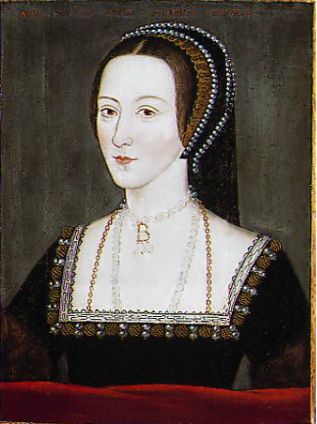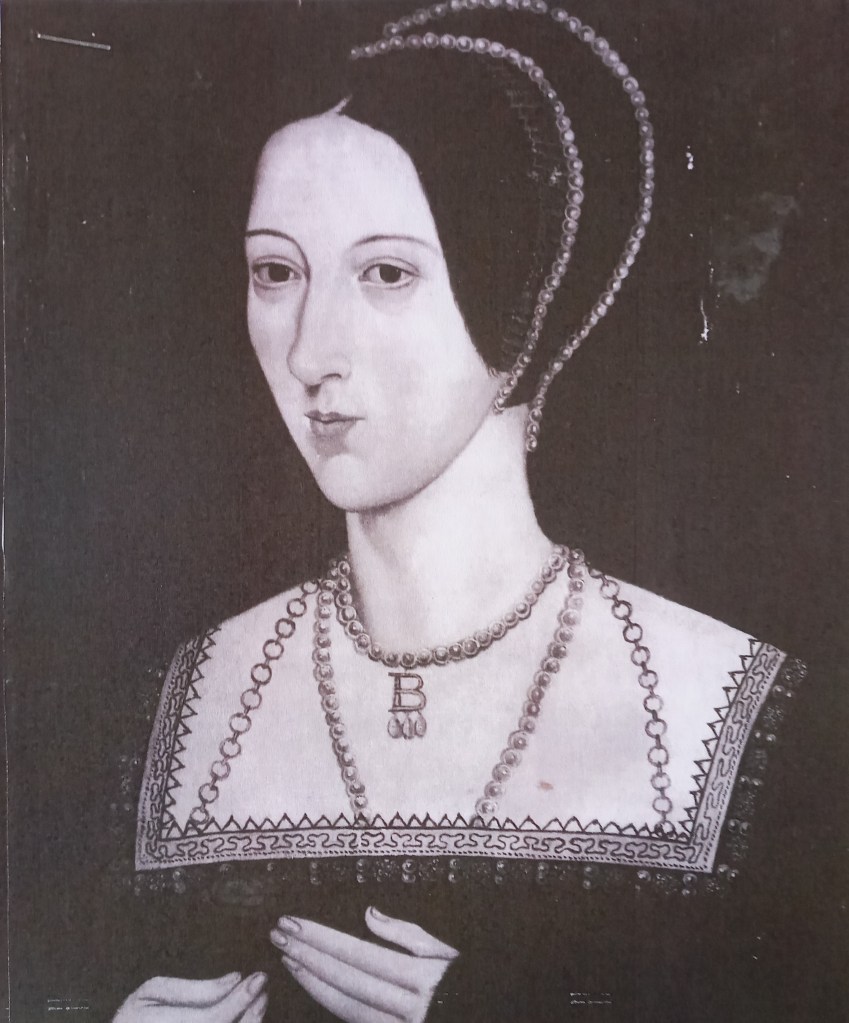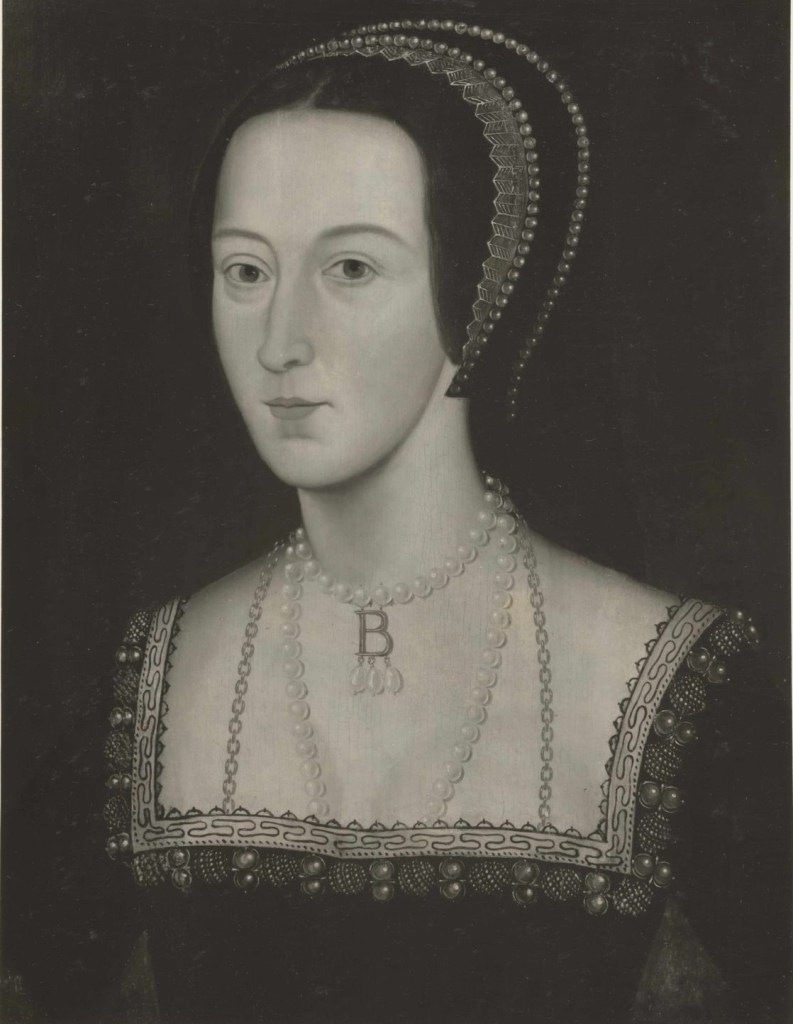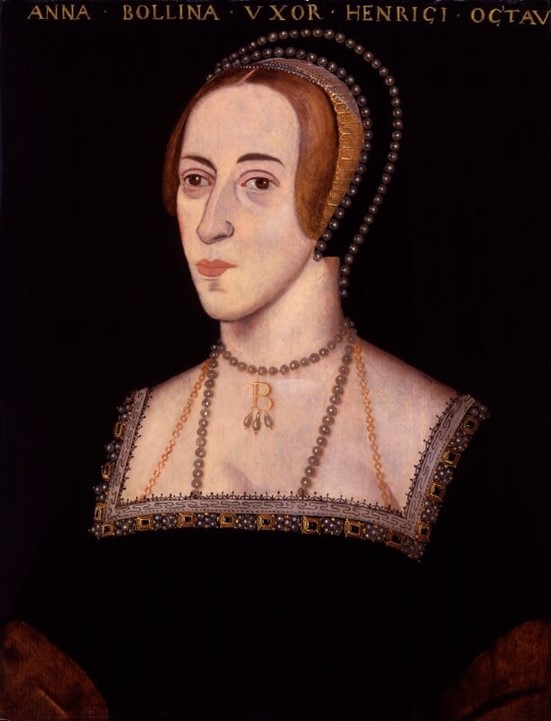
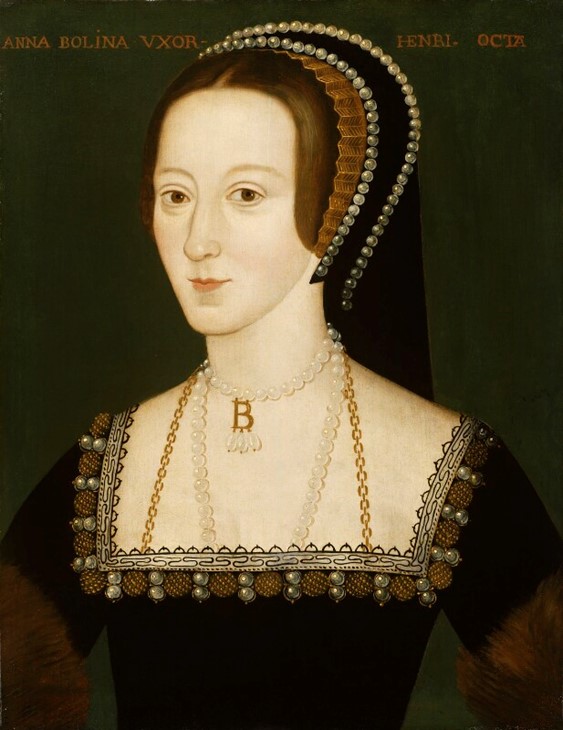
The Hornby Anne Boleyn

NPG 4980 (15)
Anne Boleyn
Oil on Panel
22 ¼ x 17 3/8 inches
© National Portrait Gallery, London

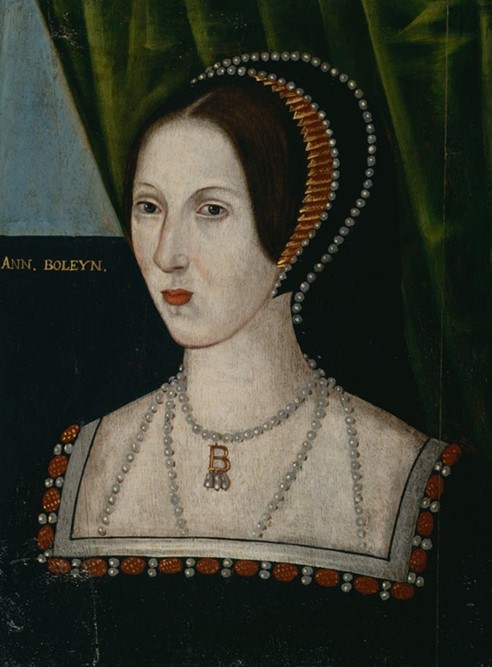
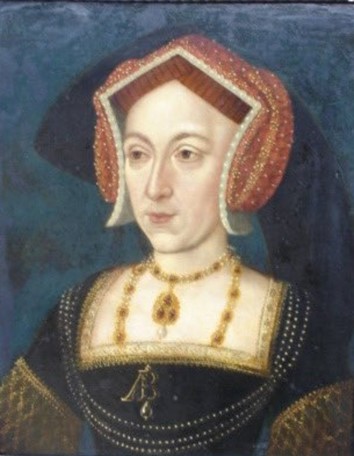
NPG 668 is not the only portrait of Anne Boleyn owned by The National Portrait Gallery, London.  In 1974, the gallery purchased a set of sixteen portrait’s depicting Kings and Queens of England which also included a portrait of Anne.  Though inferior in technique, and artistic quality to that of the now infamous NPG 668, the Hornby portrait or NPG 4980 (15) as it is better known was undoubtably created with the use of the B Pattern.  

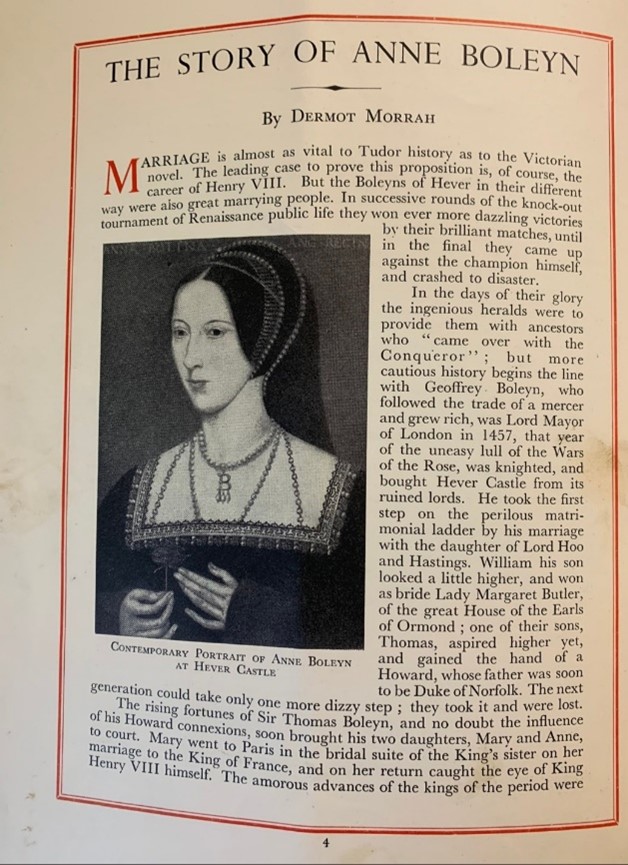
Executed with the use of oil on panel.  The panel support is constructed with the use of two oak boards, seven millimetres thick, and aligned vertically to create one panel measuring 22 ¼ x 17 3/8 inches. The portrait depicts the head and upper torso of an adult female, placed before a plain background with her head turned slightly towards the viewers left. Her face is long, oval in shape, with a high forehead. Her hair is straight in texture, parted in the centre, and pulled back over her ears, and placed under her coif of gold fabric. Her eyes are brown, heavy lidded, and are crooked in appearance. She has full pink lips, an aquiline nose, and her eyebrows are pronounced with a strong shape.  Anne is seen wearing her trademark French Hood, constructed of black fabric, ending just below the jawline, and the black veil is visible hanging down at the back.  An upper billament of thirty-nine white pearls is visible on the back of the hood, and a lower billament of thirty-one pearls is seen at the front of the hood. At her neck she wears two strings of pearls with a large letter B pendant of goldsmith work with three hanging pearls suspended from the upper string.  A chain constructed of loops of square goldsmith work is also seen at the neckline.  Anne wears a French Gown constructed with the use of black fabric, cut square at the neck, and a white chemise, embroidered with blackwork.  Sixteen square cut ouches, each containing a diamond, are attached to the neckline of her kirtle. A further sixteen ouches, constructed of goldsmith work, and five pearls, are also seen in between these.  The turned back sleeves of the French Gown are constructed of a brown fabric, rather than the fur sleeves seen in other depictions.

Detail showing inscription on panel surface.
© National Portrait Gallery, London

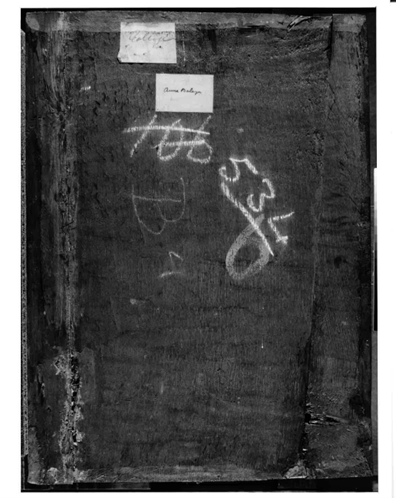
An inscription applied to the top of the panel in a yellow pigment identifies the sitter as ANNA. BOLLINA. VXOR. HENRICI. OCTAV or Anna Bollina wife of Henry Emperor. A handwritten label detailing The National Portrait Gallery registration number has also been applied to the back of the panel. No other inscriptions or labels are visible on the panel surface; however, it must be noted that the reverse of the panel was covered in a layer of balsa wood during early conservation treatment. I have been unable to obtain an image of the reverse of the panel prior to this treatment and I am unable to determine if any labels or further inscriptions lie below this.

Back of NPG 4980(15)
© National Portrait Gallery, London

When purchased by The National Portrait Gallery in 1974, the paintings had come from the collection of George Osborne, 10th Duke of Leeds.  It was recorded that the set had been on display at Hornby Castle, near Bedale. George Osborne died in 1927, and on his death his estate was broken up and eventually sold off.  The portrait set had initially been stored by the National Portrait Gallery in the 1930’s and was later offered for purchase by the 10th Duke of Leeds Trust.[1]

As with many of the portraits of Anne Boleyn seen in this study, documented information concerning them is scarce. In the case of the Hornby Portrait Set, we only start to see it appear in written documents towards the end of the nineteenth century. The first reference appears in 1868, when the collection of portraits was recorded as hanging in two rows in the Nursery Passage at Hornby Castle.[2]

Hornby Castle was originally built by the St. Quentin’s family in the fourteenth century and passed to the Conyers and Darcy families during the sixteenth century.  By 1778, the property then passed into the possession of Francis Osborne, 5th Duke of Leeds, through his marriage to Amelia Darcy.[3]

Due to lack of documentation, it is not exactly known if the set had originated in the Leeds collection and was transferred to Hornby castle from another property. Or, if it had originated with the sixteenth century owners of Hornby Castle and was commissioned for that specific residence.

When purchased by The National Portrait Gallery, a full condition report was undertaken on each of the sixteen portraits included in the Hornby Set. The condition reports held in the registered packet for the portrait of Anne Boleyn identifies that at the time of purchase the left-hand side panel of NPG 4980(15) was in a weak condition due to a splitting of the joint, flaking paint layers and paint loss was also noted to the sitter’s neck and chin, and extensive oil retouching was also observed throughout the portrait.  A thick layer of discoloured varnish was also viable on the panel surface.  

NPG 4980(15)
Before Conservation Work
© National Portrait Gallery, London

Conservation work was commenced immediately on the portrait, to stabilise the panel, secure the joint, and apply a thin layer of balsa wood to the reverse of the portrait. The flaking paint layers were secured with the use of wax resin, and adhesive, and the later overpaint and discoloured varnish was also removed from the panel surface. A gesso filling was applied to the large areas of paint loss, and retouching was completed. The portrait was then revarnished with a conservation varnish.[4]

Though not scientifically analysed until 2011, In 1975, Robin Gibson suggested that the Hornby set was created over a long period of time. He also suggested that the set was made up and purchased as two or three smaller portrait sets, much like that seen with the Dulwich Set.  Gibson separated the paintings into three distinctive groups in terms of date of creation, distinct differences in quality, and composition.

Group A: William I, Henry I, Stephan, Henry II, John, Edward II, was identified as being the later addition to the set, with Gibson estimating a date for creation as circa 1620-30.  

Group B: Edward III, Richard II, Henry IV, Edward IV, Edward V, Anne Boleyn. Gibson identified that Dr John Fletcher of Oxford University had completed Dendrochronology testing on the portrait of Anne Boleyn and Richard III, and a date of 1590-1605 was established as the most likely period in with both portraits were painted. 

Gibson identified Group B and Group C: Richard III, Henry VII, Henry VIII, Mary I, as a standard long gallery portrait set for this period. However, he also noted that Group C: contained a different characterisation in background and a higher quality craftmanship than that seen in the works of group B.  Robin suggested that although group B and C were created at the same time, group C was probably purchased from alternative workshops, and it was Gibson’s dates and theory that was applied by the National Portrait Gallery to the set.[5]

In 2011, the Hornby portrait set finally underwent significant testing as part of the Making Art in Tudor Britian project at the National Portrait Gallery.  During this, all portraits were dendrochronology tested, and it was identified that all panels were made from trees felled in the Eastern Baltic, between the 1580’s and early 1590’s.[6]  Test also carried out on the paintings identified that the portraits were produced by several artists, using different painting techniques, and working across multiple workshops. [7] This suggested that the set was either produced as a single commission, and not added to over the course of time as suggested by Gibson or was assembled at the same time using ready- made paintings from different sellers.

As seen in my article on the Dulwich Portrait set, printed material published at a similar time to the Hornby sets creation also appears to be the source material used by some of the artist when creating the portraits for the Hornby Set. The portraits of William I, Henry I, Stephan, John, and Henry III show visual similarities to the full sheet woodcuts produced by an unknown artist and published in a book entitled ‘A Booke, containing the true portraiture of the countenances and attires of the kings of England’.

First published in London in 1597, by John de Beauchesne, this book pre-dates ‘Bazliologia’, the book thought to have been the source for the Dulwich set, by twenty-one years. Its author, who was only named as ‘T.T.’ is now thought to be Thomas Talbot, who also produced what is now called the Talbot Rose containing similar images of the English monarchs some eighth years earlier in 1589.

Though the importance of accurate historical documentation was still in its infancy towards the end of the sixteenth century, some of the illustration produced for Talbot’s book can today be matched with contemporary source materials depicting the sitter illustrated, which does suggest that the artist who created the illustration at least attempted to reproduce what was thought to be an authentic likeness.

Left: NPG 4980 (2), King Henry I ©National Portrait Gallery, London Right: King Henry I Statue York Minster © Public Domain

When looking for a possible source for the portrait of Henry I, it could be argued that the image seen in the Hornby set shows a strong resemblance to the fifteenth century statue depicting the King at York Minster.  Both the statue and painted image show similarities in the hair, the treatment of the beard, moustache, and the collar of the gown.

Left: NPG 4980 (3) King Stephan ©National Portrait Gallery, London Right: Miniature From Matthew Paris’s Historia Anglorum ©Public Domain

The portrait King Stephan also shows similarities to several contemporary illustrations showing the king with a bobbed hairstyle and beardless.  Stephan is also seen beardless in his profile image on a silver penny from 1136 and is depicted in a full-frontal pose in the illustrated image for Matthew Paris’s ’Historia Anglarum’ produced between 1250 and 1259. Unfortunately, Talbot’s book does not include an image of Anne Boleyn, and it appears that artist who created the Hornby portrait looked elsewhere when depicting this legendary queen.

Sadley, NPG 4980(15) provides little information regarding the evolution of the B-pattern. The portrait is, however, it is one of a small number of paintings created with the use of this pattern that currently has a scientific date attached to it. What we can establish is that both NPG 4980(15) and NPG 668 were produced around the same time, and that both images were seen as, and identified as, an image of Anne by contemporary viewers towards the end of her daughter’s reign.  This image would continue to be seen as a depiction of Anne Boleyn some thirty years later when Edward Alleyn purchased his portrait of Anne for the Dulwich set and continues to be reproduced as an image of Anne Boleyn to this day.


[1] Heniz Archive, National Portrait Gallery, Registered Packet NPG 4980(15)

[2] Catalogue of the Paintings and Portraits at Hornby Castle the Seat of the Duke of Leeds, 1868.  The portrait set of Kings and Queens of England also appeared in subsequent catalogues detailing the collection at Hornby Castle, published in 1898 and 1902, and are again described as hanging in the ‘Nursery Passage’.

[3] Anon, Hornby Castle, Yorkshire, The Seat of the Duke of Leeds, Country Life Magazine, 1906, P 54-64

[4] Heniz Archive, National Portrait Gallery, Registered Packet NPG 4980(15), Technical Examination Report 1974

[5] Gibson Robin. The National Portrait Gallery’s set of Kings and Queens at Montacute House, National Trust Yearbook, 1975, P81-87

[6] Tyers. Ian, Tree-ring Analysis of Panel Paintings at the NPG, Group 4.5. March 2011, Registered Packet NPG 4980(15)

[7] Picturing History: A portrait set of early English kings and queens – National Portrait Gallery (npg.org.uk), accessed October 2023

The Dulwich Portrait of Anne Boleyn

Stored within the large collection of paintings at the Dulwich Picture Gallery, London, and currently on long-term loan to Strawberry Hill House, is a rather unique collection of portraits depicting seventeen Kings and Queens of England. Today, the Dulwich Portrait set is one of the largest sets of portraits, depicting English Monarchs to survive. However, it has received little attention when it comes to the literature concerning the production of portraits sets during the latter part of the sixteenth and early seventeenth century. In this article, we take a brief look at the history of the Dulwich set, examine its formation and possible sources. We will also take an in depth look at the portrait of Anne Boleyn and try to identify its role in relation to her iconography. 

The Dulwich Picture Set
© The Dulwich Picture Gallery

Though, not necessarily known for their artistic quality, the Dulwich Picture set brings with it the unique documentation that allows us to see how and when this collection of portraits was bought.  Originally purchased as a set of twenty-six portraits, all close in size, and, unified visually by the depiction of a blue skyline and a draped curtain in the background.  The collection was bequeathed in its entirety to the Dulwich College by its founder Edward Alleyn in 1626.[1]

Born on 1st September 1566, Edward Alleyn was an English Actor who achieved ‘celebrity status’ in Elizabethan England. In 1592, he married Joan Woodward, daughter of Philip Henslowe, Groom of the Chamber. Alleyn and Henslowe would eventually go into business together and Alleyn would eventually become sole proprietor of several playhouses, bear pits and other rental properties across London.  This made Alleyn a wealthy man, and on 25th October 1605, he purchased the manor of Dulwich, made up of 1500 acres of land and farms from Sir Francis Calton and began to build the College.  Completed on 1st September 1616, God’s Gift College, as it was originally named, was granted a Royal Patent from King James I and, today, is more famously known as the Dulwich College.[2]

Though no inventory survives detailing the collection of Edward Alleyn, the college does have his original diary/account book in its collection. This account book details his expenditure and daily activities between the years of 1617 to 1622, and it offers the unique insight into the purchase and trade of paintings in seventeenth century England.  It also shows us the exact sequence in which Alleyn purchased his portrait set of Kings and Queens of England and how much he paid for them.

In an entry written 29th September 1618, Alleyn records that he spent 200 pounds and bought the first set of paintings.  This entry notes that Alleyn started his set by purchasing the portraits of James I, Elizabeth I, Mary I, Edward VI, Henry VIII and Henry V.[3]  Just nine days later on 8th October, Alleyn returned to purchase another eight portraits of Edward III, Richard II, Henry IV, Edward IV, Edward V, Richard III and Henry VII, thus extending the sequence back to King Edward III.[4]  A gap of almost two years is noted within the account book before Alleyn returned to purchase more paintings. On 25th September 1620, Alleyn purchases the portraits of Edward II, Edward I, Henry III, Richard I and Henry II. [5]    He again returns one last time to complete his set on 30th September 1620, and purchases the portraits of Henry I, Stephan, William I, William II, the Black Prince, and Anne Boleyn. [6]

Alleyn’s handwritten account for the purchase of the portrait of Anne Boleyn
© Dulwich College, London

By the early seventeenth century, when Alleyn was purchasing his set of Kings and Queens, it had become relatively common for people of wealth to purchase paintings or engravings of political, religious, or influential figures.  Artists workshops of the period were producing portrait sets of various qualities, quickly, with much focus on the authentic image and detail.  These paintings were not only to decorate the home, but to also demonstrate loyalty to a specific cause. Today, only a small selection of portrait sets have survived, in some sort of entirety, however, many single paintings, which were once part of a set are now scattered among collections around the world. The publication of a variety of books containing written text and images of historical figures from many different sources began to be published in large quantities during the second half of the sixteenth century, and single-sheet engraved portraits were also becoming widely available for people of less income to collect and artists to copy.

Alleyn’s account book is unclear as to whether he purchased the set for his own home or to be displayed at the college, however, both places would have been a suitable dwelling for the set to achieve the impact it was designed for. It also needs to be remembered that around the time of purchasing the set, Alleyn was trying to obtain a Royal Patent for his college.

The surviving portraits of the Tudor Monarchs in the Dulwich set appear to be based on portraits completed by Holbein, Scrots and Antonis Mor, who as we know were all employed by the crown to produce an authentic likeness of the sitter. This demonstrates that the artist/artists who created the set were indeed looking and gaining access to authentic images of the more recent monarchs.

The surviving portraits of some of the earlier monarchs, from William the Conqueror up to Henry IV, show a close relationship in pose and detail to a set of engraved portraits by Renold Elstrack, published in Henry Holland’s ‘Baziliologia’ in 1618.   The portrait of Henry V, purchased by Alleyn during his first shopping spree in the September of 1618, also appears to be based on the image printed in ‘Baziliologia’, which suggest that the workshop had obtained a copy of this book, or at least a single sheet containing the image of Henry V early in its publication.

Far Left: Elstrack engraving of William II Left: Dulwich Copy Right: Elstrack engraving of Henry V Right: Dulwich Copy
© Public Domain

We do not know the specific reasons as to why Alleyn opted to wait two years to purchase further portraits of the earlier English Monarchs. It is highly unlikely that this was due to a lack of source material or that he had to wait for them to be painted.  At 6s 8d each, the paintings were not an expensive purchase for Alleyn, and money does not appear to be an issue as his account book demonstrates that he made larger purchases between buying the initial portraits of the more recent monarchs and completing the set in 1620. It may just be possible that he simply made the decision to extend the set further back and opted to revisit the seller years later to achieve this.

Alleyn died on 25th November 1626, without any children, and left ‘hangings and pictures’ to the college in his will. The college later received a further bequest of two hundred and thirty-nine pictures from the actor William Cartwright, and it was then decided to put the entire collection on public exhibition.  During the eighteenth century, the collection was displayed on the upper floor of the old college, however, by this point in time many of the portraits appear to have been in a state of disrepair.  Art Historian Horace Walpole noted that the collection contained ‘a hundred mouldy portraits among apostle’s sibyls and kings of England’.  The fact that the portraits received little attention in terms of conservation is possibly one of the reasons why the Dulwich portrait set is not complete today.[7]

Anne Boleyn
Oil on Panel
22 3/8 x 16 5/8 inches
© The Dulwich Picture Gallery

In terms of the portrait of Anne Boleyn, it is currently one of three portraits depicting Anne that has remained in the same collection for a long period of time and has not been separated from its original set.

As we have seen with many other portraits in the study, the Queen is seen painted to just below the bust and is facing the viewers left. Anne is no longer placed in front of a plain background, and in accordance with the rest of the set, she is depicted in front of a curtain. Painted with the use of green pigment, the curtain is covering a window and seen under this is the inscription ‘ANN. BOLEYN.’  Anne wears her familiar French Hood on her head, constructed of black fabric with an upper billament showing thirty-nine pearls and a lower billament showing thirty-four pearls. Her gown is constructed with the same black fabric, cut square at the neck, and decorated with eighteen ouches and thirty-four pearls.  Under this, she wears a shift of white fabric, also cut square at the neckline, however the familiar blackwork embroidery around the edge of this is missing.  Around her neck, is a long strand of pearls with the now infamous ‘B’ Pendant hanging from them. Instead of the looped gold chain seen in the many other portraits of Anne, the artist has opted to depict another string of pearls.  The portrait does appear to have been painted quickly, lacking some of the finer details, form and shadows seen in other copies. 

Constructed with the use of three uneven vertical panels of oak, cut to create one rectangular panel measuring 22 3/8 inches by 16 5/8 inches. The panel reverse contains two early labels detailing the sitters name and a small number of old inventory numbers has also been chalked onto the back.[8]

Image showing the reverse of the portrait of Anne Boleyn
© The Dulwich Picture Gallery

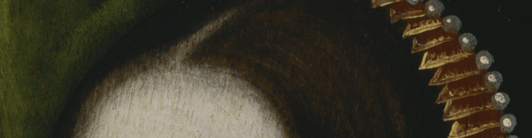
The portrait has been painted with the use of oil paint; however, the painted surface is thin and much of the dark wood grain from the rough panel surface below is showing through and obstructing the original image. This can be seen on several portraits throughout the set, and would suggest that the images were painted quickly, with little time of effort put into preparing the panel surface for the paint application.   As discussed above, the use of a pattern was used to create the image of Anne, and evidence of under-drawing in the face, hair and jewels is observed through the painted surface.

Close up image of the hairline showing evidence of under drawing.
© Dulwich Picture Gallery

As we have seen from the entries written by Alleyn in his account book, the portrait of Anne Boleyn is the only image of a royal consort to be produced for the Dulwich set.  It could be possible that this was simply an overhang from the reign of her daughter, Elizabeth, however the fact that this was painted almost fifteen years after her death is a mystery, and we will never truly know the reasons why Alleyn opted to include her.  

Henry Holland did include an engraved image of Anne Boleyn in his 1618 book ‘Baziliologia’.  Anne is again noted to be the only consort to be depicted in the book, and this may possibly be one of the reasons why she is depicted in the set.  The Dulwich image is, interestingly, not based on Elstrack’s engraving of Anne, even though we know with some certainty that the artist/artists who created this image had used the Baziliologia engravings for other images produced in the set.  The exact reason why the artist opted to use the B Pattern image of Anne, over the Baziliologia image is unknown. It may just be possible that the B Pattern had already gained acceptance as an authentic image of the Queen by this point in time and the artist simply opted to use this over the other image produced in Baziliologia.

Baziliologia image of Anne Boleyn
Engraving
Renold Elstrack
© Public Domain

Unfortunately, the Baziliologia image of Anne created by Renold Elstrack has caused some debate over the course of time, as some art historians have argued that the engraving was possibly based on Holbein’s depiction of Queen Jane Seymour in the now lost Whitehall mural. The reason for this is that Anne is seen in the Elstrack engraving wearing similar jewellery and hood to that seen worn by Jane Seymour in the surviving copies of the Whitehall mural [9]

To me this theory has been accepted far too easily, and there are another two images of Anne Boleyn which in my opinion are closely related to the Elstrack engraving.  Both depict Anne wearing an English Gable Hood, and both are identifiable by the use of the monogram AR. The first of these is known today as ‘The Moost Happi’ medal which is stored in the collection of the British Museum, London.  Thought to have been struck during Anne’s lifetime for the expected birth of her second child in the autumn of 1534, it features an image of the Queen with her face seen in three- quarter view, like that seen in the Elstrack engraving. Unfortunately, the medal has sustained some damage to the nose at some point in its history, however, enough does remain untouched to establish some sort of face pattern.  The sitter depicted has a long-oval face, high cheek bones, a strong chin, and perhaps, a prominent nose. She also wears a large cross attached to her necklace, which again is noted in the Elstrack engraving.

The Moost Happi Medal
Anne Boleyn
1534
© British Museum, London

Unfortunately, little documentation has survived in terms of the household accounts of Anne Boleyn, and no complete Jewel inventory has, yet, surfaced to give us an in-depth view of the specific items held in her collection.  Dr Nicola Tallis has recently published a fantastic book in which she takes a fresh look at what is known today as the ‘Queen’s Jewels’.  In this, Tallis gives a unique insight into what is currently known about the personal jewellery belonging to Anne Boleyn and demonstrates how a collection of royal Jewels was passed down by Henry VIII to his wives. Tallis also notes that we do have at least three miniature portraits depicting Catherine of Aragon, Jane Seymour and Katheryn Parr wearing a similar cross to that seen in the Moost Happi medal and the Elstrack engraving, which does suggest that Anne Boleyn could have had access to one as part of the Queen’s Jewels.[10]

The second image is a panel portrait, formally in the collection of Nidd Hall, and now in a private collection. This image displays the Queen wearing and English Gable Hood, her face is three-quarter view, and once again she has that characteristic long-oval shaped face, high cheekbones, strong nose, and the firm chin as that seen in the Moost Happi medal and Elstrack’s engaging.  Unfortunately, to date the Nidd Hall portrait has not undergone any scientific investigation to establish if the engraving could be based on this pattern or vice versa. [11]

The Nidd Hall Portrait
Anne Boleyn
Sixteenth Century
Oil on Panel
© Private Collection

It could also be argued that the woman depicted in the Nidd Hall portrait has similar features to that seen in the B Pattern portrait, and this could be a more mature representation of the same individual.  As with the many portraits associated with Anne Boleyn, until a chronological date pattern is established, we will never know for certain, and cannot rule out the fact that one could be an authentic image.

Far Left: Hever Rose Portrait Left: Radclyffe Portrait Middle Rawlinson Portrait Right: Kentwell Portrait Far Right: Dulwich Portrait
© Public Domain
An overlay of the Dulwich and Hever Portrait

What is most intriguing about the Dulwich portrait of Anne Boleyn is that it appears to be the closest in comparison to the Rawlinson, Radclyffe, Kentwell, and Hever Rose Portrait. As discussed in my previous articles, two distinctive patterns appear to have been used when creating images of Anne Boleyn. It is highly likely that the pattern used to create these four portraits was also used to create the Dulwich copy, however the artist opted to leave the hands and rose out of this version.  The depiction of the Jewels and pearls are rendered with a much less refined technique than that seen in the Hever Rose, Radclyffe, and Rawlinson version, which suggests that these examples could possibly be earlier versions, however, this will not be known for sure until one of the copies has been dendrochronologically tested.  I have heard from a reliable source that the Hever Rose portrait is due to have this scientific procedure completed, so all the Anne Boleyn community are currently waiting in anticipation of these results.


[1] Though Alleyn purchased a portrait of James I to be included as part of this set, the portrait of James which is in the collection today appears to be of a finer quality than that seen in portraits of the earlier monarchs. Some further research is required to establish if this was indeed the original portrait purchased by Alleyn or a later copy that has been adapted in style to correspond with the rest of the paintings.

[2] G. F. Warner. The Manuscripts and Muniments of Alleyn’s College of God’s Gift at Dulwich, 1881, p. V-IIV

[3] Dulwich College, London. MSS 9,32r, Diary and Account Book of Edward Alleyn, September 29th, 1617, to October 1st, 1622.  29th September 1618 ‘bought 6 pictures of K J(ames): Q E(lizabeth): Q M(ary): K E(dward VI): K H(enry) ye 8th and K H(enry) ye 5th’

[4] As above, ‘8 pictures off E(dward) ye 3: R(ichard) ye 2: H(enry) ye 4: H(enry) ye 6: E(dward) ye 4: E(dward) ye 5: R(ichard) ye 3: H(enry) ye 7.’

[5] As Above: ’25 September 1620 Bought 6 heds of E(ward) ye 2/ E(dward) ye 1/ H(enry) ye 3/ Jo(hn)/ Ri(chard) ye 1/ H(enry) ye 2/ Paid 6s 8d a peec’ .

[6] As Above. 30th September 1620 ‘paid for six heds of H(enry) ye 1st: Steven: W(illiam): Rufus: W(Illiam) conquer: black prince: an of bullen’

[7] The Athenaeum Magazine, Volume 1630, January 22nd, 1859. P. 112

[8] My sincere thanks to the Dulwich Picture Gallery for providing me with an image of the back of the panel and  the condition report for the portrait of Anne Boleyn.

[9]Philip Mould Ltd, Lost Faces Identity and Discovery in Tudor Royal Portraiture, 6-18th March 2007, Page: 80

[10] Tallis, Nicola. All The Queen Jewels 14-45 – 1545 Power, majesty and Display, Routledge Taylor & Francis Group, 2023 p.136-138

[11] The Nidd Hall portrait has recently undergone some cleaning and restoration work, however, no dendrochronology testing has, as yet taken place.

Anne Boleyn & The Romney Portrait

 A Tale of Too Many Thomas’s

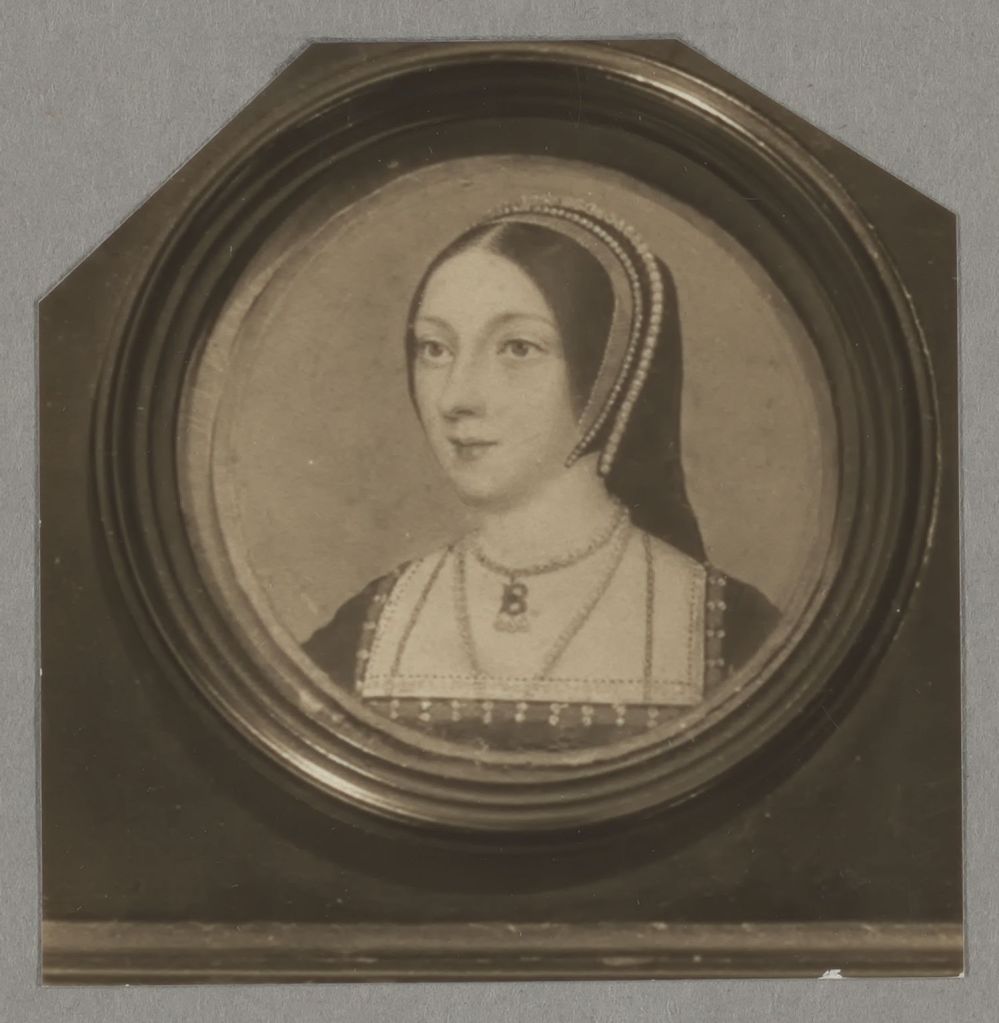
The Romney Portrait
Anne Boleyn
Oil on Panel
10 inches in diameter
© Earl of Romney

The Romney Portrait is among a small group of paintings associated with the Iconography of Anne Boleyn which has rarely been seen or studied by any academic.  Much has been written about NPG 668 and the Hever Rose Portrait, and in terms of a published image these two portraits tend to be the most popular when an illustration of Anne Boleyn is provided.

The Romney portrait has made a few public appearances. It was first exhibited in 1890, when it was featured among eight other portraits supposedly depicting Anne Boleyn in the New Gallery, ‘Royal House of Tudor Exhibition.’[1]  The portrait appeared again in 1902, when it was displayed among portraits of other British Kings and Queens in the ‘Monarchs of Great Britain’ exhibition.[2]

According to tradition, the portrait has been in the collection of the descendants of the Wyatt family for over four hundred years and was claimed by members of the family to be an authentic likeness of the doomed queen. At first glance, everything appears to add up, and for the first time in this research we have a portrait with a long family tradition, inscription, and artists name, however, are things too good to be true?

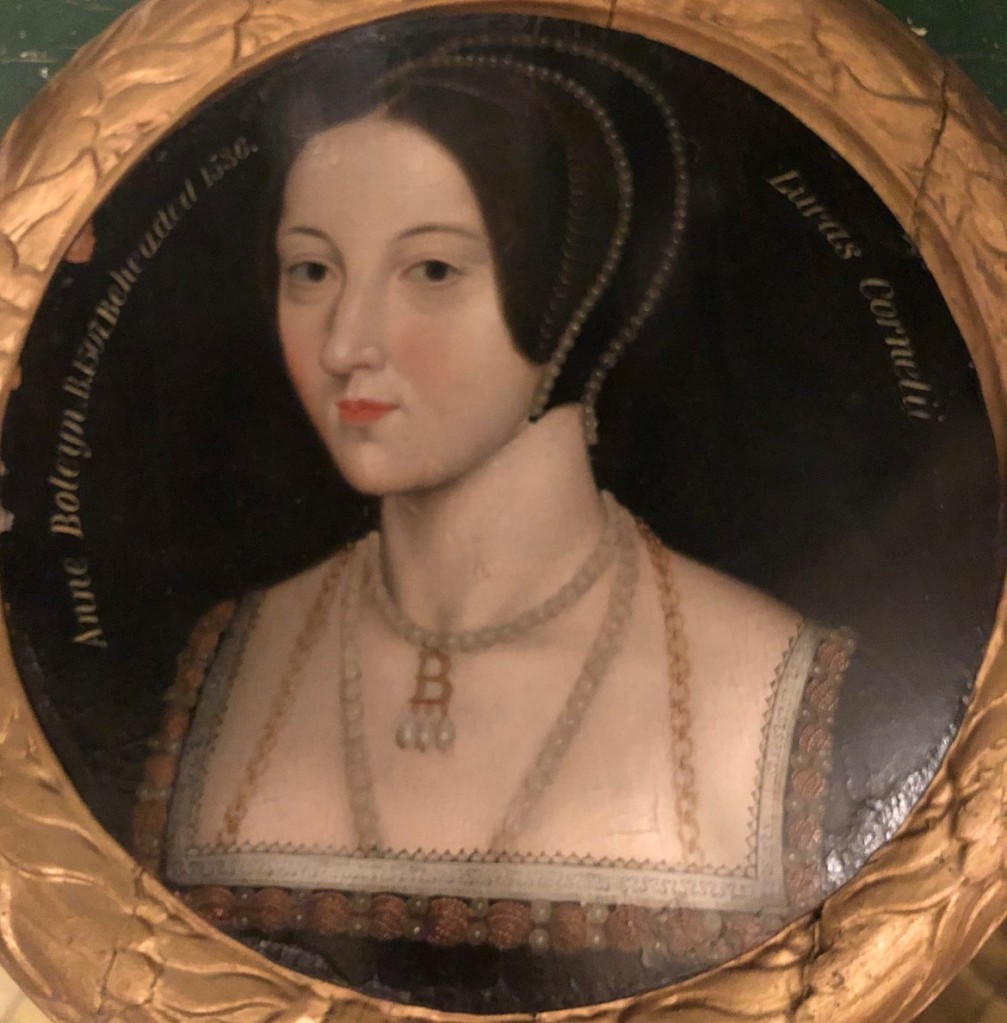
Painted with the use of oil on a singular wooden panel, the portrait depicts the image of Anne Boleyn, which over the course of time has become ingrained in the mind of any viewer familiar to her story.  The Queen is seen painted to just below the bust, facing the viewers left, and is placed in front of a plain dark background. On her head, she wears the French Hood constructed of black fabric with eighty-eight pearls visible. Her gown is constructed with the same black fabric, cut square at the neck, and decorated with twenty-four ouches and forty-three pearls set in gold.  Under this, she wears a shift of white fabric, also cut square, with blackwork embroidery around the edge.  Around her neck is a gold chain and a long strand of pearls with the now infamous ‘B’ Pendant hanging from them. 

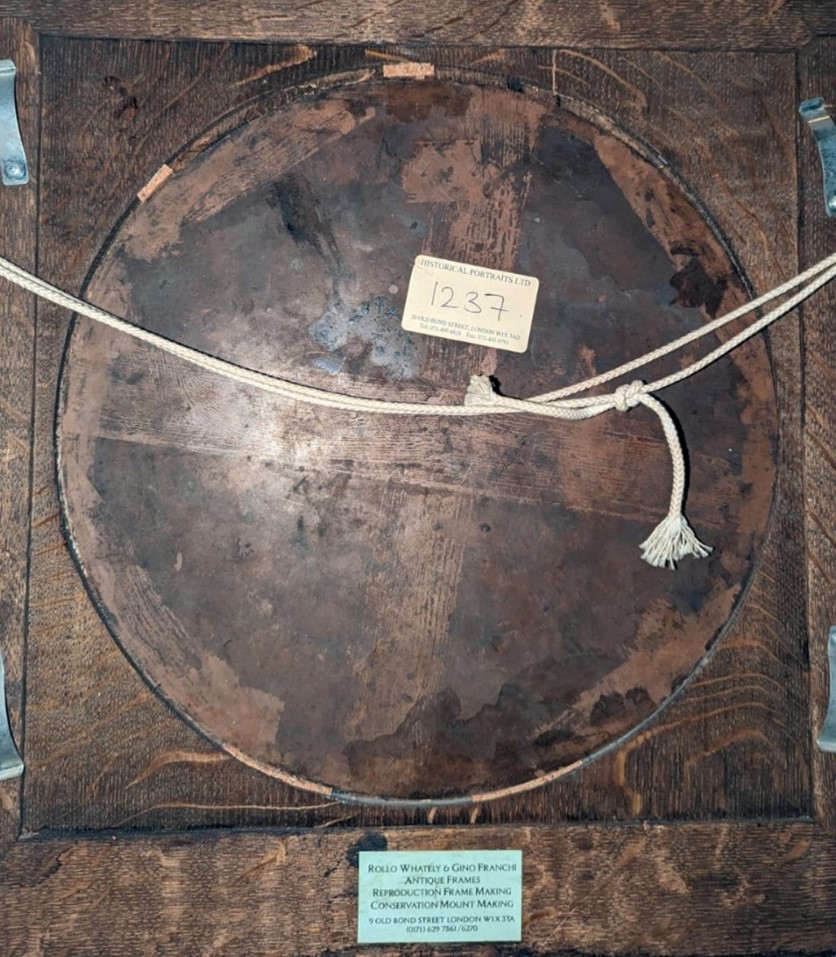
The Romney Portrait Reverse The Romney Portrait
© Earl of Romney

Generally, the portrait is in relatively good condition, however, surface dirt and discoloured varnish has obstructed the image slightly, and the portrait would most definitely benefit from having some restoration work completed. Some large areas of paint loss around the edge of the panel are also noted which may possibly suggest that the painting has been cut down at some point in time. A small area of lifting/flaking paint can also be seen above the sitters left breast.

As seen in the image above, the portrait contains an inscription completed in a yellow pigment. This informs the viewer that the sitter is ‘ANNE BOLEYN. B. 1507. BEHEADED 1536’ and that the artist is ‘LURAS CORNELLI.

The association with Lucas Cornelli or Cornelisz de Kock, as he is better known, is a tricky one.  Cornelisz was a Dutch painter born in Leyden in 1493, he is today one of the more obscure artists from the Tudor Court.  According to the seventeenth century biographer, Karel Van Mander, Cornelisz moved to England with his wife and seven or eight children and was eventually employed by King Henry VIII as the Kings Painter.[3]  Unfortunately, no work that can be reliably identified as being by his hand, has yet, surfaced and the exact date in which he arrived in England is unknown. A set of nineteen portraits depicting the office of constable of Queenborough Castle in Kent, was once associated with him during the eighteenth century. Today, this set is now known to date to the1590’s, and the association with Cornelisz was made due to the wrong interpretation of the monogram ‘LCP’ on one of the portraits.[4] 

Having undertaken a large amount of research into the iconography of Lady Jane Grey, I am personally very sceptical when it comes to portrait inscriptions.  I am only one hundred percent convinced when the inscription has undergone rigorous investigation to identify if the inscription is authentic to the artists hand or not.

Left: Thomas Wyatt the Elder Right: Thomas Wyatt the Younger
Oil on Panel
© Earl of Romney

Two further portrait’s depicting Thomas Wyatt the elder and his son Thomas Wyatt the younger, are also in the collection of the Earl of Romney.  Both are of similar size and constructed with the use of a circular oak panel.  Both also contain a similar inscription completed in yellow pigment as that seen in the Boleyn Portrait, and the portrait of Thomas Wyatt the elder is also associated with the artist Lucas Cornelli.  Both these paintings contain an earlier inscription which indicates that all three portraits had inscriptions added to the outer area at a later period, rather than by the artist who created them.

Before we look at the provenance and documentation relating to the Romney portrait, we first need to take a brief look at the history of the Wyatt family and the properties associated with them.  Allington Castle in Kent was the seat of the Wyatt family during the first half of the sixteenth century. It was purchased Sir Henry Wyatt as his principal residence in 1493, and the castle is less than twenty miles away from Anne Boleyn’s childhood home of Hever Castle.  Much debate, myth and exaggeration has been had over the centuries as to the exact relationship between Thomas Wyatt the elder, son of Sir Henry Wyatt and Anne Boleyn.  We do know for certain that both families knew of each other and most definitely mixed in the same circles. No record of a portrait of Anne Boleyn within the Wyatt family’s collection has yet surfaced, and no inventories listing the possessions at Allington Castle has survived. The castle remained within the Wyatt family until 1554, when it was confiscated by the Crown due to Thomas Wyatt the youngers involvement in the plot against Queen Mary I. His wife, Jane Hawte was left destitute after the execution of her husband, however, some of the Wyatt lands, not including Allington, were restored to her in 1555. In 1568, Allington Castle was granted by Queen Elizabeth I to John Astley, and it eventually passed through marriage into the hands of the Earls of Romney.  

In 1570, Queen Elizabeth I restored further Wyatt lands, including Boxley Abbey and Wavering to Sir George Wyatt, son of Thomas and Jane Hawte. George became heir to all the Wyatt estates in that same year and he became fixated on the history associated with his family. He began a conscious effort to rehabilitate his family name and fortune by collecting family stories, papers, writing pamphlets, and he even wrote what would be the first biography on Anne Boleyn.[5] 

On George Wyatt’s death in 1623, his collection of family memorabilia and the remaining Wyatt lands passed to his son Sir Francis Wyatt, then onto his son Edwin Wyatt in 1644.[6]

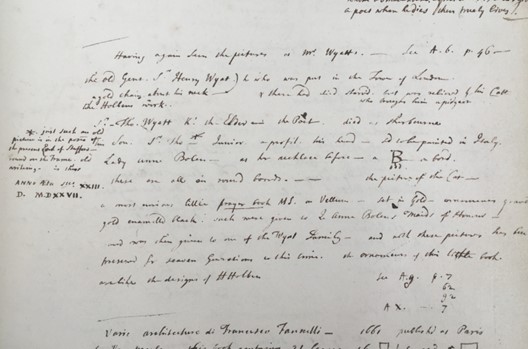
By 1725, we have our first piece of documented evidence concerning the Romney Portrait.  This comes to us when the portrait was viewed and documented in the notebook of the eighteenth-century engraver and antiquary George Vertue.  Vertue viewed the portrait on at least two separate occasions, and when seeing it he simply wrote a few lines noting that the portrait was:

‘In poss. Mr…. Wyatt in Charter House Yard. Picture of Q. Anne a Bolene. In a round (Frame) painted on Board.’

George Vertue’s Notebook detailing the viewing of the Romney Portrait of Anne Boleyn
© Public Domain

Thomas Wyatt, son of Edwin Wyatt, also presented the portrait, along with a small prayer book to the society of Antiquaries in 1725.  This viewing is again documented, and notes taken at the time indicates that Thomas Wyatt believed the portrait to be ‘original’. Also documented is the tradition that Anne gave the prayer book on the day of her execution to a member of the Wyatt family.

There does appear to be a tradition that Margaret Wyatt, sister of Thomas Wyatt the elder, attended Anne Boleyn on that fateful day in 1536.  This appears to stem from an early manuscript regarding the life of Thomas Wyatt the elder, copied and published in the eighteenth century by Thomas Gray.  Sadly, we know very little about the ladies who served Anne in her final hours.  Contemporary descriptions of this event do not provide the detail of their names, and if discussed at all then they are simply referred as ‘her ladies’, ‘her women’, or ‘four young ladies’. No description of Anne giving out gifts when on the scaffold is also known to exist and Sir George Wyatt makes no mention of the prayer book or Margaret Wyatt supporting Anne on the scaffold in his biography on Anne Boleyn.

Society of Antiquaries Notes on viewing the Romney Portrait and Wyatt Prayer Book © Public Domain

The direct Wyatt line died out in 1746, with the death of Thomas Wyatt, and it appears the small collection of family portraits and papers then passed to his aunt, Margareta, who was grandmother to the 1st Earl of Romney. The painting continued to be passed down the Romney family line and today, the portrait hangs on the walls at Gayton Hall, seat of the Earl of Romney.[7] 

As this article demonstrates, the tradition associated with the Romney portrait of Anne Boleyn appears to be a rather complex one, and although once claimed to be an authentic likeness, this is not exactly known for sure.  None of the Romney portraits have undergone any scientific investigation or dendrochronology testing to establish a date of creation, and the portrait of Anne Boleyn has not been seen in public for over one hundred and twenty years.  The portrait itself probably dates to the end of the sixteenth century when descendants of the earlier notorious Wyatt’s were attempting to restore the family fortunes and lift the association of treason which had been applied to family name.

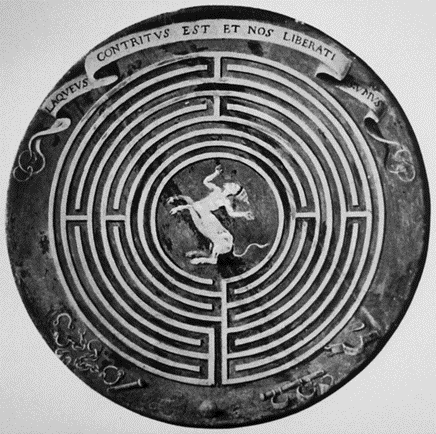
One clue does support this theory, stored in the Wyatt papers is a rather curious tale concerning Thomas Wyatt the elder, documented toward the end of the sixteenth century by his grandson Sir George Wyatt. According to Sir George, he was informed of the story from two sources: ‘One a gentleman, a follower of Sir Thomas and another a Kinsman of his name.’ Sir George then goes on to document the tale noting that when in Rome, Thomas ‘Wyatt stopped at an inn to change horses. On the wall of his chamber Thomas drew a ’Maze and in it a Minotaur with a triple crown on his head, both as it were falling’ and above this he placed the inscription ‘Laqueus contritus est et nos liberate sumus’’[8] 

The Wyatt Maze
Oil on Panel
© Earl of Romney

Once attached to the back of the Romney portrait of Thomas Wyatt the elder, was a separate panel painting depicting the image supposedly drew by Thomas on the wall of the inn. As George documents this story at a later period and notes that he was informed of this by two other individuals, it is highly likely that George Wyatt had this painting created himself.  This would also suggest the possibility that George had some of the Family portraits, as well as the portrait of Anne Boleyn, copied from available images as a way of promoting his family history.[9]

If indeed all three portraits date towards the end of the sixteenth century it would be tempting to suggest that since a portrait of all three sitters was recorded in the collection of John, 1st Baron Lumley in 1590, then it may just be possible that these portraits were used as the reference images for the Romney portraits.  Unfortunately, until further examination is completed on the paintings, we will not know for certain the year in which all were create. However, since Sir George Wyatt went to much effort to rehabilitate the family name, it is highly likely that they all date to his lifetime.   


[1] Exhibition of the royal house of Tudor : New Gallery (London, England) : Free Download, Borrow, and Streaming : Internet Archive accessed 28/05/2023

[2] The monarchs of Great Britain and Ireland : Winter Exhibition, the New Gallery, 1901-2 : New Gallery (London, England) : Free Download, Borrow, and Streaming : Internet Archive accessed  28.05.2023
[3] Het leven van Lucas Cornelisz. de Kock, Schilder van Leyden., Het schilder-boeck, Karel van Mander – dbnl, accessed January 2023
[4] Daunt Catherine, Portrait set in Tudor and Jacobean England, University of Sussex, 2015, Vol I, Page: 80 – 87

[5] Goeorge Wyatt’s book entitled ‘The Extracts from the Life of the Virtuous, Christian and Renowned Queen Anne Boleigne.’ Was published towards the end of the sixteenth century. 27 copies of the book were privately printed, and six copies are held in the British Library today.

[6] Edwin left his estate to his eldest son Francis, who died without children, leaving the estate to his brother, Richard, who also died without issue and was the last in this line of the Wyatt family. Richard left the land to a relative, Robert Marsham, Lord Romney (son of [Margaret] (Bosvile) Marsham.

[7] I am extremely grateful to the current Earl of Romney for providing me with the colour photographic images of this painting.

[8] Loades. David. The Papers of George Wyatt Esquire of Kent Son and Heir of Sir Thomas Wyatt the Younger, 1968, Royal Historical Society, PP:  28 – 29

[9] The Wyatt Maze is no longer attached to the back of the Thomas Wyatt portrait as it was removed at an earlier period and now hangs directly next to the portrait of Thomas Wyatt the elder.

Hever Castle: The Mould and Zouche Portraits

The Hever Rose Portrait is not the only painting of Anne Boleyn, based on the B Pattern, in the collection of her childhood home at Hever Castle.  Though undoubtedly, the Hever Rose Portrait is one of the castles prize possessions, a further two later copies are stored in the castles collection and both portrait’s feature strongly in the 2023 exhibition ‘Catherine and Anne, Queens, Rivals & Mothers.’ Organised by castle curator’s Alison Palmer, Owen Emmerson, and Kate McCaffrey.  This beautifully produced exhibition explores the complex connections between Catherine and Anne. It brings together for the first time in five hundred years two Books of Hours belonging to both these remarkable Queens of England and includes some never-before-seen portraits from private collections of Catherine of Aragon.  

When it comes to contemporary descriptions of Anne Boleyn, recorded during her lifetime or in the few months after her death, we have very little. What we do have provides a mixture of opinions, and some do appear to be embellished with a personal hatred towards Anne, due to the controversy that surrounded her relationship with the king.  One thing is for sure, Anne stood out among the people who were able to witness what she looked like for themselves. Her general persona appears to have caused debate even when she was alive, and this debate would continue for centuries after her death. The French scholar and poet Lancelot de Carles described her as

‘Beautiful with and elegant figure…. She became so graceful that you would never have taken her for an Englishwoman, but for a Frenchwoman born’. [1]

Carles would go on to note that Anne’s most attractive feature was:

‘her eyes, which she well knew how to use. In truth such was their power that many a man paid his allegiance’.[2]

In 1528, she was also described as ‘very beautiful’ by a Venetian diplomat, however, when described in 1532, by Francesco Sanuto, he appears less certain about Anne’s beauty. Sanuto was again observed to be captivated by Anne’s eyes.

‘Madam Anne is not one of the handsomest women in the world; she is of middling stature, swarthy complexion, long neck, wide mouth, bosom not much raised, and in fact has nothing but the English King’s great appetite, and her eyes, which are black and beautiful, and take great effect on those who served the Queen when she was on the throne.[3]

What is interesting, about some of the above features detailed by her contemporaries, is that some of these features are seen within the B Pattern of Anne Boleyn. When comparing both the contemporary descriptions and some of the earlier portraits based on the B Pattern to the Mould and Zouche portraits. Both paintings demonstrate how the sands of time have manipulated the everchanging image of Anne, and how her features would be slightly altered or airbrushed to suit the perception of beauty during the period in which the later copies were created.

Both the Mould and Zouche paintings are, in fact, relatively modern acquisitions within the castles collection and little information concerning their provenance are currently stored in the archive at Hever Castle today.  As both portraits are held within a significant collection relating to Anne Boleyn, then what little is currently known about the history of these two paintings deserves to be documented.

The Mould Copy
Anne Boleyn
Oil on Copper
10 ½ inches in diameter
Unknown Artist
© Hever Castle, Kent

The first, and certainly the earliest portrait is what I refer to as the Mould Copy. This painting was acquired by the castle from the London Art Specialist, Philip Mould, prior to 2012, and it has continually been on exhibition since its purchase.  The Mould copy is most certainly derived from one of the earlier paintings based on the B Pattern. As the slight curvature is seen at the neckline of the bodice, and the lips and nose have been altered slightly to that seen in NPG668.  It would be tempting to say that the Mould Copy was based on a painting similar to the portrait of Anne Boleyn seen in the Royal Collection. Anne has been slightly cropped in the Mould version the painting stops just below the neckline of her sumptuous gown. Her trademark pearls and B pendant can clearly be seen around her neck. Anne’s features have been somewhat enhanced to achieve the raven-coloured hair and large dark expressive eyes she would undoubtedly become famous for.

RCIN 404742
Anne Boleyn
Unknown Artist
Oil on Panel
© The Royal Collection

The portrait is in excellent condition for its age, some slight craquelure to the paint surface is seen on close inspection, however, there does appear to be no evidence of paint loss.  At first glance, Anne appears to be missing the black veil attached to the back of the French Hood. On viewing the portrait in person, it does appear to have been part of the original composition.  However, the veil appears to have been painted out at a later period and some evidence of a slight touch up to the bottom and outer portion of the pearl billiment is also visible. No artist inscription or name was located on the painted surface.

Detail of The Mould Copy
© Hever Castle, Kent

Executed with the use of oil paint on a sheet of circular copper, the portrait has a name plate applied to the frame with an estimated date for its creation of ‘circa sixteenth century’. The use of copper as a surface to paint on, appears to have originated in Florence towards the end of the sixteenth century, however, surviving examples from this period are rare. This method of painting eventually spread to Rome, Antwerp, and other countries during the seventeenth century and was often used by artists for small paintings, as the smooth surface would provide an ideal support to create detailed images.  

Stylistically, the use of the blue pigment seen in the Mould Copy to achieve that porcelain skin affect when modelling the flesh, the handling of the eyes, nose and mouth are more consistent with the hand of a seventeenth century artist, when the use of copper as a support for portraiture was at its height. Copper began to wean off during the second half of the seventeenth century and by the beginning of the eighteenth century it would become almost obsolete when the use of canvas would again become the most popular support for a painting surface.[4]    

Reverse of The Mould Copy
©Hever Castle, Kent

When it comes to the documented provenance of the Mould portrait, we unfortunately have very little in terms of information prior to its modern purchase. The painting doesn’t appear to have been included in any of the major nineteenth century exhibitions relating to Tudor portraiture. We do have many auction records concerning portraits of Anne Boleyn sold over the course of four centuries, however, no direct record for this particular portrait has yet, been located.  Unfortunaly the back of the copper plate also provides no other details, other than the modern Philip Mould inventory sticker.

A search of the Getty Provenance Database has identified two tantalizing auction entries from the early nineteenth century that could possibly identify two of the previous owners of this painting. The first reference is a portrait described as being that of ‘Anne Boleyn on Copper’ which sold from the collection of a John Dent by Christie’s, London on 6th February 1802. The second, is another portrait described again as representing ‘Anne Bullen on Copper’ which sold some fourteen years later from the collection of a Reverend James Cradocke. Due to the poor content of these early auction entries and the constant demand for Anne’s likeness, no direct match has been made to truly confirm that either one of the references is, in fact, related to the Mould Copy or the B pattern. Until further information is obtained, then we cannot truly list either names as previous owners.[5]

During a recent trip to London, I was able to locate one positive reference about the Mould Portrait made towards the end of the nineteenth century.  George Scharf, then Director of the National Portrait Gallery London, viewed many significant Tudor related portraits during his career.  Scharf was noted to have an active interest in sixteenth century portraiture and would often seek out paintings to feed his own interests in the subject or as a possible purchase for the galleries collection. Unfortunately, Anne Boleyn does not appear to be at the top of his list when attempting to locate images, however, he does illustrate a small number of portraits that caught his eye in his many sketchbooks.

Drawing of Mould Portrait
George Scharf
©National Portrait Gallery, London

The Mould Copy portrait was viewed by George Scharf on 19th July 1872. During this viewing he took notes regarding his observations and made a drawing of the portrait in one of the sketchbooks stored in the galleries archive today.  Unfortunately, the notes given provide us with little information other than the size of the painting, materials used, and the fact that Scharf had a poor opinion of the portrait noting it to be a ‘a very poor fabrication ignorantly done from the Windsor Picture.’ Scharf does make one rather puzzling note along the far left-hand side of his drawing and lists the rather curious name ‘J.K Sepia Boleyn’. This could possibly be the owner of the portrait in 1872, however, for the moment I have unfortunately been unable to locate and information regarding a J.K Sepia Boleyn or a J.K Sepia [6]

The Zouche Copy
Anne Boleyn
Unknown Artist
15 ½ x 12 ¼ inches
Oil on Canvas
© Hever Castle, Kent

Unlike the Mould copy, the Zouche Portrait appears to have a rich history in terms of provenance and documentation. In this version, Anne is depicted to just above the waist, her famous dark hair has been lightened to an almost auburn colour, and her eyes have been enlarged. Anne’s features have been softened and appear younger in years to that seen in the earlier patterns, and the hint of rosy pink cheeks and red lips are also observed.  

The French inscription applied to the top of the panel gives us a clue as to the origin of the painting and it’s first acknowledgement to its past is seen on a label attached to the back of the stretcher. Written in French the label informs its viewer that the portrait is a depiction of:

Portrait de Anne de Boulon, femme de Henry VIII roy(al) de l’angleterre……Da Chateau de Thorigny’[7].

Located in Yonne, France, the Chateau de Thorigny was built for Alexandre Jean Baptiste Lambert on the same land as an earlier family property between the years of 1719 and 1726. On his death in 1726, the chateau entered a spiral of sales were its valuable collection of books, furniture and architectural features were unfortunately sold off. A shell of a castle was finally acquired by a wealthy Italian family; however, it was eventually demolished in 1806.[8]  

Detail showing the label fixed to the reverse of the Zouche Copy
© Hever Castle, Kent

By 1897, the portrait was in England in the collection of Robert Nathaniel Cecil George Curzon, 15th Baron Zouche of Perham Park. Curzon’s was an avid collector, traveller and writer who is known to have acquired a large collection of Biblical Manuscripts during his lifetime. Today, a large amount of his collection is stored in the British Library London. It may just be possible that Robert Curzon purchased the Zouche copy himself from one of the many sales taking place at the Chateau de Thorigny during one of his many excursions abroad.[9]

The Zouche Copy first appeared, publicly, when it was exhibited in the 1897 ‘Royal House of Tudor Exhibition’.  Situated in Manchester’s Art Gallery, the exhibition consisted of eight rooms containing thousands of Tudor related artifacts sourced from public and private collections across the country.  Seen in room two was item 32 in the exhibition catalouge:

Queen Anne Boleyn (1507-1536) Small half-length, to the left: square cut, low dark dress; black hood, edged with pearls; pearl necklace with a letter B. Canvas 15 x 12 inches. Attributed to Janet.[10]

The association with the sixteenth century artist Janet or Jean Clouet is an intriguing one. During the latter half of the nineteenth and early twentieth century many portraits were associated with the French artists Jean and Francois Clouet due to a significant amount of research being produced about both artists.  However, access to information, archival material, and any scientific investigation in terms of dating, paint analysis or infrared reflectography was non-existent.  Portraits were simply grouped together by style and associated with names of some of the more famous artists to work within the period the portrait was at that time thought to date to. It is safe to say that the Zouche Portraits has nothing in terms of the stylistic qualities seen in some of Clouet’s known works. The fact that the portrait is on canvas also indicates that it most certainly dates to a period after the sixteenth century and the attribution to ‘Janet’ in the exhibition catalouge was a simple mistake.  Today, the portrait is thought to date to the eighteenth century and may just have been commissioned by Alexandre Lambert to hang in the newly built Chateau de Thorigny.

The Zouche Copy was passed by descent to other members of the Curzon’s family. It appeared in a further two public exhibitions in 1902 and 1909 and remained in the family’s collection when Parham House and the estate was sold off in 1922. The portrait eventually appeared up for auction on 29th October 1986, when it was incorrectly described as being ‘English School’.  On completion of this sale the portrait then entered the collection at Hever Castle and remains part of the collection to this day.   


[1] Weir, Alison. The Six Wives of Henry VIII, 2007, pp 151

[2]Ibid  

[3]Calendar of state papers,  Venice: October 1532 | British History Online (british-history.ac.uk), accessed 12.02.23

[4] For more information on the history of the use of copper see: Komanecky. Michael K. Copper as Canvas: Two Centuries of Masterpiece Painting on Copper, 1575 – 1775, Oxford University Press, 1998.

[5] Getty Provenance Index & Getty Provenance Index accessed 10.02.2023

[6] The Heinz Archives, London. Trustees’ Sketchbook 18, 1871-1872, NPG7/1/3/1/2/18, pp.38 

[7] I am extremely grateful to Owen Emmerson, Kate McCaffrey and Alison Palmer for allowing me to see photographic images of the reverse of both portraits.

[8] Miller. Etienne, The Lambert de Thorigny Family, Bulletin of the Archaeological Society of Sens, Volume: VI, (2008), pp. 102-185

[9] Sidney lee. Dictionary of National Biography, Smith, Elder & Co, London, (1900) Vol 63

[10] Royal House of Tudor Exhibition Catalouge, 1897, P.12, item:32

The Moseley Miniature Set: A Well-Travelled Portrait

The Moseley Set
Watercolour on Card
1 ¾ in diameter
©Image Curtesy Freeman’s, Philadelphia, 2022.

Description:

This miniature portrait of Anne Boleyn is one of three, depicting figures from Tudor history, displayed in a black ebonised frame.  All three miniatures measure 1 ¾ inches in diameter and are executed with the use of watercolour and gouache on card. The sitter’s are depicted in front of a plain blue background with a gold boarder.  Anne Boleyn is depicted to just below the chest, she is turned slightly to the viewers left. 

Her face is oval, with a high forehead.  Her hair is brown in colour, appears straight, and is worn parted in the centre of the crown and pulled back over her ears and under her coif.  Her eyes are large and brown in colour and her eyebrows are thin and arched.  The nose is rather large with a high bridge and her lips are full.

Her costume includes her trademark French Hood, ending just below the jawline, which is constructed of black fabric and pearls. At her neck, she wears two strings of pearls with the large letter B pendant of goldsmith work seen in other images based on the B pattern.  The gown itself is constructed of a black fabric, cut square at the neck and a chemise, embroidered with blackwork protrudes along the entire bodice margin.   

Condition:

Unfortunately, I have been unable to locate a high-resolution image of this portrait, so, I am unable to comment in any great detail as to its condition. From the low-resolution image provided by the auction house, all three miniature portraits appear to be in rather good condition, with a clear surface and bright colours. The ebonized frame, in which all three miniatures are stored, does appear to show some signs of general age.

Discussion:

The Moseley Miniature, named in this study after its first documented owner, is certainly one of the lesser-known depictions of Anne Boleyn, based on the B Pattern.  As with a lot of the information regarding the iconography of Anne Boleyn, the documentation concerning the Mosely Miniature is fragmented, and its exact date of creation was for a short period of time thought to have been the sixteenth century. 

The first actual piece of evidence which can be associated with this particular portrait appears in 1857. This small miniature, along with the two others displayed within the same frame was exhibited in the ‘Art Treasures Exhibition,’ Manchester.  The Catalogue entry for this exhibition lists the owner as a William Moseley, esq and describes the sitters as

Three Miniatures: Henry VIII, Anne Boleyn, and Charles V (when 19)[1]

Unfortunately, no artist had been associated with the creation of the three portraits in the exhibition catalogue and no information concerning the portraits provenance was also provided.  No inscriptions detailing the sitter’s names or ages can be viewed on the portrait’s surfaces. So, we must then presume that either the portrait set contained a label on the back, or that the information about the sitter’s and their so-called ages was provided by Moseley himself.   

William Moseley’s principal seat was Leaton Hall, near Enville, Southbridge.  He had inherited the hall from his father Walter Henry Moseley, on his death in 1827.[2]  No documentation has, yet, been located to inform us exactly when the Moseley family acquired and sold the portrait set.  Walter Moseley began extensive remodelling of Leaton Hall in 1817, and it may be possible that the set was purchased around this time.  On the death of William Moseley, the estate then passed to his son William Henry Moseley, and remained in the family until it was eventually sold off in 1916.[3]   

By the early 1920’s, the portrait set appears to have travelled overseas and was in the collection of socialite and antique collector Edith Mary Kingdon Gould. [4]   On her death in 1921, the family began selling off large amounts from the collection she had acquired.  Between the years of 1925 – 1938, many auctions took place containing items once belonging to Edith Gould and on 12th January 1929, the portrait set was once again up for sale. The auction catalogue for this sale does give us our first piece of photographic evidence.  The portrait set was noted to be a featured lot in the sale and placed next to its lot description was an early black and white photograph showing the collection of three miniatures in all their glory.[5]

Early Image of The Moseley Portrait Set
© Public Domain
Detail: Anne Boleyn Watercolour on Card
1 ¾ in diameter
©Public Domain

Unfortunately, again, this catalogue description gives us no details as to the provenance of the set, and by this point all three portraits had been wrongly associated with the hand of sixteenth century artist Hans Holbein.  During this period, many sixteenth century portraits, and in some cases more modern creations, held in private collections or sold at auction were simply associated with the hand of Hans Holbein.  Due to lack of access to documented information and provenance details, portraits were simply associated with artists due to some slight similarities in style, the fame attached to a name, or as a way of adding value to a painting.  Several other supposed sixteenth century miniature portraits described in the same catalogue, today, certainly have some questionable identifications when it comes to both sitter and artist associated to them. As with the Moseley Miniature, little, or no evidence to support the associations was provided by the auction house at the point of sale. 

The stylistic approach used by the artist who created the Moseley miniatures is most certainly not consistent with any other sixteenth century miniature portrait.  It is also most definitely missing that fine quality of brushwork seen in other miniatures that can truly relate to the hand of Hans Holbein. The approach is more consistent with that used by the nineteenth century British Miniaturist, George Perfect Harding (1781-1853). 

Left: Moseley Anne Boleyn Centre: Anne of Cleves By George Perfect Harding Right: Prince Arthur By George Perfect Harding

During the nineteenth century, artists would often revisit the works of some of the more prominent sixteenth century artist’s and produce copies of their portraits to satisfy the high demand in the public’s fascination with English History.

In some cases, many of these newly created copies would often be so realistic that at times it would be extremely difficult to establish the genuine artifact from the newly created version.  Some of the more modern copies would, at times be sold off as a genuine sixteenth century portrait due to the quality of the copy. George Perfect Harding was a prolific copyist of historical portraiture and would often go to extreme lengths to locate works which had not, as yet been reproduced by other peers of his day. Harding was certainly an exceptionally talented artist, who would never attempt to pass his own works off as the genuine artifact. Examples of his work are stored today within private and public collection’s all show his stylistic approach of a sixteenth century portraits, rather than a direct copy created to mislead viewer.[6]

By 1971, the portrait set was once again back in England and was sold by Sotheby’s auction house on 18th of October.  During this sale the set was rightfully described as ‘after Hans Holbein, probably by George Perfect Harding’ and sold for the sum of one hundred and fifty pounds.[7] It finally appeared, once again in America, when it was sold from the collection of Dr Virginia Armentrout, in 2006, by Freeman’s auction house, Philadelphia. The set was purchased for the sum of one thousand six hundred dollars, and I am now informed that it is currently in a private collection in Pennsylvania.[8]

Conclusion:

Though undoubtably a beautiful portrait of Anne Boleyn, it appears that the portrait is most certainly a nineteenth century copy, rather than that produced by the hand of Hans Holbein. It can therefore be eliminated from any possible list of sixteenth century portraits associated with the name Anne Boleyn.  If anything, this article has attempted to document and put some order to the provenance relating to this item.  


[1] Catalogue of Art Treasures of The United Kingdom, Manchester, 1857, item 23, P.208

[2] Burke, Bernard, (1879) A Genealogical and Heraldic History  of the Landed Gentry of Great Britain & Ireland, Harrison. Pall Mall, Vol 2 P: 1134

[3] Shropshire Archives, SC/1/50, Sales Catalogue for the Leaton and Whittimere estate, July 1916

[4] This was not to be the only portrait of Anne Boleyn owned by the Gould family, and a second portrait was purchased by Anna Gould in June of 1940 and can still be seen at the Family seat of Lyndhurst Manor toady. For more information on the Lyndhurst portrait see: The Lyndhurst Portrait – Lady Jane Grey Revisited

[5] Objects of art: American Art Association: Free Download, Borrow, and Streaming: Internet Archive, accessed June 2022

[6] For more information on the historic portrait copyists and their production see: Reynolds. Graham, (1999) The Sixteenth and Seventeenth Century Miniatures in The Collection of Her Majesty the Queen, Royal Collection Enterprises Limited

[7] Sotheby’s Sales catalogue, 18th October 1971, lot 79

[8] Electronic communication with Raphael Chatroux of Freeman’s Auctions, 20th August 2020

The Hever Rose Portrait

Co-authored & researched with Dr Owen Emmerson

The Hever Rose Portraits
Anne Boleyn
Oil on Panel
22 3/4 x 17 1/4 inches
© Hever Castle, Kent

Object Description:

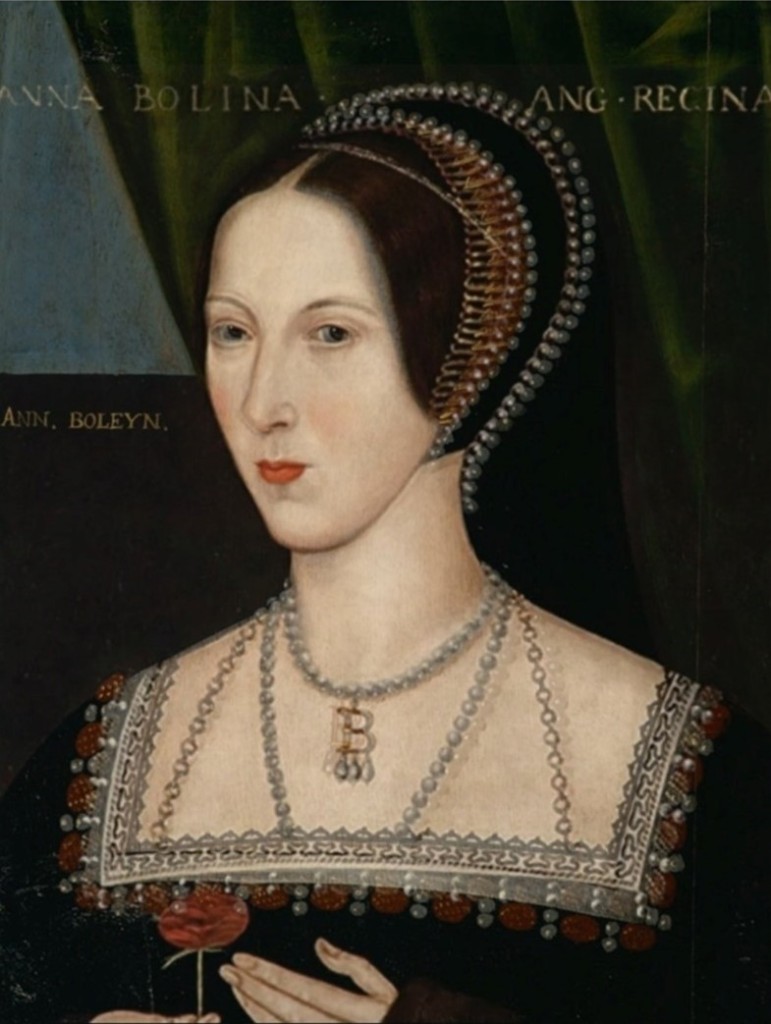
This painting is executed in oil on a wooden panel and measures in whole 22 ¾ x 17 ¼ inches.   The portrait depicts an adult female’s head and upper torso who appears sitting before a plain brown background.  She is turned slightly to the viewers left, and in her right hand, she holds a red rose. 

Her face is long and oval in shape, with a high forehead.  Her hair is brown in colour, appears straight, and is worn parted in the centre of the crown and pulled back over her ears and under her coif.  Her eyes are brown in colour, and her eyebrows are thin and arched.  The nose is slightly arched with a high bridge, and her lips are small and thin.  The use of a pink tone has been added to the sitter’s cheekbones and bridge of her nose. 

The sitter’s costume includes a French hood, ending just below the jawline.  This is constructed of black fabric that includes the use of an upper and lower billiment of pearls; thirty-four pearls can be seen in the lower billiment, and forty-three pearls have been depicted on the upper billiment.  A black veil is also seen hanging down at the back of the hood, and under this, the sitter wears a gold coif.  At her neck, she wears two strings of pearls with a large letter ‘B’ pendant of goldsmith work with three hanging pearls suspended from the upper necklace.  A gold chain constructed of circular loops is also seen at the neck, which falls and disappears into the front of the sitter’s bodice.  The gown itself is constructed of black fabric, cut square at the neck, and a chemise embroidered with blackwork protrudes along the entire bodice margin. The hint of a kirtle made of brown fabric and embellished with forty-four pearls and twenty-three buttons of goldsmith work is also seen around the neckline of the bodice.

Inscription:

An inscription applied across the top of the panel in a bright yellow pigment identifies the sitter as ANNA BOLINA. ANG. REGINA

Labels and other inscriptions:

Access to the back of the panel is unfortunately restricted due to the presence of a supporting cradle.  No assessment could be made of any other possible labels or inscriptions attached to the back of the panel surface at the time of writing.

Artist Association:

English School

Condition:

In 2000, restoration work was carried out on the painting by the conservator, Claudio Moscatelli. The most significant part of this conservation work was removing overpaint added at some point in the painting’s history. A series of three images held in Hever Castle’s archive, taken immediately before, during and after the restoration process gives us a lucid understanding of the works completed.

The Hever Rose Portrait, Before Restoration (Left) and With Overpaint Removed (Right)
© Hever Castle, Kent

With the overpaint carefully removed, it became clear that the overpaint had been likely applied because of past damage to the panels. Subsequently, significant alterations to the facial features had been made. Most of the revealed damage appeared to have occurred on the left of the three panels, with substantial losses evident along the joint between the left-hand and central panel. Indeed, it is likely that the left-hand panel had completely detached from the central one at some point in its history.  As this damage ran through the sitter’s face, it is perhaps not surprising that the overpaint was most heavily applied upon the chin, mouth, and nose. What became evident with the removal of this later overpaint was that it had also acted to ‘smooth’ out these features into perhaps more flattering ones than were originally intended. Indeed, it is evident that overpaint had also been added to areas without paint losses which contributed to this ‘beautification’. Claudio Moscatelli’s efforts to replace losses were subsequently much closer to the original pattern revealed when the overpaint had been removed.

The Hever Rose Portrait, Before Restoration (Left) and After Restoration (Right)
© Hever Castle, Kent

Thoughts:

Similar to NPG 668, The Hever Rose Portrait is arguably one of the more famous paintings of Anne Boleyn based on the B Pattern. Today, the painting is one of four significant portraits believed to depict Anne Boleyn hanging on the walls of Hever Castle in Kent.  The portrait has become a treasured artefact that holds a special place in both the hearts of the staff and the public who view it; however, despite its widespread popularity, we appear to know very little about it.  This is not uncommon when researching historical portraiture with a history of over four hundred years behind it. In many cases, almost nothing has survived in terms of historical documentation for most of our surviving Tudor portraits. In the past, the Hever Rose portrait has been mistaken for that once owned by Mrs K. Radclyffe.[1] A close study of the Radclyffe portrait against the Hever Rose portrait shows several clear differences, perhaps most noticeably in the size of the links that make up the chain around her neck (see below). Moreover, in his study of the portraiture of Anne Boleyn, celebrated art historian Sir Roy Strong noted that the Radclyffe Portrait had no inscription upon it, unlike the Hever Rose version.[2] When the Hever Rose Portrait was exhibited at Philip Mould’s Lost Faces exhibition in 2007, it was described as “… the finest and most probably the earliest” of the ‘corridor portraits’ of Anne Boleyn.[3]

The Radclyffe Portrait (Left) and the Hever Rose Portrait (Right)

No record of the Hever Rose Portrait has been located within any of the files relating to the iconography of Anne Boleyn in the Witt Library, Paul Mellon Centre, British Museum, or the Heinz Archive.  No scientific investigation has yet, taken place on this portrait to establish an accurate date of its creation. The exact date the portrait entered Hever castle’s collection has always remained a mystery. A date of c.1550 has been added to the portrait at some point in its history at Hever Castle, however, it is uncertain when this date was attached to it and by whom. We know via dendrochronological analysis that the NPG 668 portrait of Anne Boleyn was created in c.1584, during the reign of Anne Boleyn’s daughter, Queen Elizabeth I; a period when Anne’s image underwent a period of rehabilitation.[4] It is considerably less likely that a portrait of Anne Boleyn would have been painted in 1550 during the reign of Elizabeth’s brother, Edward VI, whose mother, Queen Jane Seymour, superseded Anne. It may be, therefore, that in lieu of any scientific analysis that date of c.1550 was added. This would have allowed for a period of approximately fifteen years on either side of that central ‘circa’ date; straddling the possibility, therefore, of it having been painted during Anne’s own lifetime, or during the reign of her daughter, Elizabeth.  

To truly understand the Hever Rose Portrait as an object, we first need to look at the castle’s history on which walls the portrait hangs today.  Located in the small village of Hever in Kent, Hever Castle has a long, rich history dating back to the twelfth century.  Arguably more famous today for being the childhood home of Anne Boleyn, the castle is a cherished time capsule that takes us, the public, closer to its most famous inhabitant than any other historic building associated with her.  

The Boleyn family purchased the castle in 1462, and by 1505, Thomas Boleyn, father of Anne Boleyn, inherited Hever and various other lands and properties on his father’s death.  Today, with the assistance of architectural historians, we are beginning to understand better how the castle was developed and added to across its history.  Unfortunately, we have almost nothing in terms of documentary evidence to inform us what was used to furnish the building when the Boleyn family were in residence.  No sixteenth-century reference to a portrait of Anne Boleyn at Hever castle has also been located.  

The castle subsequently passed through various owners, including the Waldegrave family from 1557 to 1715, the Humphreys family to 1749 and the Meade-Waldo Family from 1749 to 1903.  A rather run-down Hever Castle was purchased by an American billionaire, William Waldorf Astor, in 1903.  Astor had already been captivated by the story of Anne Boleyn and had already started to acquire a collection of objects related to her story; the fact that he now had her childhood home was the icing on the cake.  William Astor immediately started the restoration work to take the castle back to its former glory and use the building as his principal residence.  Much of what is seen today within the walls of the building is thanks to this restoration work which took place between 1903 and 1908.  Astor himself immediately set about acquiring period pieces and furnishing the rooms with artefacts connected to the castle’s rich history.  This period of development was also continued by his son, John Jacob, when he inherited the castle on his father’s death in 1919. His great- grandson, Gavin Astor, inherited the castle in 1961 and eventually opened the castle up partially to the public in 1963.

Hever Castle does, in fact, have a long history associated with the documentation of a portrait of Anne Boleyn. During the nineteenth century, it became popular for various tourists to publish detailed notes taken during their tours of the historic houses across England. In a small number of these publications, a portrait of Anne Boleyn is described as hanging on the walls at Hever Castle. However, it appears that several visitors were less than impressed by the image seen of this infamous Queen.  This sense of dislike, and other clues, suggests that it was not the current portrait seen by the visitors but another painting altogether.  

Our first positive archival reference to a portrait of Anne at Hever dates to 1801 when the Meade-Waldo family owned the castle.  In his study of The Beauties of England and Wales, Reverend Hodgson observed a portrait of Anne Boleyn at Rufford Abbey:

“In the attic story… a portrait of Anne Bullen on wood, but by no means as handsome as Holbein has painted her in which is preserved at Loseley in Surrey; yet as this one bears a great resemblance to a portrait of her at Hever Castle in Kent, the seat of her family, one is almost led to suspect that Henry’s taste for beauty would not have been much followed at the present day.”[5]

Similarly, a visitor in 1823 viewed the portrait that had been pointed out to him as an image of Anne; however, he was noted to be unimpressed with the picture seen.  He later recorded that:

‘At Hever Castle is still preserved a small picture in oil, which is an heirloom, and is said to be the Queen; it is a very stiff performance, and if a likeness of Ann Bolen, we look in vain for those captivating charms which are generally supposed to have enslaved the affections of the despotic monarch, and even urged him to overthrow the religion of his country, in order to compass the fulfilment of his ungovernable desires.’[6]

Writer James Thorne also appears to have viewed the same portrait supposed to depict Anne in 1847, and he was again less than impressed by the image he viewed:

‘One is pointed out as the family portrait if Anne Boleyn, and it’s added that it was painted shortly before her execution.  To us, it seems to bear little resemblance to the authentic portrait of her.  We do not believe it is even a copy of her portrait, we need barely add, it’s not an original.[7]

While no detailed description of this portrait of Anne Boleyn at Hever Castle exists, Reverend Hodgson’s observation that the painting he observed at Rufford Abbey was unlike that held at Loseley Hall – but like that at Hever Castle – is an intriguing one. A portrait of Anne Boleyn, which derives from the ‘B’ necklace pattern, still hangs at Loseley, and if it is the same portrait that Reverend Hodgson observed at Loseley in the early 1800s, the portrait of Anne at Hever Castle at that time most likely differed from the ‘B’ pattern model.  More intriguing still is the existence of a painting that is still in the collection of the Meade-Waldo family, and which was removed from Hever Castle when they opted to sell the castle to the Astor family in 1903. This particular portrait is painted with the use of oil on the panel and includes the inscription identifying the sitter as ‘Anna. Regina. AD. 1534.’

Loseley Hall Portrait (Left) & Meade- Waldo Family Portrait (Right)
© Private Collections

One of the main reasons for the uncertainty surrounding the purchase of the Hever Rose Portrait is due to the castle being flooded on 15th September 1968.  It does appear that the Astor family did keep detailed records of items purchased for display purposes, however, due to damage caused by the flooding, which overwhelmed the castle’s cellars and library, a considerable amount of the family’s archival information was unfortunately lost or destroyed.

Until recently, the first surviving document relating to the portrait’s actual existence at Hever castle was when it was listed among other paintings and furniture in a valuation catalogue compiled by Christie, Manson, and Woods in 1965.  No description of the portrait appeared in an earlier inventory made of the collection in 1919, at the time of William Astor’s death and it had always been presumed that the portrait was purchased between 1919 and 1965, however, no surviving documentation had surfaced to prove this theory. [8]

During a search of the current archive for this article, a pamphlet produced for an open day for employees of the Times Newspaper in 1939 was discovered. In this, an early image of the portrait was located and was listed as being among the collection at Hever Castle.  The discovery of this pamphlet pushes back the timeline in which the portrait was possibly purchased, and it appears that the painting was in the castle’s collection prior to 1939.

Times Pamphlet containing an early image of the Hever Rose Portrait
© Hever Castle, Kent

A very interesting description of a portrait, published in a book from 1908, may possibly give us a clue as to the previous provenance of the Hever Rose Portrait.  In 1904, Edmund Ferrer documented that he visited Assington Hall in Suffolk and came across a portrait of Anne Boleyn in that collection.  Assington Hall was the family estate of the Gurdon family, who had lived within the manor house at Assington since it was purchased by Robert Gurdon from Sir Miles Corbert in the early sixteenth century.[9]

Ferrer later published a detailed description of the portrait seen, and the details given in his description appear to be a perfect match to the Hever Rose Portrait.

‘Queen Anne Boleyn.  H(ead) and S(soulders). Body and face both turned slightly to the dexter, hair dressed in the pedimental style. Dress: Black, with pearls round the neck, supporting a jewelled B; there is also a gold chain; the hands are forward holding a rose. Above it “Ang. Regina”’[10]

During my research into the many portraits of Anne Boleyn associated with the B Pattern, I have only come across three surviving copies of the distinctive Rose pattern. Both the Rawlinson and the Radclyffe copy do not include the distinctive inscription identifying the sitter as seen in the Hever copy and, unless another unknown copy does exist, then the only plausible option is that the portrait seen by Ferrer in 1904 is now in the collection of Hever Castle.

One final piece of evidence to back this theory up is the auction catalogue for the sale of the contents of Assington Hall in 1937.  Unfortunately, no specific portrait identified as being that of Anne Boleyn is listed among the paintings sold on the 6th of October.  The descriptions give

n of the fifty-one paintings to appear in the catalogue are noted to be very vague and only a small number of portraits are identified by the sitter’s name are listed. Item 171, ‘portrait of a lady of the Elizabethan period with a black headdress and pearl necklace’ could possibly be the portrait of Anne and it is also noted that it was painted on panel and measures 22 x 17 inches.  If indeed the portrait was measured by the auction house in its frame, then this would be a perfect fit for the Hever Rose Portrait and would suggest that the portrait was presumably purchased by John Jacob Astor for display at Hever Castle[11]

Further research does need to take place to try and establish once and for all if the portrait of Anne seen at Assington Hall in 1904, is indeed the portrait we all see when visiting Hever Castle today. Moreover, the absence of any scientific analysis on this portrait leaves many unanswered questions. It is often stated that the are no extant painted portraits of Anne Boleyn that date to her lifetime. Yet few of the panel portraits which bear Anne’s likeness have been subjected to either paint or dendrochronological analysis which would help to determine a likely date of their creation. Considering that the Hever Rose Portrait was appraised and exhibited by art historians Philip Mould and Bendor Grosvenor as “… the finest and most probably the earliest” of the ‘corridor portraits’ of Anne Boleyn, the desire to satiate the unanswered questions surrounding this portraits age has never been more acute.[12]  What is clear from this article is that the Hever Rose Portrait is now, finally, starting to shed some of its secrets and we are now starting to find out a little more about such a treasured and renowned artefact.  


[1] https://www.arthistorynews.com/articles/894_Anne_Boleyn_regains_her_head

[2] Strong, R, Tudor and Jacobean Portraits, Volume 1, 1st ed. (H. M. Stationary Office, 1969), p.6.

[3] Grosvenor, B, Lost Faces: Identity and Discovery in Tudor Royal Portraiture, 1st ed. (Philip Mould Ltd, 2017), p.12.

[4] https://ladyjanegreyrevisited.com/2021/01/16/anne-boleyn-npg-668/

[5] Hodgson, R, The Beauties of England and Wales, or, Delineations, topographical, historical, and descriptive, of each count, Volume 12, Part 1, 1st ed. (Vernor & Hood, 1801), pp.389-90.     

[6] Bell. J, Belle Assemblée or, Court and Fashionable Magazine, 1829, page: 29

[7] Thorne. Thomas, The Land we Live in, 1847, Vol III.

[8] Christie, Manson & Wood, Valuation for Insurance of Pictures and Furniture, 1965, Hever Castle Archive

[9] Burke. Bernard, History of The Landed Gentry of Great Britian and Ireland, 1875, vol I, Page. 555

[10] Farrer. Edmund, Portraits in Suffolk Houses (West), 1908, Page. 4

[11] Garrod, Turner & Son, Assington Hall, Suffolk A Catalogue of The Remaining Contents of The Mansion, 6th October 1937, page: 5

[12] Grosvenor, B, Lost Faces: Identity and Discovery in Tudor Royal Portraiture, 1st ed. (Philip Mould Ltd, 2017), p.12.

Anne Boleyn – NPG 668

Anne Boleyn
NPG 668
Oil on Oak Panel
21 3/8 x 16 3/8 inches
©The National Portrait Gallery

NPG 668 is arguably the most famous portrait of Anne Boleyn that derives from the B Pattern.  Once acquired by The National Portrait Gallery, London this image has continuously been reproduced in books, magazines, movies and even on the occasional t-towel and cushion.  This portrait has become an icon in its own right, to many individuals across the globe, it has become a symbol of British history.

During my last visit to the National Portrait Gallery, I spent approximately forty-five minutes stood in front of NPG 688, listening, and observing what other visitors had to say about the image.  It was only during this visit that I first became aware of the power the painting appears to hold over people.  NPG 668 as an historical artifact is a bit of an enigma, a view into the past that inspires debate which, as yet, has not been truly resolved.  Some believe that the portrait depicts the true identity of one of King Henry VIII’s most famous queens, whilst others were noted to discuss the fact that no known portrait of Anne exists and that this particular copy was painted after her death, so therefore must be a made up image and cannot be relied on.  The National Portrait Gallery themselves note that the portrait was ‘based on a work of circa 1533-1536, when Anne was Queen’, however have produced little documentary evidence to back this theory up.[1] 

Object Description:

The painting is executed in oil on a wooden panel.  Two vertical panels have been used to construct the support on which the image is painted on and the portrait measures in whole 21 3/8 x 16 3/8 inches.   The painting depicts the head and torso of an adult female who appears before a plain green background.  She is turned slightly to the viewers left, though her eyes engage the viewer directly.  Her face is oval in shape, with a high forehead.  Her hair is brown in colour, appears straight, and is worn parted in the centre of the crown and pulled back over her ears and under her headwear.  Her eyes are brown in colour and her eyebrows are thin and arched.  The nose is straight with a high bridge and her lips are small and thin. 

The sitter’s costume includes a French hood, ending just below the jawline.  This is constructed with the use of black fabric that includes the use of an upper and lower billiment of pearls.  A black veil is also seen hanging down at the back and under this the sitter wears a gold coif.  At her neck she wears two strings of pearls with a large letter B pendant of goldsmith work and three hanging pearls suspended from the upper necklace.  A gold chain is also seen at the neck, that falls and disappears into the front of the sitter’s bodice.  The gown itself is constructed of a black fabric, cut squared at the neck and a chemise, embroidered with blackwork protrudes along the entire bodice margin. Large brown fur sleeves can be seen at the bottom edge of the panel.  

An inscription across the top of the panel identifies the sitter as ANNA BOLINA VXOR HENRI. OCTA otherwise translated Anna Bolina, wife of Henry 8.  The inscription has been heavily restored over the course of time and the first two letter of ‘Anna’ have been entirely repainted when a twenty-centimetre addition was added to the left-hand side of the panel.

Recent photographs showing the reverse of the painting indicate that there are no labels or other inscriptions located on the back of the panel surface. During conservation work on the portrait in 1967, it was identified that the surface of the wooden panel had been thinned down at some point during its history and any inscription would have been removed during this process.[2]

Artist Attribution:

Documented as unknown English Artist.

Provenance:

Little information is known regarding the portrait’s early provenance. It was acquired by the National Portrait Gallery in 1882, from the Reynolds Gallery.  No information concerning the portraits provenance prior to the sale was provided and no other information regarding the history of this painting has been located during modern research. The portrait has been on public display at the National Portrait Gallery since its purchase and has only briefly left its walls to undergo conservation work or to be included in other temporary exhibitions across the globe.

Discussion:

This portrait, of all the others associated with the B Pattern has certainly been subject to the most scientific investigation.  Museums and galleries around the world can use several techniques on a painting to identify information such as date of creation, origin and the techniques and sequencing used by the artist to create it.  Several of these techniques have taken place on NPG 668 and a large amount of information has already been documented regarding the gallery’s findings. Due to the fact that of all the paintings associated with the B-Pattern, NPG 668 is the portrait that has undergone the most scientific investigations I have opted to take a fresh look at what we know about this portrait, so far.  

As highlighted above, the portrait was examined in 1967, where it was noted to be in a rather bad state of preservation.  An early photographic image taken of the portrait during this period identifies that the panel surface contained a large vertical crack down the right-hand side. [3]

NPG 668 Prior to 1967
© National Portrait Gallery

This is not uncommon in portraits that have a history of approximately four hundred and fifty years behind them.  The damp climate of the British Isles has taken its toll on many of our historical images painted on wood.  Most have succumbed to clumsy restoration techniques of past generations; structural renovations, overpainting, excessive cleaning and often the panel surface itself has expanded and contracted during time which results in the paint layers becoming weakened. Today, very few portraits painted on a wooden support cannot be described as being in an immaculate state of preservation. 

In an attempt to strengthen the fragile panel of NPG 668, a cradle support was added to the back of the panel surface in 1967.  During a recent examination of the panel as part of the National Portrait Gallery’s ‘Making Art in Tudor Britain’ project, it was established that the cradle added was now having a dramatic impact on the portraits condition.  

A fundraising campaign was established by the gallery to help raise the money to stabilise the historic portrait and due to the generosity of public donor’s, conservation work began in the autumn of 2011.[4]  The cradle was removed from the back of the panel allowing the portrait to sit in its natural warped position.  Splits in the panel surface were secured and filled with a conservation adhesive and filler.  A specially designed frame was also constructed to allow the portrait to sit in its natural position when exhibited to enable the public to view the portrait without causing further damage to its support.

Due to the removal of the wooden cradle, dendrochronological testing took place on the portrait in 2012. A previous attempt had been made in 2010, however, the thick wooden cradle attached to the back of the panel made this awkward to complete and an accurate date was unable to be obtained.  On completion of the 2012 tests, it was established that NPG 668 was painted no earlier than 1584, confirming the theory that this copy was indeed a later copy and was probably produced as part of a larger set of paintings.[5]  

NPG 668 has also undergone x-radiography and infrared reflectography.  Both these techniques are used by The National Portrait Gallery to see under the painted surface, identify possible changes in composition and reveal underdrawings produced by the artist prior to the painting process.  Images taken during the infrared reflectography show the B Pattern in all its glory. It was established that the artist who created NPG 668 used a pattern to transferer a pre-existing image of Anne onto the panel prior to painting the portrait.  The graphite under drawing can clearly be seen in the image below and this closely follows the painted outline of the subsequent layers.   Some minor adjustments to the outline of the sitter’s face and shoulders have been made during the painting process however the physical features of the sitter’s face have been followed exactly.

Infrared Reflectography Image of NPG 668
©National Portrait Gallery

To truly understand the demand for Anne’s image and the evolution and use of the B Pattern we first need to understand the complex matter of portrait sets within Tudor England. 

A large amount of information has been written over the course of time regarding sixteenth century art and the production of portraits by some of the more famous artists working within the Royal court and across Tudor England. However, very little information has been documented regarding some of the lesser-known artists who produced portraits sets on a large scale to meet the public demand for imagery.

One main reason for this lack of information is that very little is known and therefore not documented about some of the lesser-known artists and the work produced by them. In the past, most portrait sets produced by some of these lesser-known artists have unfortunately been branded as poor quality with little historical significance.  Museums and galleries around the world have only recently started to take these portraits seriously and use modern technology to truly understand some of the works of art created on a mass scale to fulfil a high demand from Tudor society.

The wooden panel portraiture created in Tudor England that we view today in galleries and country houses across the globe formed a small part of the visual artifacts viewed by the men and women who lived in sixteenth century England.  Houses of the rich and elite members of society were filled with tapestries, painted cloths, and furnishings depicting imagery of some kind.  Clothes, books, and jewellery also became more prominent during the sixteenth century and were also filled with images of significance to the individual who may have commissioned them.  The use and demand for visual imagery did not only exist within domestic settings but town halls, schools and colleges across England were filled with portrait images of political and state figures from history and reformers of the protestant faith.  Art was not only used for decoration purposes but could also be used to demonstrate an individual’s commitment to a specific cause.

From the beginning of the sixteenth century there appears to have been a keen interest for information concerning historical events from the past.  Several plays, ballads, pamphlets, and published works were created throughout this century documenting the stories of either historical royal figures or famous contemporary individuals who had made their mark on history.  With this also came the demand for images of some of the figures promoted.[6]

One of the earliest examples of historical printed text from the sixteenth century is Robert Fabyan’s The New Chronicles of England and France. This book details events from the legendary arrival of Brutus of Troy to the death of King Henry VII and was first published in 1516. The book was subsequently republished in 1533, 1542 and 1559 demonstrating the high demand for the subject. In 1563, John Foxe’s Acts and Monuments was first published in England detailing the stories of men and women from the fourteenth to the sixteenth century who were martyred for their faith. [7]

By the end of the sixteenth century and beginning of the seventeenth century plays about historical figures such as those written by William Shakespeare, were being staged in both the Royal Court and playhouses.   Books containing engraved portraits of historical figures started to appear and in 1597 Thomas Tablot’s “Booke Containing the True Portraiture of the Kings of England” was printed followed by Henry Holland’s “Baziliologia” in 1618 and his “Herowlogia Anglica” two years later.  All three books contained many engraved images of Kings, Queens, and prominent figures from the sixteenth century which had been claimed by the authors to be based on authentic likenesses.[8]

Holland’s “Baziliologia” did contain an engraved portrait depicting Anne Boleyn, however this was not based on the B-Pattern which would have been a relatively common image by 1618 and much debate has taken place over the authenticity of this image.  The “Baziliologia” engraving of Anne does look remarkably similar to a depiction of Jane Seymore from the Whitehall mural, by Hans Holbein.  Several other engravings produced in Holland’s book’s such as the well-known Van da Passe engraving of Lady Jane Grey have also now been proven to be based on portraits of other sitters, so we do need to air on the side of caution when it comes to this particular engraving of Anne.

Portrait sets depicting Kings and Queens of England survive today, however the majority have been broken up and only a small amount survive in some sort of entirety.  Anne Boleyn was generally one of three of King Henry VIII’s queens depicted within sets of English monarchs and their consorts along with Katherine of Aragon and Jane Seymour. These three wives were included in the sets because they all produced a child during their marriage and therefore a future monarch.  Anne herself was Queen Mother to the reigning monarch Queen Elizabeth I and although Anne’s marriage was never officially legitimised during the reign of her daughter her image was often included within portrait sets and Elizabeth herself, does appear to have acknowledged both her parents within her own iconography during her long reign.

Many portraits depicting Anne which where once part of a larger set and derive from what I refer to as the B Pattern, survive in public and private collections around the world.  Today, those that have been published and are well known to us have often been grouped together and referred to as “posthumous” dating to “the later period of the sixteenth century”[9]  

When creating portrait sets, artists appear to have gone to every effort in attempts to locate written descriptions, previous portraits, illustrations, and effigies to support them to create panel portraits of individuals both past and present.  We know for example that the many later portrait patterns depicting Elizabeth of York was based on another painting which was probably painted from life currently held in the Royal Collection.

Elizabeth of York
RCIN 403447
Oil on Panel
© Royal Collection Trust

Initially, the Royal Collection portrait was thought to date to the late sixteenth century, however current research has identified that this portrait may have been painted in the late fifteenth century.[10] Subsequent copies of this portrait indicate that a pattern was created and used by workshops when producing further copies.  A large majority of the surviving copies all show the same characteristics, brown eyes, light red hair, pale complexion, and a red gown with ermine trim. This suggest that the patterns created also contained notes or visual reminders for the artists of how the final portrait should be finished, much like the provisional drawings produced by Hans Holbein for some of his major works.

One perfect example of an early portraits set is a small group of portraits again held within the royal collection.  These painting’s depict King Henry V, Henry VI and Richard III and all are of similar format and size and include the characteristic red demask background.

Initially, as seen with the portrait of Elizabeth of York these painting’s where again thought to date to the latter half of the sixteenth century.  Recent dendrochronology testing has identified that all three paintings were actually constructed from the same tree which was cut down no earlier than 1504.  This once again demonstrates the importance of modern technology within the world of art history and the possibility that some of the portraits created for the use of sets could date to an earlier period than initially thought.[11]

When looking at the surviving portraits depicting Anne Boleyn, two specific portrait patterns begin to emerge. The first is the bust length pattern seen in NPG 668, NGI.549 and the Rosse Portrait.

The second is a pattern that has been slightly extended to incorporate Anne’s hands and a rose which can be seen in the alternative version on display at Hever Castle, the Radclyffe portrait and the Shindler portrait.  Multiple copies of both patterns survive today, however paintings derived from the second pattern appears to be scarcer than that of the first.

Only a small amount of the portraits depicting Anne have undergone dendrochnology testing to establish an accurate date of creation.  Some can easily be dismissed as later copies, produced during the seventeenth and early eighteenth centuries.  A large proportion of the portraits depicting Anne remain untested which makes it difficult to determine what order of dates each portrait was produced and the possibility that one of the portraits may be an earlier copy possibly painted from life.

Unfortunately, to date, I have been unable to locate any written documentation relating to the production of a portrait of Anne Boleyn during her actual lifetime. There does appear to be a number of sixteenth century references regarding the use and collection of her image after her death.  Unfortunately, these references are vague, and it is hard to distinguish if any of these portraits were in fact an authentic image or one of the many portraits based on the B pattern that where apparently created at a later period.

The first reference to an image of Anne dates from 1559, and is taken from several written descriptions regarding the events that took place during the coronation of Anne’s daughter Queen Elizabeth I.  All descriptions refer to a large stage being built and used as part of the pageant at the upper end of Gracechurch Street.  It appears that this stage was designed to represent Queen Elizabeth I’s lineage and not only included an image of her royal grandparents King Henry VII and Elizabeth of York but also an image representing her father and mother King Henry VIII and Anne Boleyn.  Unfortunately, these descriptions provide little detail as to what the images of the figures looked like, however, they do provide evidence that there was, at least, a recognisable image of Anne in 1559.[12]

The second reference is taken from 1577 and is listed within an inventory of the possessions of Archbishop Matthew Parker at the time of his death at Lambeth Palace.  The inventory lists thousands of items within the palace including a portrait of “Quene Anne Bolleyn” displayed in the gallery. Matthew Parker was in fact Anne’s personal Chaplain and it would be difficult to believe that an individual who was such a close associate of Anne would have owned a portrait that was not a reasonable likeness of her.[13] 

The third and probably most famous reference comes from a collection of inventories documenting the extensive collection of paintings, sculptures, furniture, and books collected by the 1st Baron of Lumley (John Lumley 1533-1609).  Lumley’s collection consisted of over one hundred and ninety portraits scattered across his residences of Lumley Castle, Nonsuch Palace and Harts Street. His walls were not only hung with paintings of family members, but portraits of royals and nobilities demonstrating a list of who’s who, in England.  In an inventory made in 1590 there is a reference to a portrait of “Queen Anne Bulleyne.” As the portrait is listed among other portraits described as “Statuary” we may then presume that the painting was in fact full-length as portraits of half-length or small in size are referred to as “scantling.”[14]  Upon John Lumley’s death some of his collection passed to his nephew Thomas Howard Earl of Arundel though the vast amount remained at Lumley Castle were the collection eventually passed to the Earls of Scarborough.  Some of the collection was subsequently sold through auction in 1785 and 1807, however no portrait of Anne Boleyn is listed among the entries for either auction, and this particular portrait remains lost today.[15]

As this article demonstrates the use of modern technology is now answering some of the unanswered questions regarding the production and use of portrait sets from Tudor England.  We are now finally starting to get a good understanding of the techniques and processes used to create these images. From the references discussed above regarding the use of Anne’s image we can see that there was at least some sort of recognisable image of Anne Boleyn used from 1557 onwards.   It would certainly be of high interest to locate all surviving examples of the B Pattern and have them undergo some of the testing which has taken place on NPG 668.  Modern science will enable us to identify once and for all what order these images came in and if there is any possibility that one may be a life portrait.   


[1] The National Portrait Gallery, https://www.npg.org.uk/collections/search/portrait/mw00142/Anne-Boleyn?LinkID=mp00109&search=sas&sText=anne+boleyn&role=sit&rNo=0 accessed September 2020

[2] Heinz Archive, London, Object File NPG668. Further information on conservation assessment and treatment which has taken place on this portrait can be located in this file.

[3] My sincere thanks to Roland Hui for providing me with a copy of this image.

[4] https://www.npg.org.uk/research/programmes/making-art-in-tudor-britain/case-studies/conservation-treatment-of-a-portrait-of-anne-boleyn accessed September 2020

[5] Heinz Archive, London, Object File NPG668

[6] For further information see: Woolf. Daniel, R, The circulation of the Past: England’s Historical Culture 1500-1730, Oxford University Press, 2003

[7] Ellis. Henry, The New Chronicles of England and France in Two Parts by Robert Fabyan, London, 1811 page: xiii–xviii

[8]Hind M Arthur, Engravings in England in the sixteenth and seventeenth centuries, 1955

[9] Mould. Philip LTD, Lost Faces Identity and Discovery in Tudor Royal Portraiture,2007, Page. 59

[10] Tyers. Ian, Tree-ring Analysis of Panel Painting from the Ryal Collection, Dendrochronology Consultancy Ltd, January 2013

[11] Tyers. Ian, Tree-ring Analysis of Panel Painting from the Ryal Collection, Dendrochronology Consultancy Ltd, January 2013

[12] I am grateful for the fantastic research into these descriptions produced and published by Natalie Grueninger at Anne Boleyn and Elizabeth I’s Coronation (onthetudortrail.com), accessed January 2021

[13] Archaeologia of Miscellaneous Tracts, Society of Antiquaries of London, 1844, Vol XXX, Page. 11

[14] Walpole Society, Vol I, 1918, Page.21

[15]The Getty provenance database,  http://piprod.getty.edu/starweb/pi/servlet.starweb

The B Pattern: The Belmont Portrait

The Belmont Portrait
Anne Boleyn
Oil on Wooden Panel
20 x 14 ½ inches
©The Frick Art Reference Library, New York

The Belmont Portrait is one of the more vague and seldom seen images of Anne Boleyn based on the B Pattern.  This specific portrait is named in this study after one of its documented owners and as far as I am aware, it has never before been published, nor has it ever been exhibited in any gallery or museum. 

The portraits existence is purely known through a selection of old black and white images held in the Frick Art Reference Library, New York.  This is probably the first ever effort to study this painting and its connection to other portraits utilising the B Pattern in a scholarly manner.

Object Description:

The painting is executed in oil on a wooden panel and measures 20 x 14 ½ inches.   The portrait depicts the head and upper torso of an adult female who appears before a plain dark background.  She is turned slightly to the viewers left, though her eyes engage the viewer directly.  Her face is oval in shape, with a high forehead.  Her hair is dark in colour, appears straight, and is worn parted in the centre of the crown and pulled back over her ears and under her headwear.  Her eyes appear dark in colour and her eyebrows are thin and arched.  The nose is straight with a high bridge and her lips are small and thin. 

The sitter’s costume includes a French hood, ending just below the jawline.  This is constructed with the use of black fabric that includes the use of an upper and lower billiment of pearls.  A black veil is also seen hanging down at the back.  At her neck she wears two strings of pearls with a large letter B pendant of goldsmith work and three hanging pearls suspended from the upper necklace.  A gold chain is also seen at the neck, that falls and disappears into the front of the sitter’s bodice.  The gown itself is constructed of a dark fabric with what appears to be the hint of large fur sleeves, seen at the bottom edges of the portrait.  The upper edge of the bodice is cut squared and a chemise, embroidered with blackwork protrudes along the entire bodice margin.  

There are no identifying inscriptions readily visible on the painted surface and no photograph of the reverse of the painting is available.

Artist Attribution:

Documented as Flemish School

Provenance:

As highlighted above, very little is known regarding the early provenance for this particular portrait.  An information sheet, stored along with the old photographic images in the Frick Library does inform us that the portrait was once in the collection of a Mrs Belmont and that it was purchased form her by a Malcom Sands Wilson of New York.  It is also recorded that the old black and white photographic images of this portrait were acquired for the Frick Collection in the April of 1936 form Mrs Belmont.

Discussion:

This portrait’s current location remains unknown, at this point in time.  As far as I am aware the painting has not undergone any scientific investigation to establish a date of production or place of origin, so no precise date can be documented.  From the records held in the Frick Collection it does appear that the painting was deemed significant enough to undergo some restoration techniques.[1]  The restoration work was completed by William Hisgrove of New York in 1936 and a photographic image which was taken of the portrait before this took place clearly shows the that later overpaint, and old varnish was removed were removed during this process.  This suggests that the portrait was possibly of a significant age when the restoration work was completed.

The Belmont Portrait
Prior to Restoration Work
©The Frick Art Reference Library, New York

In my opinion, what is significant about the Belmont Portrait it that, of the many copies related to the B pattern, this, is probably the closest in comparison to the portrait in the collection of the National Portrait Gallery, London. 

This copy, Known as NPG668, was purchased by the Gallery in 1882 and will be discussed in later part of this study.[2]  All portrait relating to the B pattern have significant differences in the finer details which are applied by the artist. Though slightly bigger in size, the facial feature seen in NPG668 are noticeably similar to those depicted in the Belmont Copy.  The blackwork design depicted on the chemise, worn under the sitter’s bodice is also depicted in an identical manner.

It is my opinion that, the Belmont portrait is of significant interest, due to it similarities to NPG668.  It would certainly be interesting if The National Portrait Gallery where able to locate the Belmont paintings current whereabouts and attempt to clarify if indeed there is any possible connection between the two portraits.      


[1]Frick Art Reference Library, New York, https://arcade.nyarc.org/record=b1512889~S1, accessed August 2020

[2] See NPG668 Object File for More information.

New Project Announcement!

Anne Boleyn: The B Pattern

Introduction:

Anne Boleyn was the second Queen of Henry VIII, she was executed in 1536, and she is arguably one of the more popular figures in Tudor history today.  Similar to Lady Jane Grey, many portraits have been associated with Anne’s name over the course of time.  None have produced the documentation to conclusively prove an identification and Anne continues to go without a portrait painted from life to this day.

One of the most famous depictions of Anne is what I refer to as the B pattern. This image has been extensively reproduced in history books when discussing Anne’s story.   The B pattern depicts a lady wearing a black French Hood and a pearl necklace with a gold letter ‘B’ hanging from it.  All surviving portraits were probably produced as part of portrait sets illustrating Kings and Queens of England, but what I find interesting about these portrait’s, is, we know so little about them.

During the latter half of the sixteenth century it had become popular for ‘portrait sets’ to be produced.  These sets were often displayed in public places, in galleries, in homes across Tudor England and in some of the royal palaces occupied by the Monarch.  Portrait sets were not only produced to document historic figures, but also demonstrated loyalty to a specific cause.  As the mother of the Reigning Monarch, Elizabeth I, Anne was often depicted within the sets as the wife of Henry VIII. 

Portrait sets were created in workshops and required a lesser skilled artist than the Great Masters who were probably commissioned to paint the original, thus making them cheaper and more accessible to the individual living in Tudor England.  An image was often derived from a standard pattern of an individual, based on an existing image, description, engraving or in some circumstances a tomb effigy.  These could be used by the workshops to quickly trace the desired image on to a wooden panel so that the portrait could be produced as quickly and effectively as possible.[1]

A small number of portraits based on the B pattern and dated to the end of sixteenth century still exist today.  Some are in public galleries whilst others remain in private collections across the world.  Most of the individual portraits depicting Anne, first appear in documentation during the turn of the twentieth century, with little known regarding there provenance prior to this.   

The B pattern was most certainly accepted as an image of Anne Boleyn during the latter half of the sixteenth century.  As for what source it was based on, in truth, we do not really know today. The purpose of this study is to look at the surviving collection of portraits depicting Anne that derive from the B pattern.  In compiling this study, I hope to establish a better understanding about the production of ‘portrait sets’, and the use of Anne’s image. I hope to Look at each portrait as an individual, in the hope of establishing some sort of database of information concerning each portrait.  Where possible I will attempt to document information relating specifically to the date and provenance of each image in the hope of ascertaining more information and identifying a possible sequence in which the portraits were painted.      


[1] For more information on the production and use of portrait sets see: Daunt. Catherine, Portraits Sets in Tudor and Jacobean England, May 2015